Tongass National Forest is a national forest in Southeast Alaska and the largest in the United States, covering about 16.7 million acres. Proclaimed in 1907 by President Theodore Roosevelt, it is often described as the largest remaining temperate rainforest on Earth. It encloses much of the Alexander Archipelago and the Inside Passage coast, supports all five Pacific salmon species and large numbers of bears and bald eagles, and is the homeland of the Tlingit, Haida and Tsimshian peoples [1].
| Location | Southeast Alaska (Alexander Archipelago and coast) |
|---|---|
| Established | September 10, 1907 (Theodore Roosevelt) |
| Area | About 16.7 million acres |
| Status | Largest national forest in the United States |
| Wilderness areas | 19, more than any other national forest |
| Headquarters | Ketchikan |
| Main trees | Western red cedar, Sitka spruce, western hemlock |
Overview
The Tongass was established on September 10, 1907 by proclamation of President Theodore Roosevelt and was joined in 1908 with the earlier Alexander Archipelago Forest Reserve. It covers about 16.7 million acres, making it the largest national forest in the country, although roughly 40 percent of that area is wetlands, snow, ice, rock or other non-forest vegetation [1]. Its headquarters are in Ketchikan, and Juneau, the state capital, is the largest community within the region [1].
A Temperate Rainforest
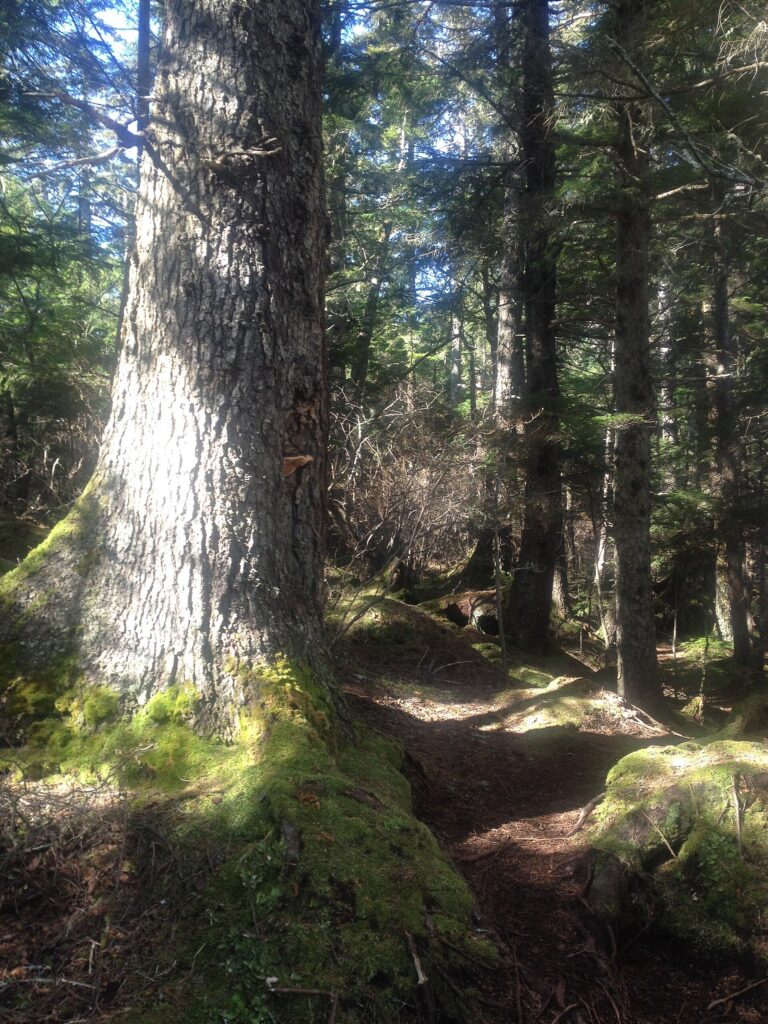
Wikipedia and the Forest Service describe the Tongass as Earth’s largest remaining temperate rainforest. Its dominant trees are western red cedar, Sitka spruce and western hemlock, and the heavy rainfall and cool climate produce a dense, mossy forest that stretches from the water’s edge to the alpine zone [1][2]. Old-growth stands, with large and long-lived trees, are an important part of its ecological value.
Wildlife
The forest supports five species of Pacific salmon, brown and black bears, bald eagles, wolves, mountain goats, Sitka black-tailed deer and orcas in the surrounding waters. The Haida ermine is found only here within the United States [1]. Salmon runs are central to the ecosystem, feeding bears and eagles and carrying nutrients inland.
Wilderness and Protected Areas
The Tongass includes 19 designated wilderness areas, more than any other national forest. The largest is the Misty Fjords National Monument Wilderness [1]. These areas protect fjords, glaciers, rivers and old-growth forest, and they are popular for kayaking, fishing and wildlife viewing.
Indigenous Homeland
The forest lies in the homelands of the Tlingit, Haida and Tsimshian nations. A 1968 court case found that these peoples held aboriginal title to the lands and the matter was settled for $7.5 million [1]. Many Native communities of Southeast Alaska still depend on the forest and its waters for subsistence and cultural practices.
Communities
About 70,000 people live in the region, and 31 communities lie within the forest. Many are accessible only by boat or aircraft, and the forest shapes local life through fishing, tourism and timber [1].
Logging History
Long-term timber contracts with two pulp mills, Ketchikan Pulp and Alaska Pulp, began in the 1950s and shaped the region’s economy for decades. Environmental rulings and the Tongass Timber Reform Act of 1990 changed the arrangement, and both mills had closed by 1997 [1]. Timber harvesting has since declined, though debates about the remaining old-growth forest continue.
Roadless Rule
The 2001 Roadless Rule, which limits road building in certain national forest lands, was applied to the Tongass in different ways over time. The Tongass was exempted in 2020, and a 2021 rule restored the Roadless Rule, with the restoration taking effect in January 2023 [1].
Economy
Non-timber sources such as recreation, subsistence, salmon fisheries and carbon storage are reported to contribute more than $2 billion annually to the regional economy [1]. Tourism, including cruise ship visits to Southeast Alaska ports, depends heavily on the scenery and wildlife of the forest.
Geography
The Tongass covers the islands of the Alexander Archipelago and a narrow strip of coastal mainland along the Inside Passage. Mountains, icefields and fjords rise directly from the sea, so travel between communities is largely by boat, ferry or floatplane. The terrain includes glaciers such as the Mendenhall Glacier near Juneau and the fjords of Misty Fjords National Monument [1][2].
Climate and Soils
Heavy precipitation throughout the year, moderated by the temperate Pacific climate, supports the growth of large conifers and a thick understory of moss, ferns and shrubs. Much of the forest floor is saturated, and wetlands, muskegs and streams cover large areas, helping explain why roughly 40 percent of the forest is not productive timberland [1].
Salmon and the Forest
All five species of Pacific salmon spawn in Tongass streams. Their annual runs support commercial, sport and subsistence fisheries, and the carcasses fertilize the forest, linking the ocean and land ecosystems. The same streams feed brown and black bears and bald eagles, which gather at river mouths during the runs [1][2].
Recreation and Tourism
Visitors come for kayaking, fishing, hiking, glacier viewing and wildlife watching. Public-use cabins, trails and designated wilderness areas offer opportunities for backcountry travel, and tourism is one of the sources of non-timber economic activity reported for the forest [1].
Current Management Questions
Management of the Tongass continues to involve balancing conservation, recreation, subsistence, fishing and timber harvest. The changing status of the Roadless Rule, from its 2001 adoption to the 2020 exemption and the 2021 restoration, illustrates how the forest’s management has evolved over time [1].
Why the Tongass Matters
The Tongass combines scale, biodiversity and cultural importance in a way few other forests do. It holds a large share of the old-growth temperate rainforest that remains in the world, supports fisheries that feed communities far beyond Alaska, and is the homeland of three Native nations whose cultures are tied to its waters and trees [1][2].
Further Context
Southeast Alaska’s forests are shaped by the same maritime climate that supports glaciers in neighboring Glacier Bay and Wrangell–St. Elias, and the Tongass forms part of the larger coastal rainforest that extends south along the Pacific coast of North America [1].
FAQs
How big is the Tongass National Forest? About 16.7 million acres, making it the largest national forest in the United States.
When was the Tongass established? It was proclaimed on September 10, 1907 by President Theodore Roosevelt.
Is the Tongass a rainforest? Yes. It is often described as the largest remaining temperate rainforest in the world.
Which peoples live in the Tongass? The Tlingit, Haida and Tsimshian peoples have lived in the region for thousands of years.
Where is the Tongass headquartered? Forest headquarters are in Ketchikan, Alaska.
Sources
More in Conservation
Key facts
Quick checkHow large is the Tongass National Forest?Show answer
About 16.7 million acres
Sources
- Wikipedia. Tongass National Forest. 2026 (accessed 2026-11-12)
- USDA Forest Service. Tongass National Forest: About the Area. 2026 (accessed 2026-11-12)
Editorially reviewed by Specialty Digest Editorial TeamLast reviewed November 12, 2026Researched and drafted with AI assistanceReport an issue