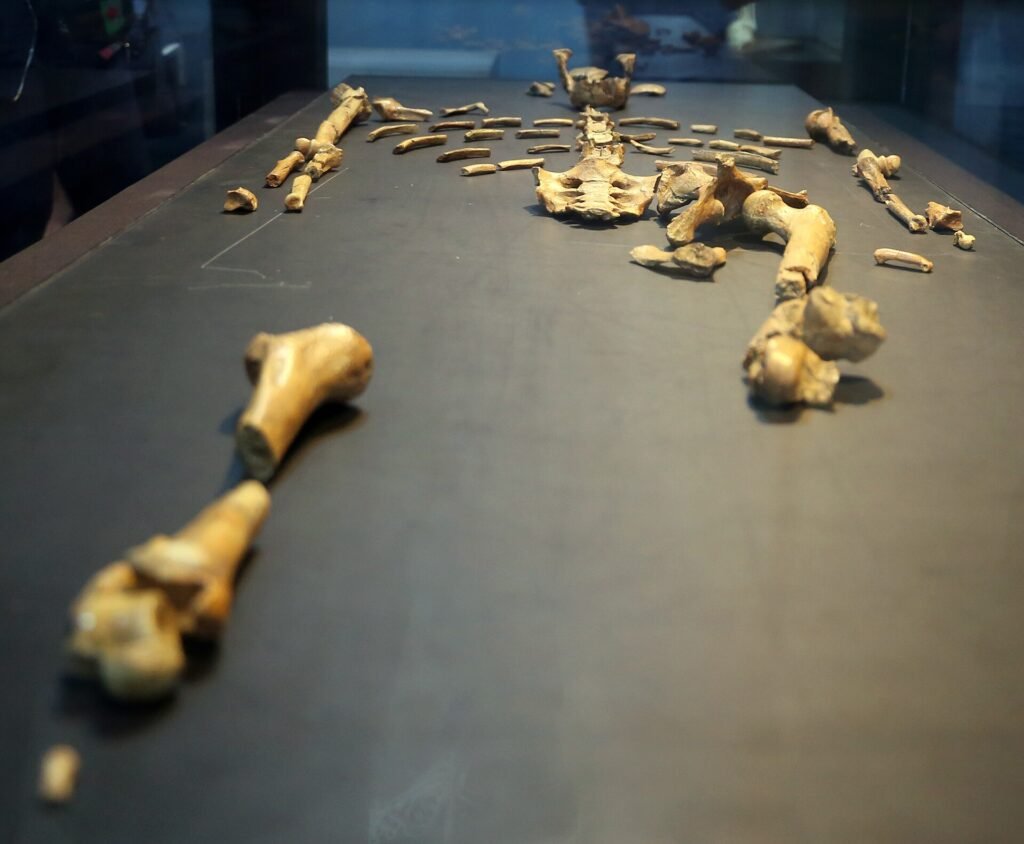
The discovery of Lucy was the finding of a 3.2 million-year-old fossil skeleton of the early human relative Australopithecus afarensis at Hadar, Ethiopia, on 24 November 1974. The paleoanthropologist Donald Johanson spotted the first bone while surveying with a graduate student, Tom Gray.
Lucy is about 40 percent of a single skeleton, and in 2024 it was still the most complete adult skeleton of her species. Johanson describes her as arguably the best-known fossil human ancestor of the twentieth century.
Background to the discovery of Lucy
Hadar lies in Ethiopia, and fossil hunters work there by walking slowly over eroded ground and scanning the surface for bone. Johanson says he is always looking at the ground, a habit that mattered on the day of the find.
Johanson’s team was on its second expedition to the area in 1974. On the day of the find they were not hunting for hominins at all, since they had gone to map the exact spot where a complete pig skull had been found.
The discovery
It was noon, the temperature was around 110 degrees Fahrenheit, and the team was tired and heading back to the vehicle. Johanson glanced over his right shoulder, as he habitually scans the ground, and saw a small fragment of an elbow bone.
He recognized that the piece did not come from a monkey or an antelope. Further searching turned up more bones from the same individual, which together amounted to about 40 percent of a skeleton.
The find was named Lucy after the Beatles song “Lucy in the Sky with Diamonds,” which was playing in camp that night. Johanson thought the individual was female because of her small size, and the nickname stuck.
Her catalog designation is AL 288-1. The Smithsonian Institution describes her as an adult female who lived about 3.2 million years ago.
How the discovery was confirmed
Confirmation came from several directions. The geology of the site showed the fossil was older than three million years, and the best estimate of her age is about 3.18 million years.
The anatomy mattered just as much. The bones showed that Lucy could walk upright on the ground and also climb trees, which suggests her kind used both woodlands and grasslands.
Her species was formally named in 1978 by Johanson, White and Coppens, who described Australopithecus afarensis from the Pliocene of eastern Africa. The description drew on a wave of fossil finds at Hadar and at Laetoli, Tanzania, and it later absorbed older fossils found as early as the 1930s.
Later finds supported the picture. Hadar also produced a group of individuals nicknamed the First Family, the Dikika site in Ethiopia yielded a juvenile skeleton described in 2006, and Laetoli preserved the oldest documented trails of bipedal footprints.
In total, fossils from more than 300 individuals of the species are known, so Lucy is no longer a lone specimen.
Impact and legacy of the discovery
Lucy gave researchers a skeleton rather than scattered teeth and jaws. Johanson calls her the first evidence of ancestors that walked upright all the time, and he describes her as a touchstone for people who become interested in the study of human origins.
The species she represents lived between about 3.85 and 2.95 million years ago in Ethiopia, Kenya and Tanzania. It survived for more than 900,000 years, about three times as long as our own species has existed.
Australopithecus afarensis mixed ape and human traits. Females averaged about 105 centimeters (3 feet 5 inches) in height and males about 151 centimeters (4 feet 11 inches), and they ate mostly plants, including leaves, fruit, seeds, roots, nuts and insects, with the occasional small vertebrate.
Children grew rapidly after birth, as chimpanzees do, and reached adulthood earlier than modern humans. That left less time for teaching and social learning in childhood.
Because the species ranged across Ethiopia, Kenya and Tanzania, the Hadar finds fit into a wider eastern African record rather than standing alone. The sites together show a long-lived species that adjusted to changing environments over nearly a million years.
A single skeleton can anchor a species. The bones of Lucy show body proportions, while the larger sample of more than 300 individuals shows how much variation existed within the group, and researchers need both to describe the species well.
Teeth give clues to how the species lived. Paleoanthropologists study the wear on them to work out what Australopithecus afarensis ate, and the ability to live both in trees and on the ground helped the species survive for almost a million years as climates and environments changed.
Body size differed between the sexes. Males averaged about 42 kilograms (92 pounds) and females about 29 kilograms (64 pounds), according to the Smithsonian.
The find also built institutions. Johanson became the founding director of the Institute of Human Origins at Arizona State University, and in the 50 years since the find, Johanson says its importance has fueled a wider search for how humans came to be. You can read about the wider process in the entry on evolution.
Later developments and related finds
Lucy remains a reference point for later discoveries of human relatives. Compare the small-brained Homo naledi from South Africa, which is far younger, and the better-known Neanderthals of Europe and Asia.
Layers of rock still define the context for such fossils. The same principle that told Johanson’s team that Lucy was old applies to other sites, and the entry on stratigraphy explains how sequences of layers are read.
The name Lucy is a nickname, and scientists use the catalog number AL 288-1. The popular name, however, carried the story around the world.
New finds continue to refine the early human family tree, and the question of how Australopithecus afarensis relates to later species is still studied. Lucy is not a final answer, but she fixed the starting point for many of the questions researchers ask today.
More in Anthropology
Key facts
- Donald Johanson and Tom Gray found Lucy at Hadar, Ethiopia, on 24 November 1974.1
- Lucy is an adult female Australopithecus afarensis who lived about 3.2 million years ago, with catalog number AL 288-1.2
- About 40 percent of her skeleton was recovered, the most complete adult skeleton of her species in 2024.1
- The species was formally named in 1978 and lived between about 3.85 and 2.95 million years ago.2
- Fossils from more than 300 individuals of the species are known.2
Related concepts
Quick checkWho discovered Lucy and where?Show answer
Paleoanthropologist Donald Johanson found Lucy on 24 November 1974 at Hadar, Ethiopia, while surveying with graduate student Tom Gray.
Sources
- Arizona State University News, Lucy's lasting legacy: Donald Johanson reflects on the discovery of a lifetime, https://news.asu.edu/20241121-science-and-technology-lucys-lasting-legacy-donald-johanson-reflects-discovery-lifetime
- Smithsonian Institution Human Origins Program, Australopithecus afarensis, https://humanorigins.si.edu/evidence/human-fossils/species/australopithecus-afarensis
Editorially reviewed by Specialty Digest Editorial TeamLast reviewed November 5, 2026Researched and drafted with AI assistanceReport an issue