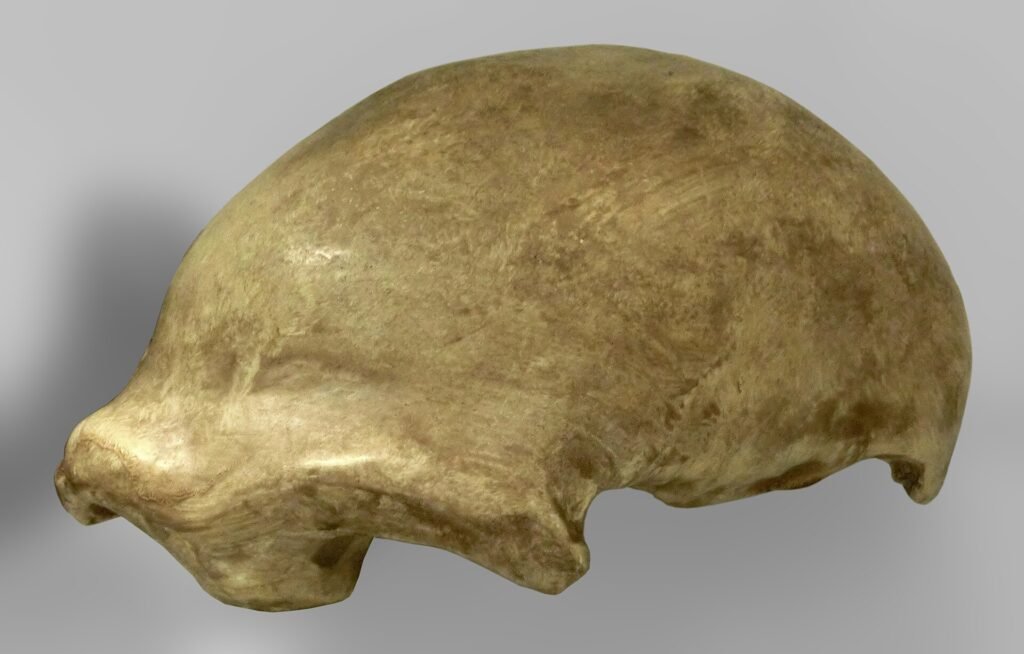
The discovery of Neanderthals began in 1856, when fossils from a cave in the Neander Valley of Germany became the first specimen to be recognized as an early human fossil. In 1864 the geologist William King named the species Homo neanderthalensis, making it the first fossil hominin species to receive a scientific name.
Neanderthals lived in Europe and southwestern to central Asia from roughly 400,000 to 40,000 years ago. They are the closest extinct relatives of modern humans.
Background to the discovery of Neanderthals
Neanderthal bones had in fact turned up earlier, but nobody understood them. Fossils were found at Engis, Belgium, in 1829 and at Forbes’ Quarry, Gibraltar, in 1848. Scientists realized only years later that both were Neanderthal.
Because of the Engis find, the Smithsonian Institution lists 1829 as the discovery date of the species, even though recognition came much later.
The discovery
In 1856 the fossils known as Neanderthal 1 came to light in Feldhofer Cave in the Neander Valley in Germany. The German word tal is an old spelling of thal and means valley, so the species name refers to the valley where the bones were found.
The name is pronounced with the th sounding like a t, as in the German original.
When it was found, scientists had never seen anything like the skull. It had an oval shape, a low receding forehead, distinct browridges and thick, strong bones.
Neanderthal 1 was therefore the first specimen recognized as an early human fossil. In 1864 King proposed the name Homo neanderthalensis in a paper in the Quarterly Review of Science.
How the discovery was confirmed
Confirmation came from many more fossils and, much later, from DNA.
Neanderthals were shorter and stockier than people today, a build suited to cold climates. Males averaged about 164 centimeters (5 feet 5 inches) tall and 65 kilograms (143 pounds), and females about 155 centimeters (5 feet 1 inch) and 54 kilograms (119 pounds).
Their skulls had a large middle part of the face, angled cheekbones and a very large nose. Their brains were as large as ours and often larger in proportion to their sturdy bodies.
The first genetic analysis came in 1997, when scientists extracted and replicated mitochondrial DNA from the original Neanderthal 1 fossil. Mitochondrial DNA is the small circle of DNA that is passed down in the maternal line, and the Neanderthal sequences proved substantially different from those of modern humans.
In 2008 a team led by Svante Paabo at the Max Planck Institute published a complete mitochondrial genome from a 38,000-year-old Neanderthal from Vindija Cave, Croatia. Five more mitochondrial genomes followed in 2009.
The Neanderthal genome came next. A 2010 genome study compared Neanderthal and modern human DNA and found 78 places where Neanderthals kept the ancestral version and modern humans had a newer one. Five of those genes had more than one change that affected the protein, including a gene active in skin, hair and sweat glands.
Researchers found no Neanderthal mitochondrial DNA in the modern human gene pool, even though nuclear DNA shows interbreeding. The Smithsonian lists several possible explanations, including that modern humans carrying Neanderthal mitochondrial DNA once existed but their lineages died out.
In 2014 a Nature paper reported a high-quality genome from a Neanderthal found in the Altai Mountains. Its comparison with Denisovans and 25 present-day human genomes showed that gene flow occurred among several groups, even if the amounts were small, and possibly included gene flow into Denisovans from an unknown archaic group. The genome also allowed a definitive list of changes that became fixed in modern humans after they separated from the ancestors of Neanderthals and Denisovans.
Impact and legacy of the discovery
The find changed ideas about human origins. It showed that other kinds of humans had lived in recent prehistory, and it opened the way for later recognition of species such as the small-bodied Homo naledi and the older Lucy.
Genetics showed that Neanderthals and modern humans interbred. Neanderthals contribute up to about 1 to 4 percent of the genomes of non-African modern humans, depending on region, and early modern humans from about 40,000 years ago carried up to 6 to 9 percent.
A 2020 study showed that some Neanderthal DNA is present in African populations as well. The result changed the earlier assumption that none would be found there, because no Neanderthal fossils have been found in Africa.
Neanderthals were the first fossil hominin species discovered, and they have held a place in the public imagination ever since. They made and used sophisticated tools, and researchers continue to study their behavior and symbolic activity. DNA has been recovered from more than a dozen Neanderthal fossils, and the Neanderthal Genome Project is an active area of research.
Neanderthal DNA also helped identify another group. Denisovans are known mainly from DNA and from a finger bone fragment and two teeth that date to about 40,000 years ago, and a Denisovan jaw from Tibet and a molar from Laos have been reported since.
The overall story of how new groups appear and change is explained in the entry on evolution, and genetics continues to be one of the strongest tools for testing ideas about our closest relatives.
Disputes over credit and dating
The date of discovery is a matter of definition. The Engis skull of 1829 and the Gibraltar skull of 1848 were Neanderthal fossils found earlier, but the 1856 specimen was the first to be recognized for what it was.
Credit for naming the species goes to King, who proposed the name in 1864. The Smithsonian notes that scientists later realized earlier finds also belonged to the species.
Debates continue about how Neanderthals related to modern humans and to Denisovans, a population known mainly from DNA that overlapped with Neanderthals in time and space in Asia. Researchers also ask what the Neanderthal genes in the human genome actually do.
More in Anthropology
Key facts
- Neanderthal 1 was discovered in 1856 in Feldhofer Cave in the Neander Valley, Germany, and was the first specimen recognized as an early human fossil.1
- William King named Homo neanderthalensis in 1864, making it the first fossil hominin species to be named.1
- Earlier Neanderthal fossils from Engis, Belgium (1829) and Gibraltar (1848) were only recognized later.1
- Mitochondrial DNA from Neanderthal 1 was first analyzed in 1997, and a complete Neanderthal mitochondrial genome from Vindija Cave, Croatia, was published in 2008.2
- Neanderthals contribute up to about 1 to 4 percent of the genomes of non-African modern humans.2
Related concepts
Quick checkWhen were Neanderthals discovered?Show answer
Neanderthal 1 was found in 1856 in Germany and was the first fossil recognized as an early human, although earlier Neanderthal skulls from 1829 and 1848 were identified later.
Sources
- Smithsonian Institution Human Origins Program, Homo neanderthalensis, https://humanorigins.si.edu/evidence/human-fossils/species/homo-neanderthalensis
- Smithsonian Institution Human Origins Program, Ancient DNA and Neanderthals, https://humanorigins.si.edu/evidence/genetics/ancient-dna-and-neanderthals
- Prüfer K and colleagues, The complete genome sequence of a Neanderthal from the Altai Mountains, Nature, https://www.nature.com/articles/nature12886
Editorially reviewed by Specialty Digest Editorial TeamLast reviewed November 5, 2026Researched and drafted with AI assistanceReport an issue