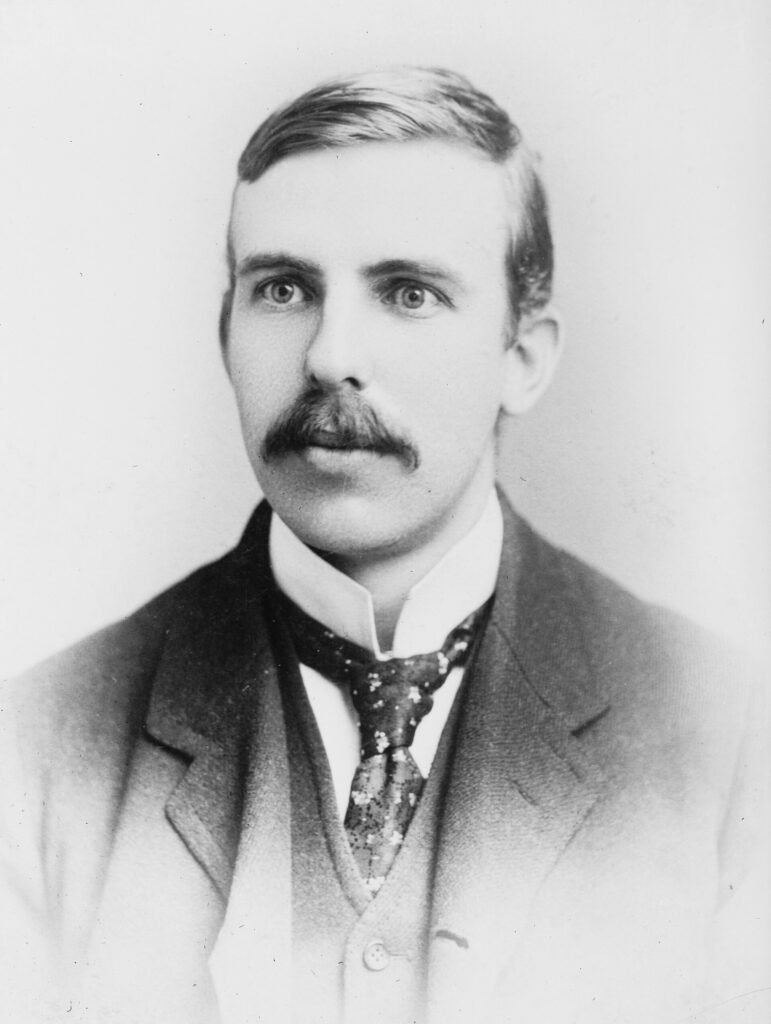
The discovery of the atomic nucleus was the conclusion, published by Ernest Rutherford in 1911, that nearly all of an atom’s mass and its positive charge are concentrated in a tiny, dense core. The finding grew out of alpha-particle scattering experiments carried out by Hans Geiger and Ernest Marsden at the University of Manchester, and it overturned the leading model of the atom.
Background to the discovery of the nucleus
Ernest Rutherford was born in 1871 in Nelson, New Zealand, one of 12 children. A scholarship took him to the Cavendish Laboratory at Cambridge in 1894. On hearing the news, he is reported to have said, “That’s the last potato I’ll ever dig.” At Cambridge he worked with J. J. Thomson, the discoverer of the electron. The earlier work is covered in the entry on the discovery of the electron.
In 1898 Rutherford took a professorship at McGill University in Montreal. There he identified alpha and beta radiation as two separate types, and in 1901 he and the chemist Frederick Soddy found that one radioactive element can decay into another. The work, which followed from the discovery of radioactivity, earned him the 1908 Nobel Prize in Chemistry. In 1907 he returned to England, to the University of Manchester.
The model of the atom then in favor was the plum pudding model proposed by Thomson. It pictured electrons embedded throughout a blob of positively charged matter, like raisins in a pudding. Such an atom should deflect a passing charged particle only slightly.
The discovery
In 1909 Rutherford and his colleague Hans Geiger were looking for a project for a student, Ernest Marsden. Rutherford had already studied how alpha particles from a radioactive source scatter off a gold target, measuring the small forward angles through which most particles turn. Not wanting to neglect any angle, however unpromising, he suggested that Marsden look for alpha particles scattered backward.
The setup used a thin gold foil and a screen coated with zinc sulfide, which flashes when a charged particle strikes it. Marsden sat in a darkened room, waited for his eyes to adjust and watched the screen. He expected to see nothing, but he saw many small, fleeting flashes, on average more than one per second. He tested and retested every part of the apparatus, found nothing wrong, and reported the result to Rutherford. Rutherford later called the news the most incredible event of his life.
About one alpha particle in every few thousand scattered through an angle greater than 90 degrees. Rutherford later compared this to firing a 15-inch shell at a piece of tissue paper and having it come back to hit you. Such large deflections could not happen in a plum pudding atom, where the positive charge is spread thinly, and the result was in plain conflict with the accepted model.
How the nuclear atom was established
Rutherford thought about the problem for more than a year. His explanation was that the alpha particles were being repelled by a large amount of positive charge concentrated in a very small space at the center of the atom. A simple calculation put the size of this core at roughly one hundred-thousandth the size of the atom, so the atom was mostly empty space.
He announced the result in March 1911 at a meeting of the Manchester Literary and Philosophical Society and published it in May 1911 in the Philosophical Magazine, in a paper on the scattering of alpha and beta particles by matter and the structure of atoms. The Nobel Foundation summarizes his conclusion as an atom with all of its mass concentrated in a nucleus smaller than 10 to the power of minus 14 meters across, and it marks the paper as the birth of nuclear physics.
The model was not accepted at once. Maxwell’s equations of electromagnetism implied that electrons circling a nucleus should radiate energy and spiral inward, so a planetary atom would not last. Niels Bohr soon resolved the difficulty by applying ideas from quantum mechanics, proposing that electrons can occupy only certain discrete orbits. Marsden and Rutherford also repeated the experiment with other target elements and measured their nuclei.
The Nobel Foundation places the discovery of the nucleus and of its building blocks, the protons and neutrons, in the period between 1910 and 1940. Rutherford’s 1911 paper is the first step in that sequence and the point at which the field of nuclear physics is usually said to begin.
Impact and legacy of the discovery
The discovery gave a new meaning to the atom. It showed that an atom’s identity is set by the charge of a tiny nucleus, and it opened the way to modern nuclear physics even though Rutherford did not yet know what the nucleus contained. It also changed how scientists thought about matter: if the nucleus occupies only a tiny fraction of an atom, then nearly all of the volume of everyday objects is empty space.
Rutherford took the next step in 1919, when he showed that bombarding nitrogen with alpha particles frees protons, and he concluded that nuclei have an inner structure. In 1932 James Chadwick found a second kind of nuclear particle, as described in the entry on the discovery of the neutron. Later experiments looked inside the protons and neutrons themselves, a story told in the entry on the discovery of quarks.
The nuclear model also underlies later energy technologies. Splitting heavy nuclei, covered in the entry on the discovery of nuclear fission, is the process used in nuclear power.
Roles of Rutherford, Geiger and Marsden
The experiment and its interpretation involved different people. Geiger and Marsden made the measurements in 1909, while Rutherford supplied the analysis and the nuclear model in 1911. The Nobel Foundation describes his 1911 paper as an analysis of measurements made by, among others, Hans Geiger and Ernest Marsden.
More in Physics
Key facts
- Hans Geiger and Ernest Marsden observed alpha particles scattering backward from gold foil in 1909.1
- Rutherford announced the nuclear atom in March 1911 and published it in May 1911.1
- Rutherford estimated the nucleus at about one hundred-thousandth the size of the atom.1
- Rutherford received the 1908 Nobel Prize in Chemistry for his work on the disintegration of the elements, before the nucleus was announced.2
Related concepts
Quick checkWho discovered the atomic nucleus?Show answer
Ernest Rutherford, working at the University of Manchester, deduced the nucleus in 1911 from alpha-particle scattering experiments carried out by Hans Geiger and Ernest Marsden in 1909.
Sources
- American Physical Society, This Month in Physics History: May 1911, Rutherford and the Discovery of the Atomic Nucleus, https://www.aps.org/apsnews/2006/05/rutherford-discovery-atomic-nucleus
- Nobel Prize Outreach, Ernest Rutherford: Facts (Nobel Prize in Chemistry 1908), https://www.nobelprize.org/prizes/chemistry/1908/rutherford/facts/
- Nobel Prize Outreach, The Nobel Prize in Physics 1990: Illustrated presentation (history of particles), https://www.nobelprize.org/prizes/physics/1990/9592-the-nobel-prize-in-physics-1990/
Editorially reviewed by Specialty Digest Editorial TeamLast reviewed November 5, 2026Researched and drafted with AI assistanceReport an issue