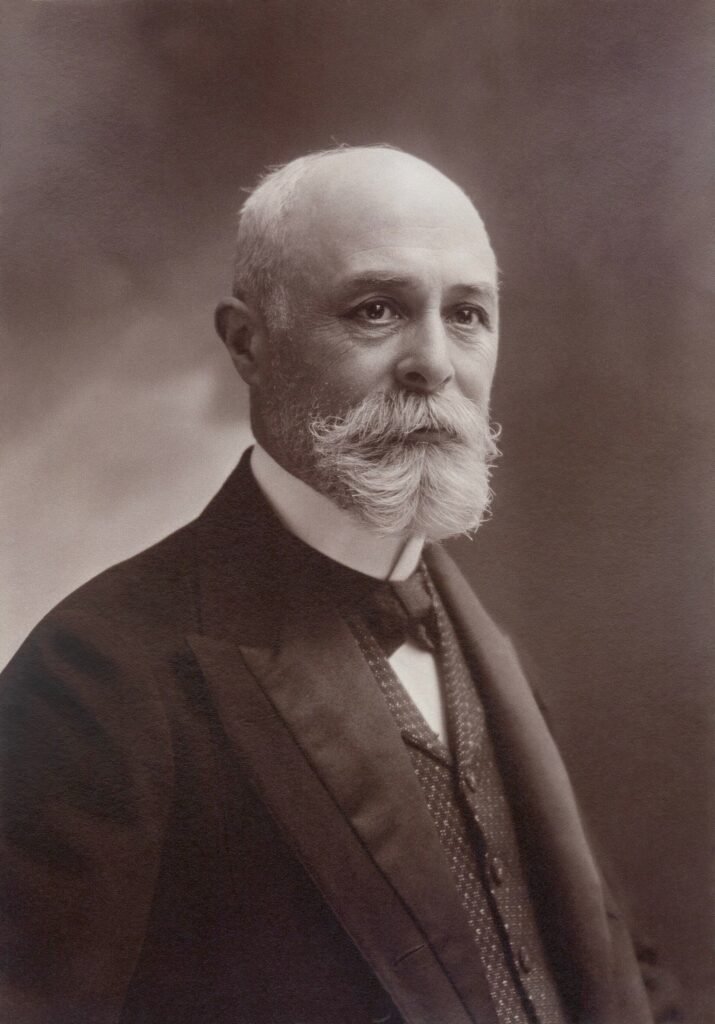
The discovery of radioactivity was the finding, made by the French physicist Henri Becquerel in Paris in 1896, that uranium salts give off a penetrating radiation without being exposed to light or any other outside stimulus. It showed that atoms can release energy spontaneously, and it started the line of research that led to modern nuclear physics.
Background to the discovery of radioactivity
In November 1895 the German physicist Wilhelm Röntgen found that a vacuum tube produced an invisible, penetrating radiation. His result, described in the entry on the discovery of X-rays, excited scientists across Europe in the following weeks.
Henri Becquerel, born in Paris in 1852, held the chair of applied physics at the National Museum of Natural History. Like his father Edmond, he studied fluorescence and phosphorescence, the glow that some substances give off after exposure to light, and he was especially interested in uranium compounds. He was also a skilled photographer, which mattered because photographic plates were a standard way to detect X-rays.
Becquerel heard about Röntgen’s work in January 1896 at a meeting of the French Academy of Sciences. He wondered whether phosphorescent uranium salts might absorb sunlight and then re-emit it as X-rays. The guess turned out to be wrong, but it led him to the right experiment.
The discovery
To test his idea, Becquerel wrapped photographic plates in black paper so that sunlight could not reach them, placed crystals of a uranium salt on top, and set the arrangement in the sun. When he developed the plates, he saw outlines of the crystals. Coins and cut-out metal shapes placed between the crystals and the plate left shadows too, which suggested that a penetrating radiation was passing through the paper. He reported this result to the Academy on 24 February 1896.
The weather in Paris then turned overcast for several days, and Becquerel put the plates and crystals away in a drawer. On 1 March he developed the plates anyway, expecting only a faint image, and found a remarkably clear one. The next day he told the Academy that the uranium salts emitted radiation without any stimulation from sunlight.
Why he developed the plates at all is not known. The American Physical Society notes that simple curiosity, pressure to report something at the next meeting, or impatience are all possible explanations.
How radioactivity was confirmed
Becquerel soon showed that the effect did not depend on phosphorescence. Uranium compounds that do not glow gave the same result, and earlier exposure to light was never needed. In May 1896 he announced that the element uranium itself was the source. Unlike X-rays, which are neutral, his rays could be deflected by electric or magnetic fields, so they were a different phenomenon from the one he had first assumed.
The Royal Swedish Academy of Sciences later stressed that the radiation continued at an unchanged strength, with no known source of energy behind it. That made the finding puzzling as well as new.
Many physicists at first stayed focused on X-rays. From 1898, Marie and Pierre Curie in Paris worked out how to measure the intensity of the radiation, examined many substances and minerals, and found further radioactive elements, including polonium and radium.
Their method relied on a property that the Royal Swedish Academy of Sciences later highlighted: the new rays make bodies that normally do not conduct electricity able to carry a current. Measuring that effect gave the Curies a reliable way to compare how strongly different materials radiated, and they used it to search through many simple substances and a large number of minerals.
Ernest Rutherford then showed in 1899 that the radiation from radioactive substances contains at least two distinct types, which he named alpha and beta radiation. In 1902 he and the chemist Frederick Soddy proposed that radioactive elements disintegrate and turn into other elements, an idea that overturned the older view that atoms of an element were unchangeable.
Impact and legacy of the discovery
The Royal Swedish Academy of Sciences described the discovery as revealing a new property of matter and a new source of energy, whose origin was a puzzle at the time. It gave birth, in its words, to a whole host of new investigations. The 1903 Nobel Prize in Physics was divided, one half to Becquerel for the discovery of spontaneous radioactivity and the other half shared by Pierre Curie and Marie Curie for their joint researches on the radiation phenomena that Becquerel had discovered.
The work of the following decades built directly on this start. The idea that a radioactive substance loses its activity at a steady, characteristic rate leads to the half-life, and the recognition that atoms of one element can differ in mass but behave alike chemically leads to the isotope. Radioactive decay is also the principle behind radiocarbon dating.
Radioactivity also pointed toward the structure of the atom. Rutherford used the alpha particles from radioactive sources in the experiments described in the entry on the discovery of the atomic nucleus, and the study of radioactive materials later led to the discovery of nuclear fission.
Rutherford received the 1908 Nobel Prize in Chemistry for his investigations into the disintegration of the elements and the chemistry of radioactive substances. The American Physical Society notes that he was somewhat irritated to be honored in chemistry, since he considered himself a physicist.
Becquerel was working at the École Polytechnique in Paris when he received his prize, and he died on 25 August 1908, at the age of 55.
Disputes over credit
Credit for the first radioactive element after uranium was shared. The Nobel presentation speech of 1903 records that the German scientist Schmidt and Marie Curie found, at approximately the same time, that thorium is radioactive to about the same degree as uranium.
The wording of the 1903 prize reflects the division of roles. Becquerel was honored for the discovery of spontaneous radioactivity itself, while the Curies were honored for their systematic research on the radiation he had found.
More in Physics
Key facts
- Henri Becquerel discovered spontaneous radioactivity in Paris in 1896 using uranium salts and photographic plates.1
- Becquerel developed plates that had been kept in a drawer on 1 March 1896 and reported on 2 March that uranium emitted radiation without sunlight.1
- The 1903 Nobel Prize in Physics went one half to Becquerel and one quarter each to Pierre Curie and Marie Curie.2
- Ernest Rutherford identified alpha and beta radiation in 1899 and, with Frederick Soddy, proposed in 1902 that radioactive elements change into other elements.3
Related concepts
Quick checkWho discovered radioactivity?Show answer
Henri Becquerel discovered radioactivity in Paris in 1896 when he found that uranium salts darken photographic plates without exposure to light. Marie and Pierre Curie then studied the radiation and found new radioactive elements.
Sources
- American Physical Society, This Month in Physics History: March 1896, Becquerel and the discovery of radioactivity, https://www.aps.org/publications/apsnews/200803/physicshistory.cfm
- Nobel Prize Outreach, The Nobel Prize in Physics 1903: Presentation Speech and Summary, https://www.nobelprize.org/prizes/physics/1903/ceremony-speech/
- Nobel Prize Outreach, Ernest Rutherford: Facts (Nobel Prize in Chemistry 1908), https://www.nobelprize.org/prizes/chemistry/1908/rutherford/facts/
Editorially reviewed by Specialty Digest Editorial TeamLast reviewed November 5, 2026Researched and drafted with AI assistanceReport an issue