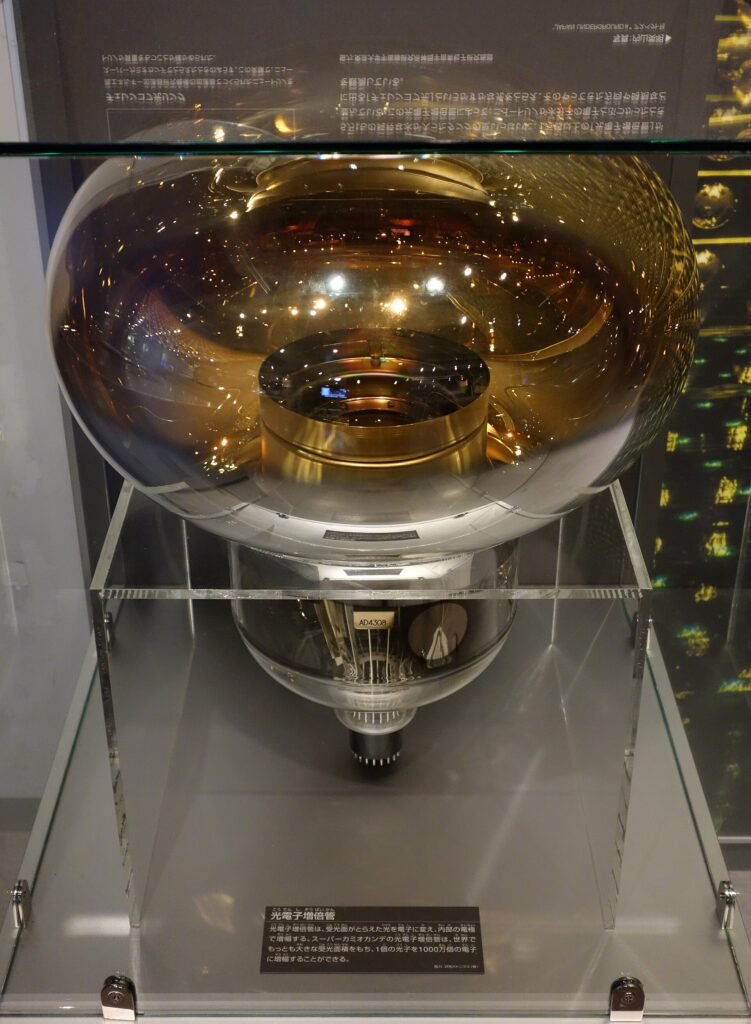
The discovery of the neutrino took place in two steps. The Austrian physicist Wolfgang Pauli proposed the particle in December 1930 to account for energy that seemed to go missing in radioactive beta decay, and Frederick Reines and Clyde Cowan detected it in 1956 with a detector placed beside a nuclear reactor. The neutrino is an electrically neutral particle that interacts with ordinary matter only very rarely.
Background to the discovery of the neutrino
Beta decay is a type of radioactive decay in which a nucleus emits an electron. When researchers studied the electron’s motion, the decay appeared to violate the law of conservation of energy. The Nobel Foundation says the problem caused researchers many headaches in the decades after the discovery of radioactivity.
In December 1930 Pauli wrote a letter to his colleagues, whom he addressed as “Dear Radioactive Ladies and Gentlemen.” He suggested a “desperate solution”: the nucleus emits a second particle along with the electron, one that is electrically neutral, very light and weakly interacting, and that carries off part of the energy. Pauli himself hardly believed the particle could ever be found.
Enrico Fermi soon built an elegant theory of the weak force that included Pauli’s particle, and the particle came to be called the neutrino. The success of the theory made physicists confident that it was real, even though no one had seen it.
The search for the neutrino
Several attempts in the 1930s and 1940s tried to detect the particle by measuring how a nucleus recoils during beta decay. All the measurements were compatible with a single neutrino being emitted with the electron, but none could capture a neutrino itself.
In 1946 the physicist Bruno Pontecorvo suggested using the inverse beta process, in which a neutrino strikes a nucleus and changes it, and he pointed to the Sun and nuclear reactors as intense sources. In the early 1950s Reines, working at Los Alamos, took up the idea that an extremely intense source and a very sensitive, large detector would be needed. He teamed up with Cowan.
The discovery
At first Reines and Cowan thought of placing their apparatus near an atomic explosion, but the background was too high. In October 1952 they agreed to use a more peaceful source, the nuclear plant at Hanford in Washington state. They wrote to Fermi, who encouraged them and noted that the new method had the advantage that it could be repeated any number of times. They called the project Poltergeist.
Their first attempt in 1953 produced a signal that was not significant enough against the background. They improved the detector and in 1956 installed it near the Savannah River nuclear plant in South Carolina. This time they reduced the background and obtained a neutrino signal with a significance of more than four standard deviations.
The detector held about 400 liters of water mixed with cadmium chloride. Antineutrinos from the reactor occasionally struck a proton in the water, producing a positron and a neutron. The positron met an electron and produced two simultaneous flashes of light, and about 15 millionths of a second later the neutron was absorbed by a cadmium nucleus, giving a second flash. That delay was the signature of a neutrino event.
On 14 June 1956 the team sent a telegram to Pauli announcing the discovery. According to the account of the neutrino’s history compiled by French researchers, he replied, “Thanks for message. Everything comes to him who knows how to wait.” The result owed much to earlier work, including the discovery of the positron and the discovery of the neutron.
How the neutrino was confirmed and extended
The 1956 discovery was not a real surprise, since the theory of beta decay had already been so successful. It did, however, open the door to what the Nobel committee called the region of impossible neutrino experiments. In 1955 Ray Davis had looked for reactor antineutrinos with a chlorine-argon detector at Brookhaven and saw nothing, and he was later more successful with neutrinos from the Sun.
Physicists later found that neutrinos come in more than one kind. The 1988 Nobel Prize in Physics went to Leon Lederman, Melvin Schwartz and Jack Steinberger for the neutrino beam method and the discovery of the muon neutrino, which showed that the leptons come in pairs.
Neutrino oscillations and scientific significance
For decades the neutrino was thought to have no mass at all. In 1998 Takaaki Kajita and his colleagues at the Super-Kamiokande detector in Japan reported that neutrinos produced when cosmic rays strike the atmosphere seem to switch identities on their way to the detector. In 2001 a group led by Arthur McDonald at the Sudbury Neutrino Observatory in Canada showed that neutrinos from the Sun do the same.
The two experiments together revealed a new phenomenon, neutrino oscillations. A far-reaching consequence is that neutrinos must have mass. Kajita and McDonald shared the 2015 Nobel Prize in Physics for the discovery.
Neutrinos are all around. According to the Nobel Foundation, thousands of billions pass through the human body every second, and apart from photons they are the most numerous particles in the universe. They come from the Big Bang, from exploding stars, from nuclear power plants and from natural radioactive decays, and most of those reaching Earth originate in nuclear reactions in the Sun.
Impact and legacy of the discovery
Reines received half of the 1995 Nobel Prize in Physics for the detection of the neutrino. Cowan had died by then, and Nobel prizes are not awarded posthumously. The other half went to Martin Perl for the discovery of the tau lepton. The Nobel Foundation described the first observation of neutrinos as a pioneering contribution that opened the way to experiments once thought impossible.
Neutrinos are now studied with giant detectors deep underground, and they connect particle physics to nuclear reactors, stars and cosmology.
Key facts
- Wolfgang Pauli proposed a neutral, light, weakly interacting particle in a letter of December 1930 to save energy conservation in beta decay.1
- Reines and Cowan detected reactor antineutrinos at Savannah River, South Carolina, and telegraphed Pauli on 14 June 1956.2
- Reines received half of the 1995 Nobel Prize in Physics for the detection of the neutrino.3
- Kajita and McDonald shared the 2015 Nobel Prize in Physics for the discovery of neutrino oscillations, which shows that neutrinos have mass.1
Related concepts
Quick checkWho discovered the neutrino?Show answer
Wolfgang Pauli proposed the neutrino in 1930, and Frederick Reines and Clyde Cowan first detected it in 1956 using antineutrinos from a nuclear reactor at Savannah River in South Carolina.
Sources
- Nobel Prize Outreach, The Nobel Prize in Physics 2015: Popular science background, The chameleons of space, https://www.nobelprize.org/prizes/physics/2015/popular-information/
- Neutrino history (IN2P3), Experimental discovery of the neutrino, https://neutrino-history.in2p3.fr/experimental-discovery/
- Nobel Prize Outreach, Press release: The 1995 Nobel Prize in Physics, https://www.nobelprize.org/prizes/physics/1995/press-release/
- Nobel Prize Outreach, The Nobel Prize in Physics 1988: Summary, https://www.nobelprize.org/prizes/physics/1988/summary/
- Nobel Prize Outreach, Frederick Reines: Facts (Nobel Prize in Physics 1995), https://www.nobelprize.org/prizes/physics/1995/reines/facts/
Editorially reviewed by Specialty Digest Editorial TeamLast reviewed November 5, 2026Researched and drafted with AI assistanceReport an issue