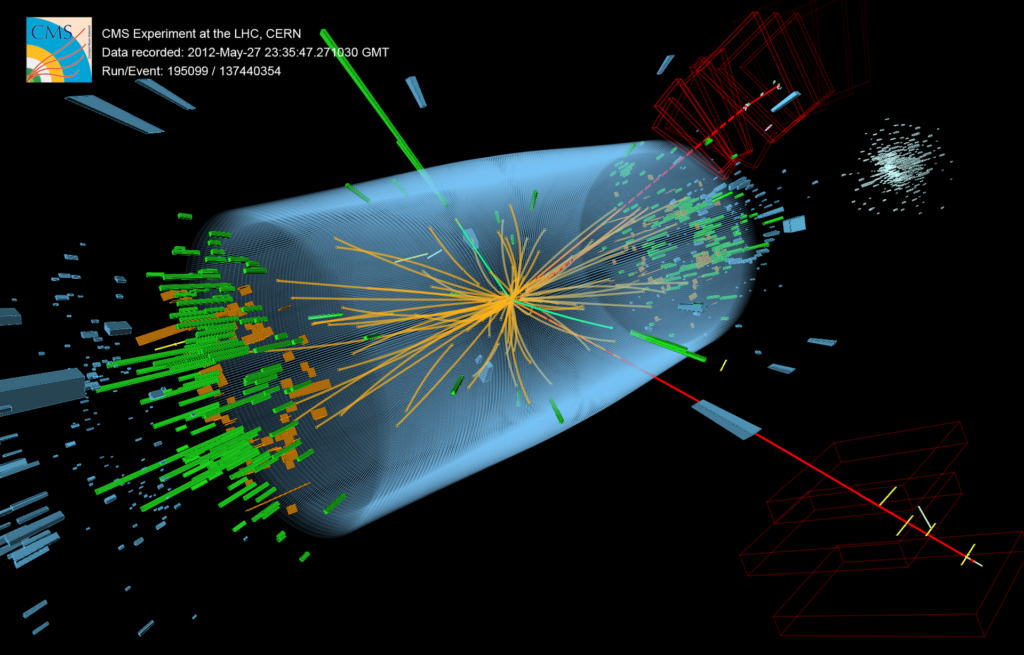
The discovery of the Higgs boson was announced on 4 July 2012 at CERN near Geneva, when the ATLAS and CMS experiments at the Large Hadron Collider reported a new particle with a mass of about 125 billion electron volts and the properties expected of the Higgs boson. The particle is a vibration of the Higgs field, an invisible field that gives mass to elementary particles.
Background to the discovery of the Higgs boson
The standard model of particle physics describes the world in terms of a few kinds of matter particles and the force particles that act between them. For the model to work, it also needs a special field that fills all of space. According to the Nobel Foundation, without that field electrons and quarks would be massless, like photons, and would rush through space at the speed of light without ever being caught in atoms or molecules.
The field is called the Higgs field. In quantum physics every particle is a vibration in a field, and the Higgs boson is the vibration of the Higgs field. CERN explains that particles get their mass by interacting with the field, and that the stronger the interaction, the heavier the particle. Photons do not interact with it and so have no mass, while electrons, quarks and some other particles do.
The theory was proposed in 1964. François Englert, working with his colleague Robert Brout, and Peter Higgs put forward the idea independently of each other, and it rescued the standard model from a serious problem. CERN refers to the mass-giving process as the Brout-Englert-Higgs mechanism. Physicists needed to know whether the field really existed, and the surest test was to produce its particle.
The search for the particle
The Higgs boson cannot simply be found somewhere. It has to be created in a particle collision, and it then decays almost immediately into other particles that detectors can record. Physicists look for those decay products in data from the detectors.
The difficulty is that the same decay products are made in many other processes, and the Higgs boson appears in only about one in a billion collisions at the Large Hadron Collider, the accelerator operated by CERN. Careful statistical analysis of enormous amounts of data was needed to separate its faint signal from the background. Two large experiments, ATLAS and CMS, searched independently, so that each could check the other.
The discovery
On the morning of 4 July 2012, a seminar at CERN began at 9 a.m. local time. People had queued for hours, and some students had spent the night outside the main auditorium. Peter Higgs and François Englert were both in the audience, and it was the first time the two had met.
Joe Incandela, spokesperson for CMS, presented his team’s results first. CMS had observed a new boson with a mass of 125.3 billion electron volts, give or take 0.6, with a statistical significance of 4.9 sigma. About an hour later Fabiola Gianotti, spokesperson for ATLAS, reported that her experiment had seen a boson with a mass of 126.5 billion electron volts and a local significance of 5 sigma. The two results agreed closely.
CERN’s director general at the time, Rolf Heuer, called it a historic milestone. Physicists stayed cautious, though. The ATLAS team noted that questions remained, such as whether this was a standard model Higgs boson, what its properties were, and whether other particles could be found.
How the Higgs boson was confirmed
The new particle had no electric charge, it was short-lived, and it decayed in ways that the Higgs boson should, according to theory. To confirm its identity, physicists needed to measure its spin. The Higgs boson is the only particle with a spin of zero. By analyzing two and a half times more data, the experiments concluded in March 2013 that some kind of Higgs boson had indeed been discovered.
Later work measured how strongly the particle couples to other particles, because the heavier a particle is, the more likely the Higgs boson is to decay into it or be produced from it. CERN reports that interactions with tau leptons were observed in 2016 and with top and bottom quarks in 2018. The discovery of quarks is part of the same story, since quarks get their mass this way.
Impact and legacy of the discovery
The 2013 Nobel Prize in Physics was awarded jointly to Englert and Higgs for the theoretical discovery of a mechanism that contributes to understanding the origin of mass of subatomic particles, which was confirmed by the ATLAS and CMS experiments. Brout had died by then, and the Nobel Foundation refers to him as the late colleague of Englert. The Foundation says the Higgs particle completes the standard model.
CERN also points to practical returns. In the search for the particle, accelerator and detector technologies were pushed to their limits, leading to advances in areas such as healthcare and aerospace.
Many questions remain open. Physicists want to know whether the Higgs boson is one of a kind or part of a larger Higgs sector, whether it helps explain why matter prevailed over antimatter, why its mass is so small, and whether it provides a route to dark matter or other new particles.
Naming and credit
The particle is named for Peter Higgs, but the theory was put forward independently by Englert and Brout as well. For this reason CERN calls the process the Brout-Englert-Higgs mechanism, and the Nobel Foundation describes Englert as having proposed the theory together with Brout.
The experimental discovery was likewise a collective achievement. It rested on the work of two collaborations, ATLAS and CMS, together with the many accelerator, detector, theory and computing teams that supported them. The ATLAS blog of that day thanked everyone involved, from engineers and technicians to theorists.
More in Physics
Key facts
- The ATLAS and CMS collaborations announced the discovery of a new particle at CERN on 4 July 2012.1
- CMS measured a mass of 125.3 GeV with 4.9 sigma, and ATLAS measured 126.5 GeV with 5 sigma.2
- Englert and Higgs proposed the mechanism independently in 1964, and they shared the 2013 Nobel Prize in Physics.3
- By March 2013, analysis of two and a half times more data showed that some kind of Higgs boson had been discovered.1
Related concepts
Quick checkWhen was the Higgs boson discovered?Show answer
The discovery was announced on 4 July 2012 at CERN by the ATLAS and CMS experiments, and by March 2013 further data had shown that the particle was a kind of Higgs boson.
Sources
- CERN, The Higgs boson, https://home.cern/science/physics/higgs-boson
- ATLAS Experiment at CERN, Very exciting day at CERN about the Higgs (4 July 2012), https://atlas.cern/updates/blog/very-exciting-day-cern-about-higgs
- Nobel Prize Outreach, The Nobel Prize in Physics 2013: Popular science background, Here, at last, https://www.nobelprize.org/prizes/physics/2013/popular-information/
- Nobel Prize Outreach, The Nobel Prize in Physics 2013: Summary, https://www.nobelprize.org/prizes/physics/2013/summary/
Editorially reviewed by Specialty Digest Editorial TeamLast reviewed November 5, 2026Researched and drafted with AI assistanceReport an issue