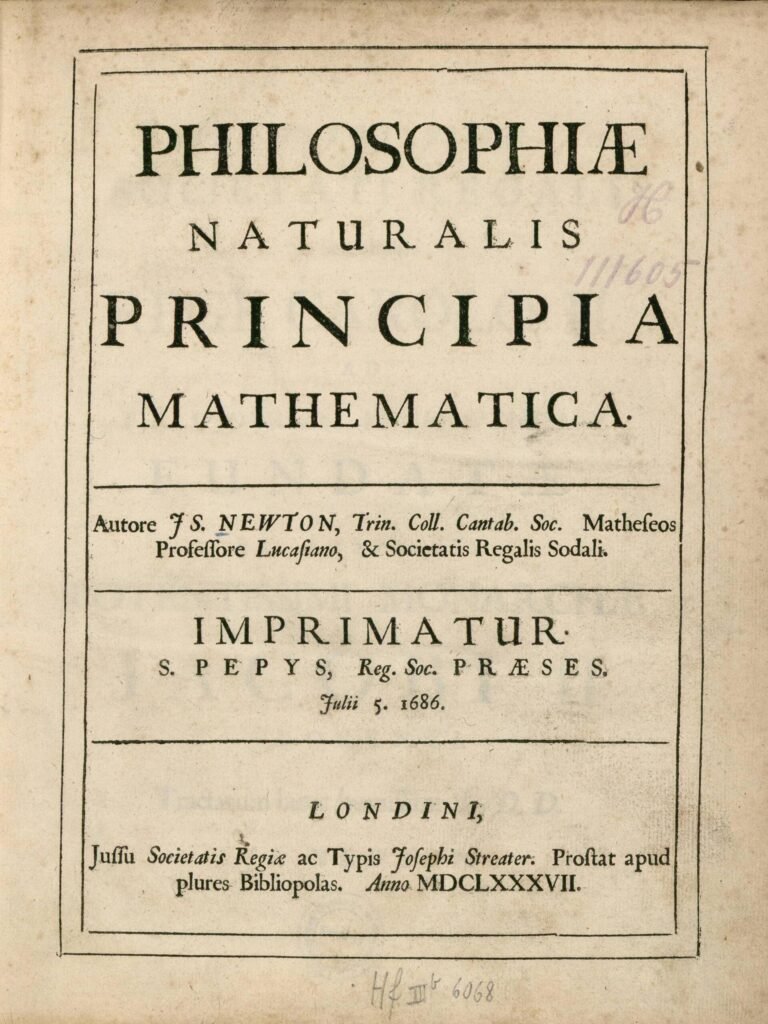
Principia Mathematica, in full Philosophiae Naturalis Principia Mathematica (Latin for Mathematical Principles of Natural Philosophy), is the three-book work in which Isaac Newton set out his laws of motion and his theory of universal gravity. It was first published in London in 1687. The short title is shared by an unrelated twentieth-century logic treatise by Bertrand Russell and Alfred North Whitehead, but this entry covers Newton’s book.
Its central result is that the force keeping the planets in their orbits is the same kind of force as the gravity that pulls objects to the ground. That conclusion ended the old view, dating back at least to Aristotle, that the heavens and the Earth call for separate sciences.
Background and creation of the Principia
Newton was a mathematics professor at Cambridge when the problem behind the book reached him. In 1679 Robert Hooke asked what path a body follows when it moves under an inverse-square force directed toward a central body, and in 1684 Edmond Halley put the same question again. Newton’s work on the answer, recorded in manuscripts from 1684 to 1686, grew into a full treatise.
Newton first planned a two-book work, with the second book laying out the system of the world in the manner of Descartes’s Principia Philosophiae. By the middle of 1686 he had moved to three books, giving motion through resisting media a book of its own. When Hooke raised a priority claim over the inverse-square law, Newton discarded his first version of the last book and rebuilt it as a chain of mathematically argued propositions. The original draft appeared in print in 1728 as the System of the World, the year after Newton died.
In 1686 Newton also changed the title to allude to Descartes’s book, which signaled that the work was meant as a rival to the Cartesian picture of nature.
Publication nearly failed for financial reasons. The Royal Society, whose president Samuel Pepys endorsed the book in 1686, had just spent its book budget on a natural history of fishes that sold poorly. Halley, who served as the Society’s clerk, paid for the printing himself and contributed a verse ode that appears in the first edition.
Contents of the Principia
The book opens with definitions, including Newton’s account of absolute space, time and motion, and then states the three laws of motion, covered further in the entry on Newton’s laws of motion.
Book 1 develops a mathematical theory of motion under centripetal forces, meaning forces directed toward a center. Its results are stated as theorems and problems in the style of Euclid, and they apply to many kinds of force, not only the inverse-square law for which the book is famous. Because the demonstrations are given in geometric form, the book is demanding to read even for trained mathematicians.
Book 2 treats motion through resisting media such as fluids. Its main purpose is to refute the Cartesian idea, shared by Leibniz, that whirling fluid vortices carry the planets around the Sun. Newton argued that vortices cannot be reconciled with Kepler’s rules of planetary motion, although his opponents noted that part of the argument depended on an untested assumption about how fluids resist motion.
Book 3 applies the mathematics to the solar system. After a short set of rules for reasoning and a list of observed astronomical phenomena, it derives the law of gravity, then works out its consequences for orbiting and rotating bodies. It goes on to account for selected irregularities in the Moon’s motion and for the precession of the equinoxes, and it ends with a method for finding the paths of comets.
Themes and interpretation of the Principia
In the preface to the first edition Newton described the task of natural philosophy as working back from observed motions to the forces behind them, and then using those forces to explain further phenomena.
Scholars stress that the book is subtler than its popular image. The clockwork universe often linked to Newton is not in the text. Laplace added that picture late in the eighteenth century, after Newton’s theory had explained complex deviations from Keplerian motion. Newton’s rules of reasoning are also provisional. The wording of the third and fourth rules says that conclusions drawn by induction should be taken as true, or very nearly true, until other phenomena correct them.
The book also carried a philosophical stake. It set a mathematical, force-based account of nature against the Cartesian picture of matter pushing matter, yet it left open what causes gravity. That gap became its most debated weakness in the eighteenth century, especially because no contact mechanism for gravitational force had been found.
Reception and legacy of the Principia
Reaction to the first edition was admiring in England and more divided on the Continent. Christiaan Huygens accepted that the gravity of falling bodies and the force holding the planets in orbit are one in kind, but he doubted that every small part of every body attracts every other, because he could see no mechanical cause for it. A review in the Journal des Scavants called the work the most perfect mechanics one could imagine, but asked for a physics as exact as its mechanics. In 1689 Leibniz published a rival explanation of planetary motion based on vortices.
Newton knew the theory had loose ends. One was a discrepancy of a factor of two in the motion of the Moon’s apogee, which weakened the claim that the Moon is held in orbit by an inverse-square force. Between the late 1730s and the early 1750s several of these loose ends were resolved, including the first truly successful account of the Moon’s motion.
Newton revised the book twice. The second edition appeared in Cambridge in 1713, twenty-six years after the first, with a long preface by Roger Cotes and a new General Scholium. The third edition followed in London in 1726. One of only four known first-edition copies that Newton and Cotes marked up for possible corrections is held by the University of Sydney, which has digitized it. The copy was rediscovered in 1908 after more than 140 years out of sight.
Andrew Motte’s English translation appeared in 1729, and I. Bernard Cohen and Anne Whitman published a new translation in 1999. By the 1790s Newton’s theory of gravity was established among researchers in orbital mechanics, and the Principia came to be seen as the model of successful science. After Einstein’s general relativity, Newtonian gravity is understood to hold only to high approximation in limited circumstances, and Einstein’s theory contains it as a limiting case. Even so, physicists still regard the Principia as an example of empirical science at its best.
More in Physics
Key facts
- Newton's Principia was first published in London in 1687, with a second edition in Cambridge in 1713 and a third in London in 1726.1
- The work has three books: motion under centripetal forces, motion in resisting media, and the system of the world.1
- Newton changed the title in 1686 to echo Descartes's Principia Philosophiae.1
- Edmond Halley personally financed the printing of the first edition.2
- The original draft of the last book was printed in 1728 as the System of the World, the year after Newton died.1
- Andrew Motte's English translation appeared in 1729.1
Related concepts
Quick checkWho paid for the printing of the first edition of the Principia?Show answer
Edmond Halley paid for it himself, because the Royal Society had spent its book budget on another title.
Sources
- 1. Stanford Encyclopedia of Philosophy, Newton's Philosophiae Naturalis Principia Mathematica, https://plato.stanford.edu/entries/newton-principia/
- 2. University of Sydney Library, Annotated first edition of Isaac Newton's Principia, https://library.sydney.edu.au/browse/special-collections/newtown-principia
Editorially reviewed by Specialty Digest Editorial TeamLast reviewed November 5, 2026Researched and drafted with AI assistanceReport an issue