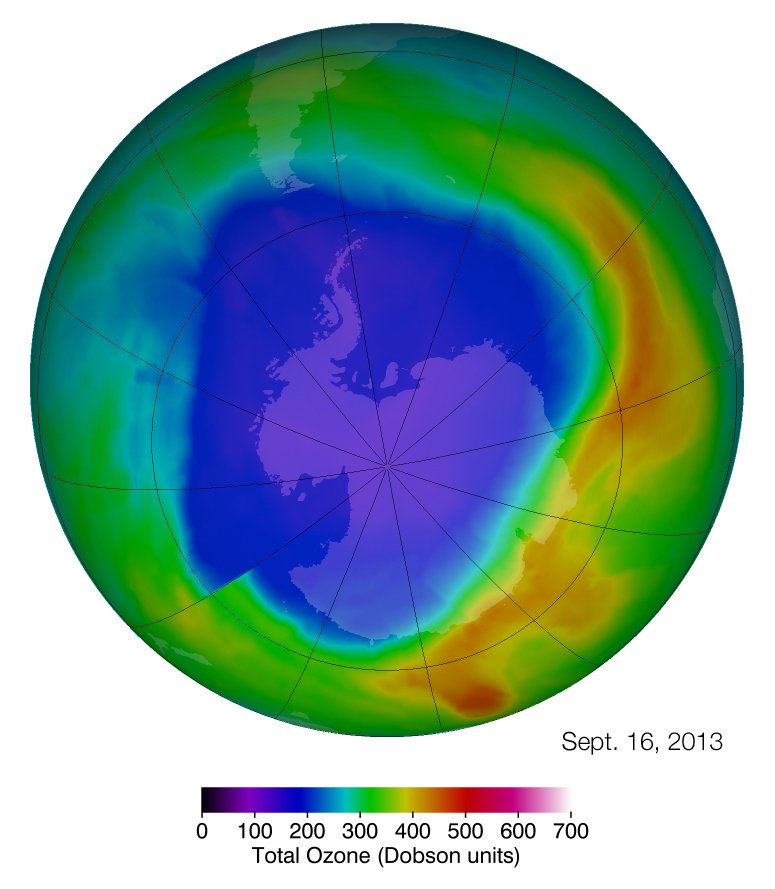
The Antarctic ozone hole is a large area of severely thinned ozone over Antarctica that appears every spring in the Southern Hemisphere. Scientists Joe Farman, Brian Gardiner and Jonathan Shanklin of the British Antarctic Survey reported it in the journal Nature in May 1985, and follow-up research linked it to human-made chemicals containing chlorine and bromine.
Background
Ozone is a gas whose molecules contain three oxygen atoms. In the stratosphere it forms the ozone layer, which absorbs much of the Sun’s harmful ultraviolet radiation. The British Antarctic Survey says the layer shields people, food crops and ecosystems from ultraviolet-B rays, and that without it the risks of skin cancer, cataracts and ecological damage would rise sharply.
Measurements over Antarctica began during the International Geophysical Year of 1957. In 1956 the British Antarctic Survey set up the Halley Bay Observatory in preparation, and in 1957 ozone measurements with a Dobson spectrophotometer, a ground instrument that measures the ozone in the air above it, began there. Satellite instruments later added a view from above.
The Halley station continues to monitor ozone with a Dobson spectrophotometer, so its record now stretches back to the late 1950s and is one of the longest in the world.
Some clues were older still. As early as 1912, Antarctic explorers recorded unusual veil-like clouds in the polar stratosphere. They could not have known it at the time, but such clouds would later prove central to the chemistry of ozone loss.
The discovery
Ground and satellite instruments measured an acute drop in total atmospheric ozone over Antarctica during October in the early and middle 1980s. These measurements gave the first clues that something was wrong. In 1985, Farman, Gardiner and Shanklin published the first scientific paper on the springtime losses of ozone over the continent.
The result was a shock. Nature’s retrospective notes that scientists suspected man-made gases called chlorofluorocarbons, or CFCs, were damaging the ozone layer, but they did not expect such a dramatic decline. Nor did they expect the discovery to come from a small group of British scientists working in Antarctica. The phrase ozone hole soon became the public name for the phenomenon.
The British Antarctic Survey says the team’s findings showed for the first time how human activity could damage the planet’s protective atmosphere, and how quickly. Its account states that the data proved that CFCs were destroying ozone high in the atmosphere.
How it was confirmed
In 1986 NASA scientists used satellite data from the Total Ozone Mapping Spectrometer and the Solar Backscatter Ultraviolet instrument to show that the ozone hole was a regional-scale Antarctic phenomenon. The British Antarctic Survey describes this as satellite confirmation of its data, with the hole spanning the entire continent.
The chemistry was worked out in the following months. Susan Solomon and colleagues published a key paper explaining how CFCs lead to ozone loss, and it stressed the need for polar stratospheric clouds to explain the reactions. Also in 1986, Michael McElroy and colleagues described a role for bromine. Paul Crutzen and Frank Arnold proposed that the polar clouds might be made of nitric acid trihydrate, which would explain why they existed at an altitude and temperature that seemed too warm for the small amount of water vapor in the stratosphere to condense.
Field measurements added evidence. The National Ozone Expedition measured elevated levels of chlorine dioxide at McMurdo Station during the springtime hole. In 1987 the Antarctic Airborne Ozone Expedition flew NASA ER-2 and DC-8 research aircraft from Punta Arenas, Chile, into the Antarctic polar vortex. Aircraft measurements in the late 1980s confirmed the link between CFCs, chlorine and ozone loss, and NASA calls this the smoking gun.
Aircraft flew into the Antarctic polar vortex, the ring of strong winds that isolates the cold air over the pole in winter and spring. Measuring inside it showed how much chlorine the air contained.
Competing explanations
At first the cause was not obvious. Between 1986 and 1987 several papers suggested possible mechanisms, including chemical, dynamical and solar cycle influences. The dynamical explanation held that changes in air movement, rather than chemicals, were responsible, and the solar explanation pointed to the Sun’s cycle. The chemical explanation prevailed because observations of chlorine compounds and aircraft data matched it, while the alternatives did not explain the findings as well.
Impact and legacy
The discovery prompted rapid international action. The Montreal Protocol on Substances that Deplete the Ozone Layer was signed in 1987 and entered into force in 1989. The parties meet once a year, and the agreement has been adjusted or amended six times. The most recent amendment, the Kigali Amendment of 2016, called for a phase-down of hydrofluorocarbons, which replaced some of the controlled substances. These do not harm the ozone layer but are powerful greenhouse gases.
The British Antarctic Survey describes the Montreal Protocol as the only treaty ratified by every country and as the most successful environmental agreement in history. It adds that removing CFCs also slowed climate change, since these chemicals are strong greenhouse gases. The United Nations Environment Programme’s ozone secretariat says that the treaty has met its objectives so far and that the ozone layer is well on its way to recovery.
The British Antarctic Survey calls the discovery a wake-up call and a turning point, one that showed bold science can reveal invisible threats. It marked 40 years since the discovery in 2025. The Nature retrospective asks what lessons the episode holds for climate change scientists, since in both cases the first signals were hard for many people to believe.
The hole still forms each Antarctic spring, but the British Antarctic Survey says it is shrinking, and scientists expect a return to pre-1980 levels by the middle of this century. It calls the recovery fragile. Halley Research Station still monitors ozone using the same type of instrument that was in use in 1957, which gives scientists a long record against which to measure progress.
More in Climate & Weather
Key facts
- Joe Farman, Brian Gardiner and Jonathan Shanklin reported the springtime ozone loss in May 1985.1
- Their paper appeared in the journal Nature in 1985.2
- NASA satellite data in 1986 showed the hole covered the Antarctic region.2
- Aircraft measurements in the late 1980s confirmed the link between CFCs, chlorine and ozone loss.2
- The Montreal Protocol was signed in 1987 and entered into force in 1989.3
- The British Antarctic Survey expects a return to pre-1980 ozone levels by the middle of this century.1
Related concepts
Quick checkWho discovered the ozone hole?Show answer
Joe Farman, Brian Gardiner and Jonathan Shanklin of the British Antarctic Survey, who published their findings in Nature in May 1985.
Sources
- 1. British Antarctic Survey, The ozone hole discovery, https://www.bas.ac.uk/about/history/ozone-hole-discovery/
- 2. NASA Goddard Space Flight Center, NASA Ozone Watch: History of the Ozone Hole, https://ozonewatch.gsfc.nasa.gov/facts/history_SH.html
- 3. United Nations Environment Programme Ozone Secretariat, The Montreal Protocol on Substances that Deplete the Ozone Layer, https://ozone.unep.org/treaties/montreal-protocol
- 4. Nature, PastCast: Discovering the ozone layer hole, https://www.nature.com/articles/d41586-019-01582-z
Editorially reviewed by Specialty Digest Editorial TeamLast reviewed November 5, 2026Researched and drafted with AI assistanceReport an issue