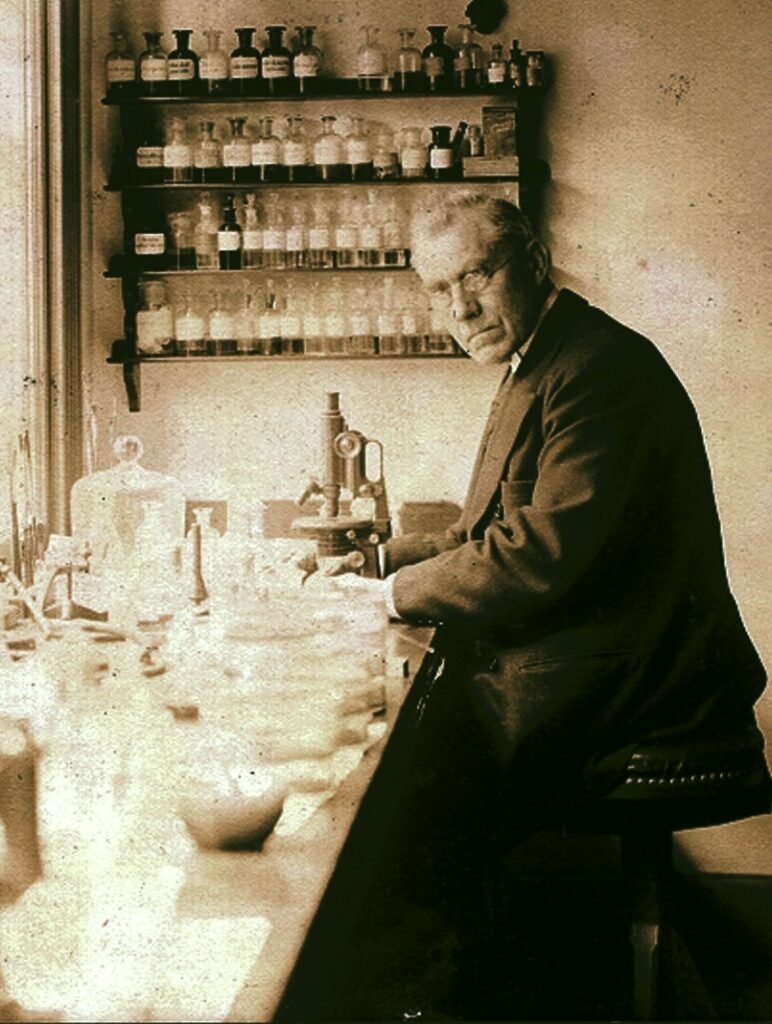
The discovery of viruses was the finding, made in the 1890s, that some infectious diseases are caused by agents smaller than bacteria. Dmitri Ivanovsky and Martinus Beijerinck showed this for tobacco mosaic disease, and Friedrich Loeffler and Paul Frosch reached a similar conclusion for foot-and-mouth disease in 1898.
Background
In the late 19th century tobacco was widely grown in Europe, and the crop suffered from several diseases of unknown cause, including one called mosaic disease. Plant diseases were known to be caused by fungi, and whether bacteria could also cause them was still debated. Nothing smaller than bacteria was known to science.
The discovery of germ theory had taught researchers to look for a microbe behind each infection and to grow it in culture. Some diseases did not fit. Rabies, for example, was already being fought with a vaccine developed by Louis Pasteur in 1885, yet the infectious particles were too small to see and would not grow on the culture media of the day.
The discovery
Three European scientists studied the cause of tobacco mosaic disease. In the Netherlands, Adolf Mayer injected healthy tobacco plants with sap from diseased plants and showed that the plants developed the same disease. This established that the illness was infectious.
Ivanovsky then passed the sap through porcelain Chamberland filters, a recent invention that held back bacteria. Healthy plants injected with the filtered sap still developed mosaic disease. Beijerinck carried out the same experiment at almost the same time and obtained the same result. Reference works place the first filtration experiments in 1892 and the published reports in 1898 and 1899.
Beijerinck concluded that the cause was neither a fungus nor a bacterium but something different that could pass through the filter. He named it contagium vivum fluidum, meaning a living infectious fluid, and shortened the label to virus, a Latin word meaning poison.
In 1898 Loeffler and Frosch found that the agent of foot-and-mouth disease of cattle also passed through porcelain filters and caused illness when injected into healthy cattle. They proposed that the agent was a particle. In 1900 Reed, Carroll, Agramonte, Lazear and Finlay reported the discovery of the yellow fever virus and its transmission by mosquitoes.
How it was confirmed
For decades viruses could be studied only by their effects. Seeing them required the electron microscope, which arrived in the mid-1930s, and growing them required living cells in culture, which was not possible until the late 1940s and early 1950s.
In 1935 Wendell Stanley extracted the tobacco mosaic virus from large quantities of infected leaves in the form of pure crystals. He first proposed that it was made only of protein. Frederick Bawden and colleagues then detected ribose and phosphorus in purified preparations and concluded that it contained protein and ribonucleic acid (RNA). The Nobel Foundation notes that Stanley’s later research showed the virus is composed of protein and RNA. Stanley shared the 1946 Nobel Prize in Chemistry with James Sumner and John Northrop for the preparation of enzymes and virus proteins in a pure form.
In 1938 Bodo von Borries, Helmut Ruska and Ernst Ruska produced the first electron micrographs of viruses, showing the ectromelia and vaccinia viruses. Tobacco mosaic virus was among the first viruses to be photographed. Between 1948 and 1955, John Enders, Thomas Weller, Frederick Robbins and Harry Eagle made the routine use of tissue culture for growing viruses practical.
Disputes over credit
Credit for the first virus is shared, and sources frame it differently. Many accounts name Ivanovsky and Beijerinck for tobacco mosaic virus. A standard medical virology reference lists the 1898 work of Loeffler and Frosch as clear proof that a virus causes disease, and as the discovery of the first virus.
Beijerinck’s idea of a fluid was partly wrong, since viruses are particles and not fluids. A 2022 review concludes that the particulate concept of Loeffler and Frosch was more correct. The observations of Loeffler and Frosch were also highly controversial at the time.
Impact and legacy
The discovery created the field of virology and gave scientists a way to define viruses as tiny infectious agents that cannot be seen with an ordinary light microscope or grown on ordinary media. Growth in cell culture then opened the way to vaccines. Inactivated influenza vaccines were developed in the 1940s, and Jonas Salk and colleagues developed inactivated polio vaccines in 1954.
The findings also cast new light on older preventive methods. Edward Jenner’s cowpox inoculation, described in the discovery of vaccination, protected people from smallpox about a century before anyone knew that a virus caused it.
Once purification showed what viruses were made of, researchers began to classify them by their properties. An early attempt in 1935 by Johnson and Hoggan used descriptive keys based on host, symptoms and mode of transmission, and the International Committee on Taxonomy of Viruses was created in the biochemical era that followed.
Later discoveries added to the list of human viruses, including the human immunodeficiency virus, reported in 1983. A modern vaccine may now be built from a virus, from part of one, or, as with mRNA vaccine technology, from genetic instructions.
FAQs
Who discovered the first virus? Ivanovsky and Beijerinck are usually credited with tobacco mosaic virus in the 1890s. Loeffler and Frosch showed in 1898 that foot-and-mouth disease is caused by a filterable agent.
Why is it called a virus? The word is Latin for poison. Beijerinck used it as a short form of contagium vivum fluidum.
When were viruses first seen? The first electron micrographs of viruses were made in 1938, when von Borries and the Ruska brothers imaged the ectromelia and vaccinia viruses.
Who crystallized a virus? Wendell Stanley crystallized the tobacco mosaic virus in 1935 and shared the 1946 Nobel Prize in Chemistry.
More in Biology
Key facts
- Adolf Mayer showed that sap from diseased tobacco plants could transmit mosaic disease, and Ivanovsky showed that filtered sap still caused it.1
- Beijerinck called the agent contagium vivum fluidum and shortened the term to virus, a Latin word for poison.1
- Loeffler and Frosch showed in 1898 that the agent of foot-and-mouth disease passed through porcelain filters.23
- Stanley crystallized tobacco mosaic virus in 1935 and shared the 1946 Nobel Prize in Chemistry.45
- The first electron micrographs of viruses were made in 1938.3
- Tissue culture of viruses became routine between 1948 and 1955.3
Related concepts
Quick checkWho discovered viruses?Show answer
Ivanovsky and Beijerinck showed in the 1890s that tobacco mosaic disease is caused by an agent that passes through bacteria-proof filters, and Loeffler and Frosch found a similar agent in foot-and-mouth disease in 1898.
Sources
- Zerbini and Kitajima, Biomolecules (2022), From Contagium vivum fluidum to Riboviria: A Tobacco Mosaic Virus-Centric History of Virus Taxonomy, https://pmc.ncbi.nlm.nih.gov/articles/PMC9599303/
- Oldstone and Schmidt, History of Virology, Encyclopedia of Microbiology, https://pmc.ncbi.nlm.nih.gov/articles/PMC7150144/
- Fenner and White's Medical Virology, History and Impact of Virology, https://pmc.ncbi.nlm.nih.gov/articles/PMC7150216/
- Nobel Prize, Wendell M. Stanley, Facts, https://www.nobelprize.org/prizes/chemistry/1946/stanley/facts/
- Nobel Prize, The Nobel Prize in Chemistry 1946, https://www.nobelprize.org/prizes/chemistry/1946/summary/
Editorially reviewed by Specialty Digest Editorial TeamLast reviewed November 5, 2026Researched and drafted with AI assistanceReport an issue