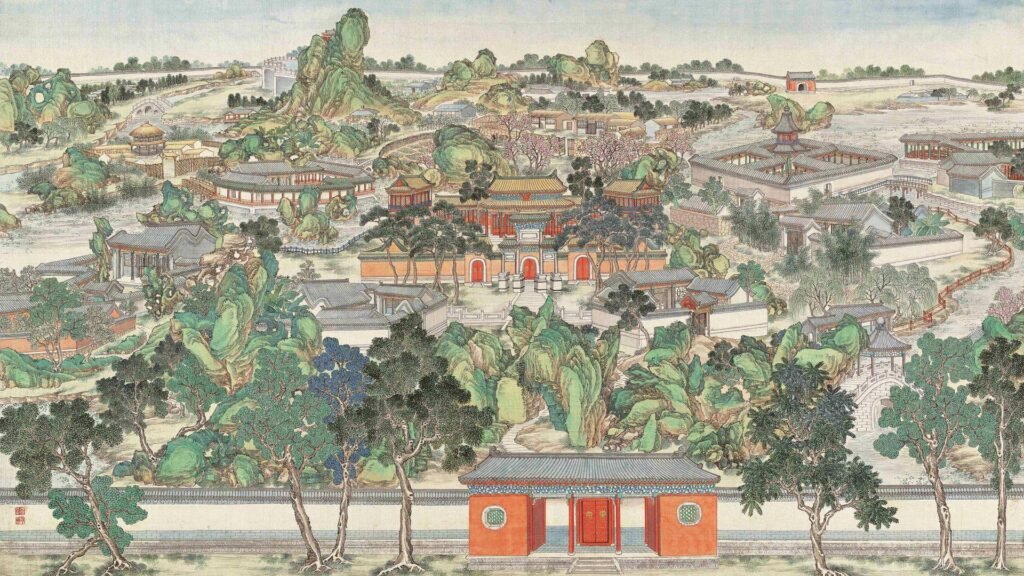
Dream of the Red Chamber, also known as The Story of the Stone and in Chinese as Hongloumeng, is an eighteenth-century Chinese novel attributed to Cao Xueqin. It follows the rise and decline of the wealthy Jia family through the young heir Jia Baoyu and his entangled bond with his cousins Lin Daiyu and Xue Baochai. It is counted among the four classic novels of Chinese literature.
Background and creation of Dream of the Red Chamber
Cao Xueqin came from a prestigious family with more than a hundred years of history, and he lived through its decline. His dates are uncertain: one source gives 1716 to 1763, while another gives 1715 or 1724 to 1763 or 1764. Near the end of his life he lived in the western suburbs of Beijing. The Academy of Chinese Studies in Hong Kong reports that he stopped writing after his young son died and that he died soon afterward.
The family’s reversal of fortune matches the central storyline, and scholars often see the book as a fictional reworking of that experience. The novel also broke with a popular genre of the time. The “scholar and beauty” romance, in which a talented young man wins a lovely woman, followed a familiar pattern, whereas Cao’s book focuses on the texture of daily life and its sorrows.
The first eighty chapters circulated in manuscript copies. Some of them carry comments and annotations written in red ink, so these manuscripts are sometimes called the rouge versions. They end abruptly, no later than the eightieth chapter, which means that the author left the story unfinished or that the rest of his manuscript was lost.
Plot of Dream of the Red Chamber
The framework of the novel is a myth in which a flower gives life to a conscious stone in a world of the distant past. In the main narrative the flower and the stone are born as humans, and they become part of a love triangle. Jia Baoyu is a sensitive boy who dislikes the formal studies expected of an heir. He is closest to his delicate cousin Lin Daiyu, while the poised Xue Baochai represents the practical choice a family would favor.
Most of the action takes place in and around the Grand View Garden, a luxurious compound where the young people live. They hold poetry gatherings, celebrate festivals, share meals and quarrel. Around them the household staff and relatives form a large cast: the book portrays close to forty main characters and about 400 minor ones.
Underneath the romance runs a second thread, the decline of four prestigious families of Jinling, the ancient name of Nanjing: the Jia, Shi, Wang and Xue families. Debts, mismanagement and political danger gradually erode the Jia household. In the 120-chapter version, Daiyu dies in sorrow as Baoyu is married to Baochai, and the family faces ruin before Baoyu finally withdraws from the world.
Themes in Dream of the Red Chamber
One central theme is the line between truth and illusion. The Jia family name sounds like the Chinese word for false, and a parallel Zhen family has a name that sounds like the word for true. The book opens with a monk and a Taoist who talk about the vanity of worldly pleasure, and it keeps asking whether the splendor of the Grand View Garden is a dream that must end.
The decline of a great house is the second theme. The novel does not simply condemn the Jia family for its extravagance. It shows how rank, obligation and tradition can trap people in roles that make them unhappy, and how a household can fail slowly through the accumulated choices of many members.
The book also gives unusual attention to the inner lives of young women. Daiyu, Baochai, the resourceful household manager Wang Xifeng and many others have distinct voices, talents and griefs. Daily culture appears in rich detail, from food and clothing to medicine and poetry, so the novel works as a record of eighteenth-century elite life as well as a story.
Textual history and Redology
The text exists in two broad families. The first is the early manuscripts that stop around chapter eighty. The second is the first printed edition of 120 chapters, assembled in 1791 by Cheng Weiyuan and Gao E and known as the Cheng version. Many later readers believe that the last forty chapters were written by someone other than Cao Xueqin, although the exact role of Gao E remains debated.
The complexity of these textual questions created an entire field of study, known as Redology, devoted to the novel’s author, family background, manuscripts and meanings.
Some of the red-ink commentary appears to hint at how the story was meant to end, which has fueled debate over how faithful the printed ending is to the original plan. Readers who prefer the early manuscripts value them for their rougher, more open-ended text, while the Cheng version remains the one most people first encounter because it gives a complete story.
Reception and legacy of Dream of the Red Chamber
Dream of the Red Chamber is generally regarded as the greatest Chinese novel. David Hawkes and John Minford produced the first complete English translation, published under the title The Story of the Stone between 1973 and 1986. The book has also been adapted for opera, film and television, and its characters, from the melancholy Daiyu to the energetic Xifeng, are familiar figures across Chinese-speaking communities. Visitors can also walk through theme gardens modeled on the Grand View Garden in Beijing and Shanghai, which shows how closely the book’s setting has been absorbed into popular culture. Scholars, students and general readers continue to return to it, partly because its unfinished state invites new theories about what Cao Xueqin intended.
More in Literature
Key facts
- Dream of the Red Chamber is attributed to Cao Xueqin, who died in 1763 or 1764.12
- The first eighty chapters circulated as manuscript copies, some with comments in red ink.12
- The first printed 120-chapter edition was assembled in 1791 by Cheng Weiyuan and Gao E.12
- The novel portrays close to forty main characters and about 400 minor characters.2
- It is counted among the four classic novels of Chinese literature.1
- The first complete English translation, The Story of the Stone by David Hawkes and John Minford, appeared from 1973 to 1986.2
Related concepts
Quick checkWho is Dream of the Red Chamber attributed to, and what is its other English title?Show answer
Cao Xueqin is the attributed author, and the novel is also called The Story of the Stone.
Sources
- Academy of Chinese Studies, The Splendid Chinese Culture: Dream of the Red Chamber, https://chiculture.org.hk/en/china-five-thousand-years/2414
- Humanities LibreTexts, Compact Anthology of World Literature, Cao Xueqin (1715 or 1724 to 1763 or 1764), https://human.libretexts.org/Bookshelves/Literature_and_Literacy/World_Literature/Compact_Anthology_of_World_Literature_-_4_5_and_6_(Turlington_et_al.)/01%3A_The_Seventeenth_and_Eighteenth_Centuries/1.02%3A_Near_East_and_Asia/1.2.01%3A_Cao_Xueqin_(1715_or_1724_-_1763_or_1764)
Editorially reviewed by Specialty Digest Editorial TeamLast reviewed November 5, 2026Researched and drafted with AI assistanceReport an issue