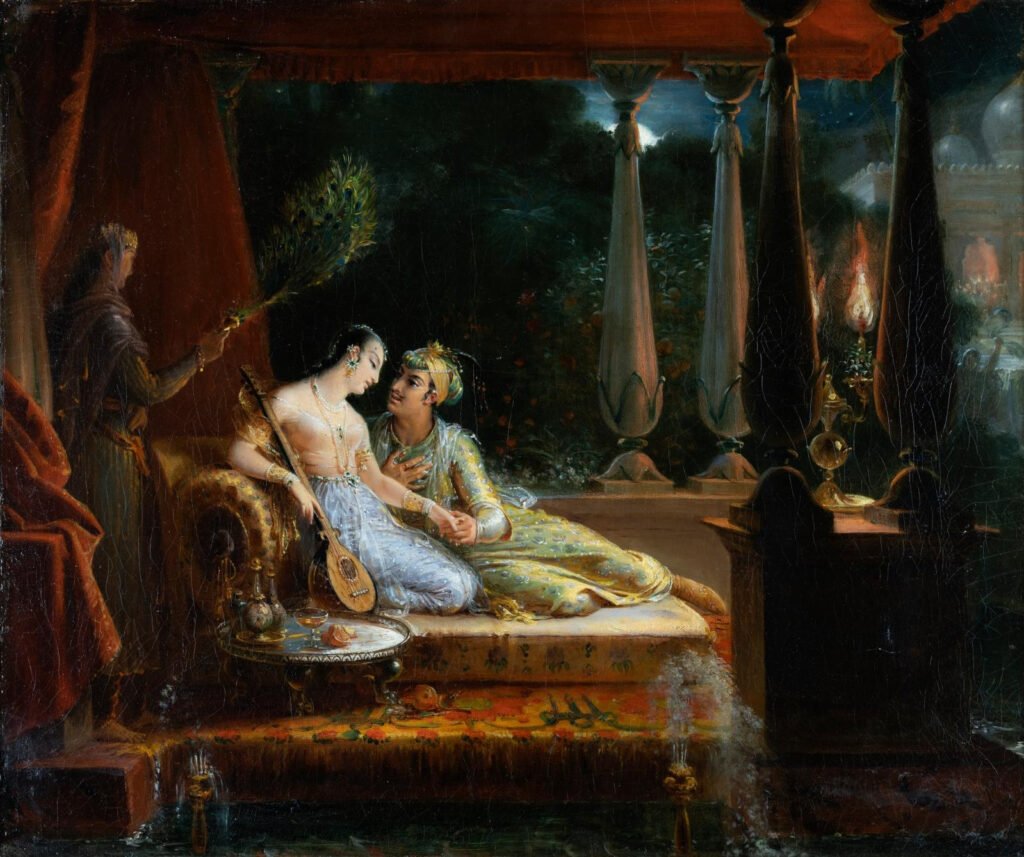
One Thousand and One Nights, known in English as the Arabian Nights, is a collection of tales from the Middle East and South Asia held together by a frame story in which Shahrazad tells a king a new story each night to postpone her death. Its Arabic title is Alf layla wa layla. The collection grew over centuries and exists in different forms in different manuscripts and editions, so there is no single fixed text.
Background and origins of the Nights
The oldest testimony to a book of this kind comes from the Arab writer al-Masudi, who died in 956. He refers to a work translated from Persian, Sanskrit and Greek called Hazar afsana, meaning the thousand tales, which the public knew as the thousand and one nights. He describes it as the story of a king, his vizier, the vizier’s daughter Shirazad and her slave Dinazad.
The Fihrist of Ibn al-Nadim, written in 987 and 988, supports this and confirms the existence of an Arabic translation that must go back to the ninth century. Ibn al-Nadim does not list the contents. A fragment of a ninth-century manuscript has been studied by scholars as early evidence.
The collection therefore did not have a single author. It developed over time as storytellers and copyists added tales, and the earliest layers were linked to Persian, Indian and other sources.
Content and structure of the Nights
In the frame story, two brothers who are kings, Shahzaman and Shahriyar, are each betrayed by their wives. Shahriyar then decides to marry a new bride every night and have her executed the next morning. Eventually the vizier cannot find another young woman. His daughter Shahrazad offers herself, and she brings her younger sister Dinarzad, who has been told to ask her each night for a story.
Shahrazad begins a tale each night and breaks off at dawn, so the king spares her to hear the ending. One thousand and one nights pass in this way. Within the frame, stories contain other stories, and the tales range across fables, romances, adventures, comic episodes and moral parables.
Scholars think that the central framework of the story, in which storytelling holds death at bay, belonged to the earliest form of the work. Other parts of the prologue, including the opening events that explain the king’s behavior, were probably added later.
Texts, translations and the Galland effect
The collections that editors and publishers assembled differed so much from one another that a table of the divergences is indispensable for research.
The extant manuscripts fall into three families, and editors have used them to build different versions of the text. The oldest printed Arabic edition appeared in Calcutta in 1814 to 1818. Later editions followed at Bulaq in 1835 and in Calcutta in 1839 to 1842.
The first published translation was made by the French orientalist Antoine Galland, who issued it in Paris from 1704. It appeared slowly, because he had difficulty getting manuscripts. His sources were Syrian manuscripts, Turkish tales and stories told orally by a Maronite Christian storyteller, Hanna Diyab, whose origin has never been determined. The complete French edition appeared between 1704 and 1717.
Because of that, some of the best-known tales are not genuine parts of the earlier Arabic collection. None of the early printed editions contains the tale of Aladdin and the magic lamp or the tale of Ali Baba and the forty thieves. Their Arabic texts were published later, and their fame goes back to Galland. Some tales without Arabic manuscripts were even translated back into Arabic from Galland’s French.
Themes and interpretation of the Nights
The main theme is storytelling as survival. Shahrazad uses narrative to delay a death sentence and gradually changes the king’s behavior, so the frame presents stories as a form of power.
Other recurring themes include fate and fortune, the reversals of rich and poor, the cleverness of ordinary people against rulers, and the relationships between men and women. The tales mix the marvelous with ordinary urban life, and they include jinn, magic, travel, trade and love.
The collection also shows how stories travel. Tales drawn from Persian, Sanskrit and Greek sources were reshaped in Arabic and later retold in French and other languages, so a reader meets them after many stages of adaptation.
Because there is no authoritative text, readers meet different Nights depending on the edition. Interpreters therefore study the collection as a living tradition with many contributors, not as the work of one author with a single intent. The opening events are also read with caution, because they were probably later additions to the earliest story of Shahrazad.
Reception and legacy of the Nights
Galland’s version was immediately regarded as a work of literature. During the eighteenth century it was rendered into English, German, Italian, Dutch, Danish, Flemish and even Yiddish. The translation became popular very quickly and helped shape a globalized literary landscape in the eighteenth and nineteenth centuries.
Galland’s French edition was reprinted many times, including long after his death, which shows that its popularity did not fade.
Later translators produced their own versions, including Edward William Lane in English in 1859, Richard Burton in English in 1885 to 1888, Joseph Charles Mardrus in French from 1899 to 1904 and Enno Littmann in German from 1921 to 1928. Each reflected the tastes of its time.
The collection influenced writers, painters, composers and filmmakers around the world, and its tales continue to be retold for children and adults. Its frame of a cultured storyteller facing a ruler appears in the artistic traditions of Iran, the Arab world and France, and the Persian and Indian sources of its earliest layers connect it to the literature of India as well.
More in Literature
Key facts
- The Arabic title is Alf layla wa layla, and the collection is known in English as the Arabian Nights.1
- Antoine Galland's French translation, the first published translation, appeared from 1704 and was completed in 1717.12
- The earliest testimony is by the Arab writer al-Masudi, who died in 956 and mentions the Persian book Hazar afsana.1
- The Fihrist of Ibn al-Nadim, written in 987 and 988, confirms an Arabic translation that must go back to the ninth century.1
- The tales of Aladdin and Ali Baba are not in the early Arabic printed editions.1
- The oldest printed Arabic edition appeared in Calcutta between 1814 and 1818.1
Related concepts
Quick checkWho made the first published translation of the Arabian Nights?Show answer
Antoine Galland, whose French translation began to appear in Paris in 1704.
Sources
- 1. Encyclopaedia Iranica, Alf Layla wa Layla (Charles Pellat), https://iranicaonline.org/articles/alf-layla-wa-layla
- 2. University of Tuebingen, Antoine Galland and Jean Jacques Antoine Caussin de Perceval: Les mille et une nuits, https://uni-tuebingen.de/en/239643
Editorially reviewed by Specialty Digest Editorial TeamLast reviewed November 5, 2026Researched and drafted with AI assistanceReport an issue