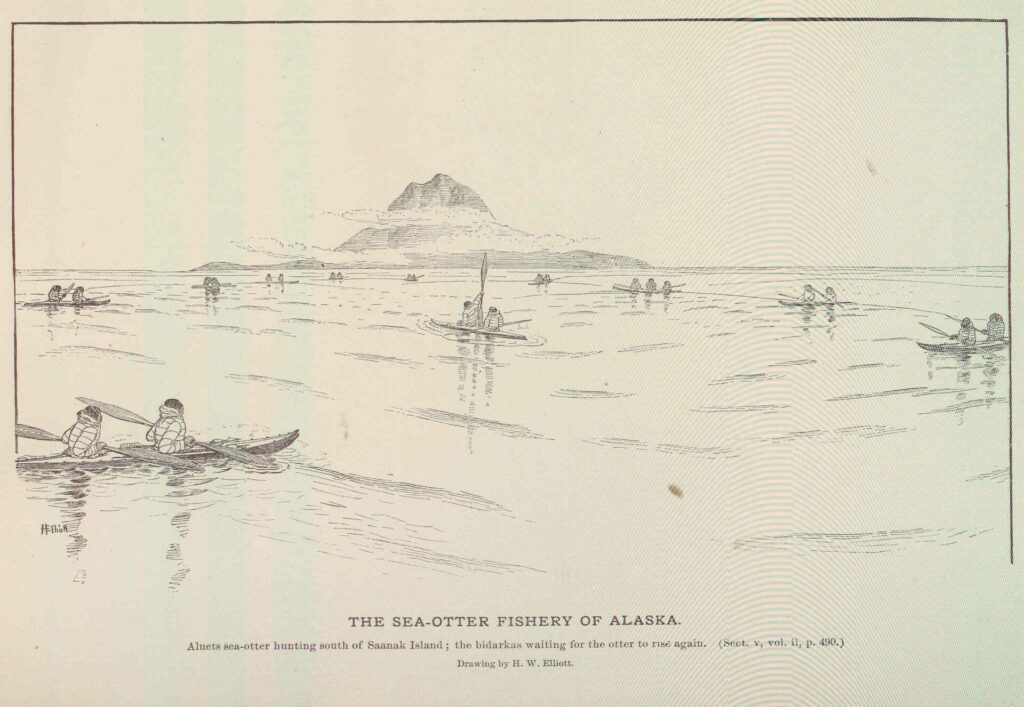
The fur trade in Russian America was the commercial driver of Russian activity in Alaska from the 1740s until the sale of the territory in 1867. After Vitus Bering’s 1741–42 expedition, Russian traders began collecting sea otter pelts from Alaskan waters and selling them mainly to China, and the trade dominated Alaska’s economy for over 150 years [1][2].
| Began | After Bering expedition, 1741–42 |
|---|---|
| Main product | Sea otter pelts |
| Main market | China, via Kiakhta |
| Early traders | Promyshlenniki |
| Company charter | Russian-American Company, 1799 |
| Duration | Over 150 years across Russian and early American eras |
Origins
Survivors of Bering’s 1741 voyage reported good fur-trading prospects in the Aleutians and Alaska [2], and Russians began trading for sea otter pelts from Alaskan waters. See the entry on the Bering expeditions.
Promyshlenniki and Early Traders
Russian frontier merchants called promyshlenniki first ran the trade, using indentured Aleut hunters to gather furs [1]. Later, joint-stock companies replaced individual traders.
The Russian-American Company
The Shelikhov-Golikov Company received a tsarist monopoly charter in 1799 and became the Russian-American Company. The company handled colonial governance but stayed focused on fur, operating about forty trading posts across Alaska [1]. Aleksandr Baranov, its first Chief Manager, expanded the sea otter and seal trade, including hunting along the California coast [3]. See the entries on the Russian-American Company and Aleksandr Baranov.
Markets and Competition
China was the main market, where wealthy buyers wanted pelts for luxury clothing. Russia sent furs overland through Kiakhta, while British and American merchants, called Boston Men, shipped directly to Canton. Following Cook’s third voyage (1776–79), these rivals sent up to 25 hunting expeditions a year [1].
Treaties and Cooperation
Treaties with the United States and Britain in 1824–25 set boundaries and trade rules, and in 1839 the Russian-American Company reached a cooperative agreement with the Hudson’s Bay Company. Trade also expanded inland along several river systems [1].
Decline
Intensive hunting drove many fur-bearing species toward extinction, and Russia’s sea otter population had collapsed by the time Alaska was sold in 1867 [1][4]. After the sale, the Alaska Commercial Company gained a monopoly on fur seal harvesting in the Pribilof Islands [1].
Related Entries
See the entries on Novo-Arkhangelsk, the Alaska Purchase, the Wildlife of Alaska and Alaska’s history as a territory.
FAQs
What was the main product of the Russian fur trade in Alaska? Sea otter pelts.
Where were the furs sold? Mainly in China, with Russian furs going overland through Kiakhta.
Who were the promyshlenniki? Russian frontier merchants and hunters who first ran the trade.
What was the Russian-American Company? A chartered monopoly company, formed in 1799, that governed the colony and ran the fur trade.
Why did the trade decline? Overhunting reduced fur-bearing populations, including sea otters.
Sources
- Library of Congress: Alaska Fur Trade
- Encyclopaedia Britannica: Vitus Bering
- Wikipedia: Alexander Andreyevich Baranov
- Wikipedia: Alaska Purchase
Key facts
Quick checkWhat animal’s pelts drove the Russian fur trade in Alaska?Show answer
The sea otter
Sources
- Library of Congress. Alaska Fur Trade. 2026 (accessed 2026-11-12)
- Encyclopaedia Britannica. Vitus Bering. 2026 (accessed 2026-11-12)
- Wikipedia. Alexander Andreyevich Baranov. 2026 (accessed 2026-11-12)
- Wikipedia. Alaska Purchase. 2026 (accessed 2026-11-12)
Editorially reviewed by Specialty Digest Editorial TeamLast reviewed November 12, 2026Researched and drafted with AI assistanceReport an issue