Honduras is a country in Central America, bordered by Guatemala to the west, El Salvador to the south, and Nicaragua to the southeast, with a long Caribbean Sea coastline in the north and a short Pacific outlet through the Gulf of Fonseca in the south. It is the second-largest country in Central America by both area and population, with roughly 10.8 million people, and its capital is Tegucigalpa.
Key Takeaways
- Honduras sits in Central America between Guatemala, El Salvador, and Nicaragua, with coastlines on both the Caribbean Sea and the Pacific’s Gulf of Fonseca.
- It was home to Copán, one of the most important cities of the Classic Maya civilization and now a UNESCO World Heritage Site.
- Honduras declared independence from Spain in 1821 and became fully sovereign after the Federal Republic of Central America dissolved in 1838.
- The economy depends heavily on agriculture, apparel manufacturing, and remittances from Hondurans working abroad, which account for more than a quarter of GDP.
- Honduras remains one of the poorest and most unequal countries in Latin America, and a 2009 political crisis that removed a sitting president still shapes debate over its recent history.
- Globally, Honduras is best known for the Copán ruins and for the Bay Islands, part of the Mesoamerican Barrier Reef, the largest reef system in the Western Hemisphere.
Geography: Mountains, Coasts, and Climate
Most of Honduras is mountainous and heavily forested, cut through by river valleys that historically isolated communities from one another and from the capital. The country’s highest point, Cerro Las Minas in the western highlands, rises above 2,800 meters. Honduras is unusual among Central American countries for having a long Caribbean coastline, more than 800 kilometers, alongside its brief Pacific access through the Gulf of Fonseca, which it shares with El Salvador and Nicaragua. Offshore, the Bay Islands, Roatán, Utila, and Guanaja, sit atop part of the Mesoamerican Barrier Reef System, the largest reef system in the Western Hemisphere. The country’s location and terrain leave it exposed to hurricanes and tropical storms: Hurricane Mitch in 1998 and the back-to-back hurricanes Eta and Iota in 2020 caused major loss of life and lasting damage to infrastructure and agriculture.
A Brief History: From Copán to Independence
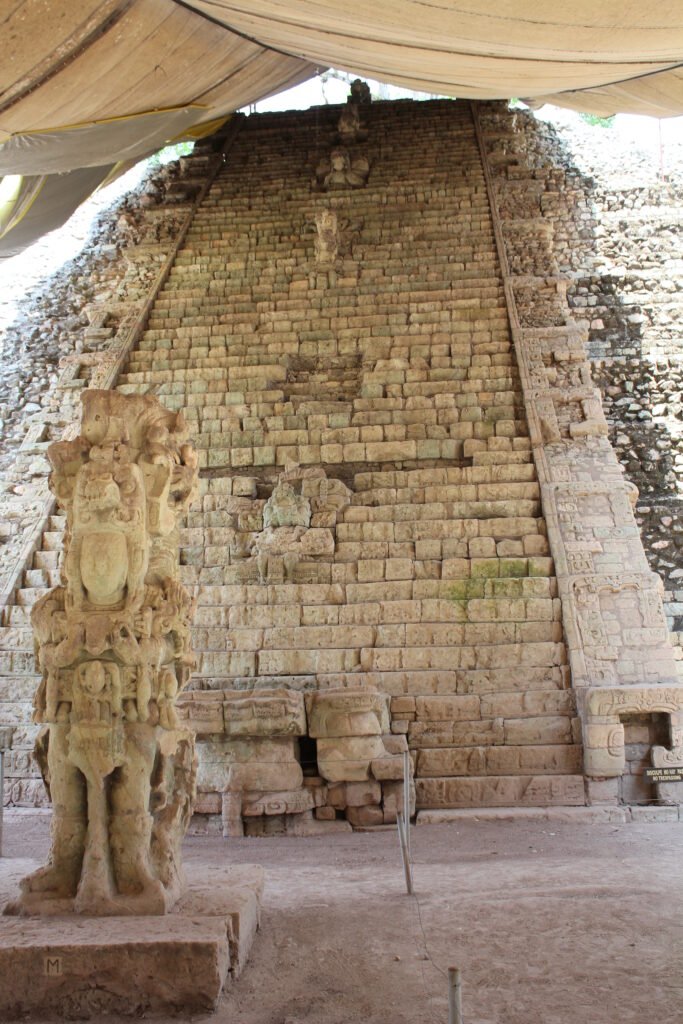
Long before Spanish contact, the valley around present-day Copán was the seat of one of the most powerful kingdoms of the Classic Maya period, flourishing from roughly the 5th to 9th centuries AD under a dynasty of kings who left behind elaborately carved stelae, temples, and the longest known Maya hieroglyphic text, inscribed on a monumental stairway. The kingdom declined by the early 9th century for reasons scholars still debate, including drought, warfare, and resource strain.
Spanish forces arrived in the early 16th century, and Honduras became part of the Captaincy General of Guatemala within Spain’s colonial empire. Along with the rest of Central America, it declared independence from Spain in 1821, briefly joined the Mexican Empire, and then became one of five states in the Federal Republic of Central America. When that federation dissolved in 1838, Honduras emerged as a fully independent republic. Political life in the following century was often unstable, marked by short-lived governments and, from the early 1900s, heavy investment by American banana companies whose influence over the national economy and politics gave rise to the term “banana republic.”
More recently, Honduras’s democratic institutions have faced serious strain. In June 2009, the military removed President Manuel Zelaya from office and expelled him from the country amid a dispute over a referendum widely seen as an attempt to extend his time in power. Honduran courts and Congress characterized the action as a lawful, constitutional removal from office, while most foreign governments and international bodies, including the Organization of American States, condemned it as a coup and suspended Honduras’s OAS membership in response. The episode remains a contested point of reference in accounts of the country’s recent political history, and perspectives on it still diverge.
Government and Economy
Honduras is a constitutional, presidential republic with a National Congress and an independent judiciary. The president is directly elected and serves as both head of state and head of government for a single term.
The economy is small and open, with agriculture, apparel manufacturing (maquila), and services as major sources of employment. According to the World Bank, real GDP growth reached about 3.8 percent in 2025, supported by record remittance inflows and strong coffee production amid higher international prices, though growth is projected to slow as remittances ease and inflation rises. Remittances sent home by Hondurans living abroad, chiefly in the United States, represent more than a quarter of national GDP, a dependence that reflects decades of outward migration driven by limited domestic job opportunities, crime, and vulnerability to natural disasters. Honduras has made gradual progress against poverty, but the World Bank still counts roughly 47.6 percent of the population as poor under a regional benchmark of US$8.30 per person per day, and inequality and human development outcomes remain among the weakest in Latin America.
People and Culture
Most Hondurans are mestizo, of mixed Indigenous and Spanish descent, and Spanish is the official language. Notable minorities include Indigenous peoples such as the Lenca of the western highlands and Maya Ch’orti’ communities near Copán, along with the Garífuna, an Afro-Indigenous people descended from West African, Carib, and Arawak ancestors, who settled Honduras’s Caribbean coast in the late 18th century and maintain a distinct language, music, and cuisine. Honduran culture blends Spanish colonial Catholic tradition with Indigenous and Afro-Caribbean influences, visible in cuisine such as baleadas, in Garífuna punta music, and in local festivals tied to patron saints’ days.
What Honduras Is Best Known For
Internationally, Honduras is most closely associated with two things: the Copán archaeological site and the reefs and beaches of the Bay Islands. Copán, inscribed as a UNESCO World Heritage Site in 1980, is regarded by archaeologists as one of the most artistically and epigraphically important Maya sites, thanks to its detailed royal portrait stelae and its Hieroglyphic Stairway, which carries the longest continuous Maya text yet discovered. The Bay Islands, especially Roatán, draw international visitors for diving and snorkeling along the Mesoamerican Barrier Reef. Honduras is also a major exporter of coffee and, historically, bananas, the crop that first drew large-scale American corporate investment to the country in the early 20th century.
Why Honduras Matters
Honduras matters globally for reasons that extend beyond archaeology and tourism. It sits at the center of Central America’s migration corridor toward the United States, making its economic and security conditions a recurring factor in regional migration policy. Its dependence on remittances and its exposure to hurricanes and other climate shocks make it a frequently cited case in development economics and disaster-resilience planning. Copán, meanwhile, remains one of the most important sources of evidence for understanding the political and intellectual life of the Classic Maya world, giving Honduras an outsized role in Mesoamerican archaeology relative to its size.
Sources
- World Bank | Honduras Overview | Undated, continuously updated (last updated April 8, 2026) | https://www.worldbank.org/en/country/honduras/overview | Accessed September 27, 2026
- UNESCO World Heritage Centre | Maya Site of Copan | Undated | https://whc.unesco.org/en/list/129 | Accessed September 27, 2026
- Organization of American States | OAS Suspends Membership of Honduras | 2009 | https://www.oas.org/en/media_center/press_release.asp?sCodigo=E-219/09 | Accessed September 27, 2026
Key facts
- Honduras has an estimated population of about 10.8 million people.1
- Real GDP growth reached about 3.8 percent in 2025, with remittances equal to more than a quarter of GDP.1
- Roughly 47.6 percent of Hondurans live below the World Bank's regional US$8.30-per-day poverty line.1
- The Maya site of Copan was inscribed as a UNESCO World Heritage Site in 1980.2
- The Organization of American States suspended Honduras's membership after the 2009 removal of President Manuel Zelaya.3
Quick checkWhat UNESCO World Heritage Site in Honduras is famous for its Maya hieroglyphic stairway?Show answer
Copan, the Maya archaeological site in western Honduras, inscribed as a UNESCO World Heritage Site in 1980.
Sources
- World Bank. Honduras Overview. Undated, continuously updated (last updated April 8, 2026) (accessed Accessed September 27, 2026)
- UNESCO World Heritage Centre. Maya Site of Copan. Undated (accessed Accessed September 27, 2026)
- Organization of American States. OAS Suspends Membership of Honduras. 2009 (accessed Accessed September 27, 2026)
Editorially reviewed by Specialty Digest Editorial TeamLast reviewed September 27, 2026Researched and drafted with AI assistanceReport an issue