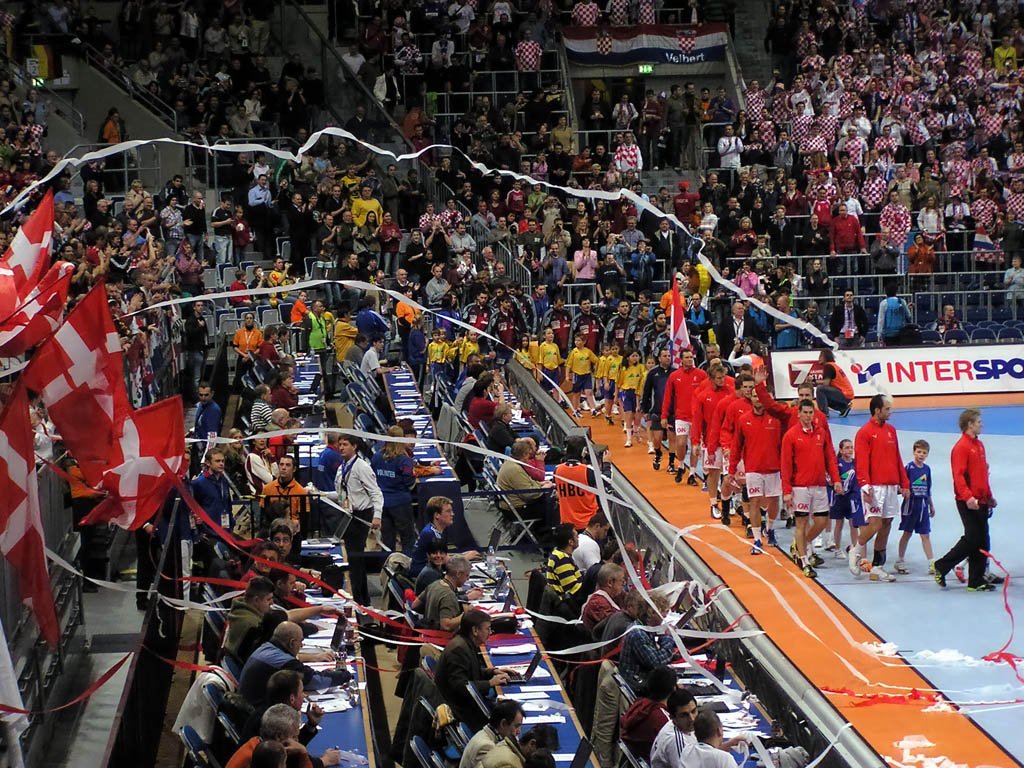
Handball, also called team handball, is a team sport in which two teams of seven players pass a ball and try to throw it into the opponent’s goal. A match has two halves of 30 minutes, and the team with more goals wins. The International Handball Federation (IHF) governs the sport, which has been in the Olympic program in its indoor form since 1972 for men and 1976 for women.
History of handball
Modern team handball was codified in the late 19th century, mainly in Denmark, Germany, Norway and Sweden. The Danish gym teacher Holger Nielsen published the first written set of rules in 1906. The modern rules were published in Berlin on 29 October 1917 by Max Heiser, Karl Schelenz and Erich Konigh, and the first official match was played there on 2 December 1917. Schelenz modified the rules again in 1919.
The first international matches were played between Germany and Austria, in 1925 for men and in 1930 for women. The International Amateur Handball Federation was founded in Amsterdam on 4 August 1928, during the Olympic Games. The IHF itself came out of a founding congress at the Palace Hotel in Copenhagen from 10 to 13 July 1946, where delegates dissolved the earlier body and Gosta Bjork of Sweden was elected the first president.
The IHF held its 50th anniversary congress in 1996, when it reported 138 member federations, more than 800,000 teams and more than eight million players. A reference summary lists 197 member federations as of 2016.
Rules and how handball is played
Each team has seven players on the court, including the goalkeeper. As in association football, the goalkeeper defends a goal, but handball players score with their hands, and a player holding the ball may take up to three steps or hold it for up to three seconds before passing, shooting or dribbling.
The court is 40 meters long and 20 meters wide, and the goals are 3 meters wide and 2 meters high. A line 6 meters from the goal marks the goal area, which only the defending goalkeeper may enter. The free-throw line is 9 meters from the goal, and a seven-meter throw is awarded when a clear scoring chance is illegally prevented.
A standard match has two 30-minute halves. Half-time lasts 10 minutes, or 15 minutes at major championships and the Olympics. Each team may call three one-minute timeouts per game, with a maximum of two per half, a rule in place since 2012. Players may not kick the ball or push, hit or fall on opponents.
Ball sizes differ by age and sex. The largest, size III, is used by men over 16 and measures 58 to 60 centimeters around with a weight of 425 to 475 grams. Women over 14 use size II, at 54 to 56 centimeters and 325 to 375 grams, and juniors over eight use size I, at 50 to 52 centimeters and 290 to 330 grams. Youth matches are shorter, with halves of 25 minutes for ages 12 to 15 and 20 minutes for ages 8 to 11.
Equipment and venues
The main equipment is the ball and the goal, along with court markings for the goal area, free-throw line and seven-meter mark. Because players jump, throw and land repeatedly, the sport is often studied through the biomechanics of movement.
Indoor handball is played in halls, while outdoor field handball with 11 players per side was played at the 1936 Berlin Olympics before the indoor game took over. Beach handball is played on sand and is a separate discipline with its own world championships, which began in El-Gouna, Egypt, on 27 to 30 November 2004. It was a demonstration sport at the World Games in Akita, Japan, in 2001 and became a full sport at the World Games in Cali, Colombia, in 2013. The IHF is based in Basel, Switzerland, where it moved in July 2002.
Governing bodies and major competitions
The IHF, like other federations described under sports governance, has five continental federations, for Asia, Africa, Pan-America, Europe and Oceania, and it governs a calendar of world championships. The first men’s world indoor championship was held in Berlin on 5 and 6 February 1938. The first women’s indoor world championship took place in Yugoslavia in July 1957, and junior world championships began in 1977. The men’s world championship has been held every two years since the 1995 event in Iceland.
On the Olympic side, the IOC decided on 8 May 1934 to include men’s field handball at the 1936 Berlin Olympics, which ran from 1 to 16 August. Indoor handball made its Olympic debut at Munich from 30 August to 10 September 1972, with 16 men’s teams. Women’s indoor handball debuted at Montreal from 18 to 28 July 1976. At Beijing in 2008 the tournaments had equal numbers of teams, 12 each for men and women.
Records and notable moments
Olympedia lists Denmark first in the Olympic medal table by gold medals, with five, followed by France and the Soviet Union with four each, and Norway and Yugoslavia with three each. France and Norway lead on total Olympic medals with eight each.
Among men, Andrey Lavrov has four Olympic medals, three of them gold, won for the Soviet Union, the Unified Team and Russia. Michael Guigou, Nikola Karabatic and Luc Abalo of France also have four medals each, three of them gold. Katrine Lunde of Norway leads the women with five medals, three of them gold. Men’s handball has been held at the Olympics 15 times and women’s 13 times.
Global reach of handball
Olympedia counts 3,029 participants from 50 national Olympic committees in Olympic handball. The IHF reported 138 member federations in 1996, and by 2016 a reference summary counted 197.
European nations lead the medal count, yet South Korea has won two Olympic golds, four silvers and one bronze. Beach handball appeared at the Youth Olympic Games in Buenos Aires from 7 to 13 October 2018 and at the first ANOC World Beach Games in Doha in October 2019. Recent world champions include Denmark among men, in 2025, and France among women, in 2023.
More in Sports Coaching and Performance
Key facts
- The International Handball Federation was founded at a congress in Copenhagen from 10 to 13 July 1946.1
- A team has seven players on court, including the goalkeeper, and the court is 40 meters by 20 meters.3
- Indoor handball made its Olympic debut at Munich in 1972 for men and at Montreal in 1976 for women.1
- The first men's world indoor championship was held in Berlin on 5 and 6 February 1938.1
Related concepts
Quick checkHow many players are on the court in handball?Show answer
Each team has seven players on the court at a time, one of whom is the goalkeeper, and the court measures 40 meters by 20 meters.
Sources
- International Handball Federation, The International Handball Federation: Timeline of Milestones, https://www.ihf.info/media-center/news/international-handball-federation-timeline-milestones
- Olympedia, Handball at the Olympic Games, https://www.olympedia.org/sports/HBL
- Wikipedia, Handball (rules and early history), https://en.wikipedia.org/wiki/Handball
Editorially reviewed by Specialty Digest Editorial TeamLast reviewed November 4, 2026Researched and drafted with AI assistanceReport an issue