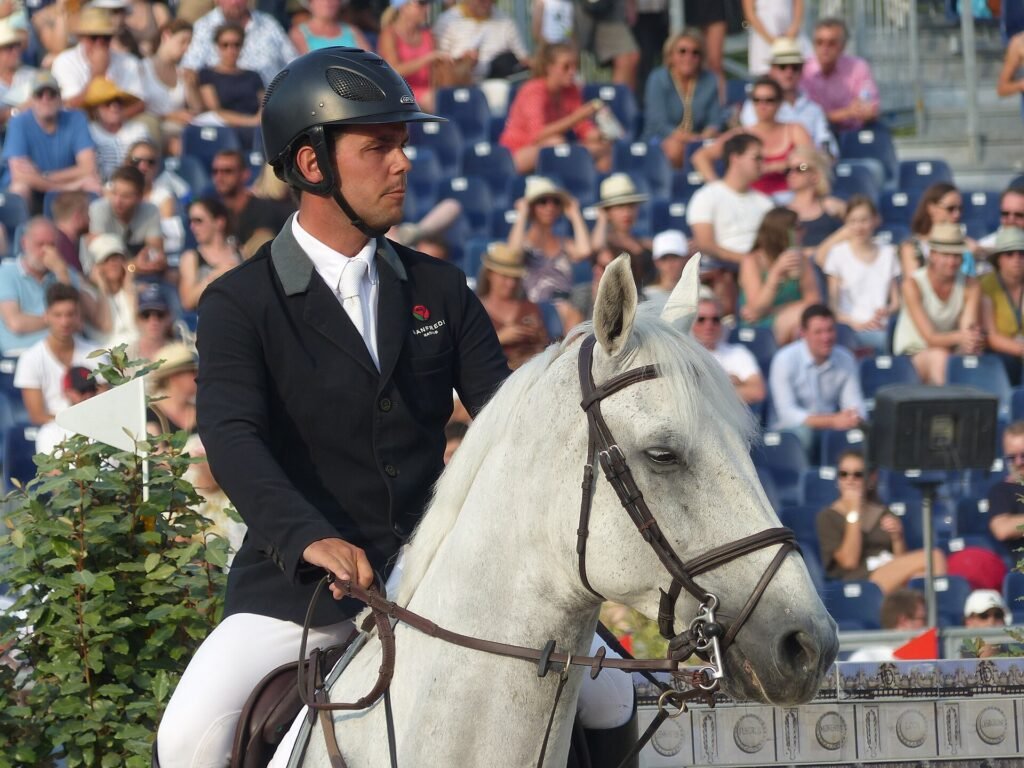
Equestrian sport covers the competitions in which a rider and a horse perform together under the rules of the International Federation for Equestrian Sports, known as the FEI. The Olympic disciplines are dressage, show jumping and eventing, and the FEI also governs driving, endurance and vaulting. Equestrian events have been part of the Olympic Games since 1900, and they are among the few Olympic events in which men and women compete directly against each other.
History of equestrian sport
Jumping and dressage first appeared at the Paris Games of 1900, where a driving event was also held once. Equestrian events returned at Stockholm in 1912 with dressage, jumping and eventing, which have been on the Olympic program ever since. At that time only men could compete, and before 1952 only commissioned military officers and gentlemen were eligible. A vaulting event at Antwerp in 1920 was also held only once.
The FEI was formed in 1921, founded by eight nations, and the first Olympics under its authority took place in 1924. Rules about who could compete changed gradually. In 1952 all men were allowed to enter every discipline, and women were admitted to Olympic dressage that year at Helsinki. Women entered jumping at the 1956 Games and eventing at Tokyo in 1964.
The 1956 equestrian events were held in Stockholm, not in Melbourne with the rest of the Games, because Australia’s strict quarantine rules made it difficult to bring in horses.
Rules and how equestrian sport is played
In dressage, horse and rider perform a set sequence of movements in a marked ring. Judges assess the level of training the horse has reached and the rider’s control. Since the 1996 Olympics the freestyle test has included music, and judges also score grace, appeal and choreography.
Show jumping is held over an outdoor course of fixed length with obstacles of varying heights and sizes, and every competitor rides the same course. Riders must finish within a set time. Penalty points, called faults, are added for knocking down an obstacle or for exceeding the time limit.
Eventing combines three tests. The phases are dressage, cross-country and jumping, and in the traditional three-day format they are held on successive days. Cross-country is a timed outdoor course of fixed natural obstacles such as water, ditches and banks. At higher levels it can run about 5,700 meters. Eventing is scored in penalties, so the horse and rider with the lowest total win. A fall on the cross-country course results in elimination.
The other FEI disciplines include driving, in which a horse or team pulls a carriage, endurance, which tests horses over long distances, and vaulting, which is gymnastics on a moving horse. Para dressage is a Paralympic discipline, and para driving is also part of FEI competition.
Equipment and venues
No single breed is used in international events, and a competition horse can weigh more than 700 kilograms. A dressage arena for eventing measures 20 meters by 60 meters. Cross-country courses commonly use frangible pins, which let part or all of a fence collapse on heavy impact so that the risk of a serious fall is reduced.
Teams usually include more than the rider. Grooms, trainers, veterinary support and coaches work alongside the athlete. Famous venues include Pratoni del Vivaro in Italy, which hosted the Olympic equestrian events in 1960 and later eventing and endurance championships.
Governing bodies and major competitions
The FEI has its headquarters in Lausanne, Switzerland, and recognizes 135 national federations. It was founded by Belgium, Denmark, France, Italy, Japan, Norway, Sweden and the United States, and the International Olympic Committee recognizes it as the governing authority for these sports. A code of conduct is meant to protect the welfare of horses from physical abuse or doping. See sports governance for how federations of this kind work.
The FEI World Cup is an indoor series that began with show jumping in 1978 and added dressage in 1985, driving in 2001 and vaulting in 2010. World championships developed discipline by discipline. A Grand Prix of dressage was held in Lucerne in 1927, and the first dressage World Championship was held in Bern in 1966. The first jumping World Championship took place in Paris in 1953, with 19 athletes from 11 countries.
The first eventing World Championship was held in Lincolnshire, Great Britain, in 1966. Driving followed in Munster in 1972. Endurance became an FEI discipline in 1982 and vaulting joined in 1983, and both held first world championships in 1986. From 1990 to 2018 the FEI combined these into the World Equestrian Games, which were held in cities including Stockholm, The Hague, Rome, Aachen, Lexington, Normandy and Tryon. Since 2022 it has used a more flexible approach that allows separate championships in different places.
Records and notable moments
Para dressage world championships began in 2007, and para dressage has been part of the Paralympic Games since 1996. Jumping has been included in the Youth Olympic Games since 2010. The 2026 FEI World Championships in jumping, dressage, para dressage and eventing are the first qualifying events for the Los Angeles 2028 Olympic and Paralympic Games.
The Olympic program has six equestrian events, with individual and team medals in each of the three disciplines. Because women have competed directly against men since the 1950s and 1960s, equestrian sport is a frequent example in discussions of gender in sport.
Global reach of equestrian sport
With 135 affiliated national federations, equestrian sport has a presence on several continents. The 2022 championships were held in Herning in Denmark, Pratoni del Vivaro in Italy and Butheeb in the United Arab Emirates, which shows how its events now rotate between regions. The sport has also been part of the Olympic Games continuously since 1912, which has helped it keep a prominent place on the international calendar.
More in Sports Coaching and Performance
Key facts
- The FEI was formed in 1921 and recognizes 135 national federations as of 2026.1
- Jumping and dressage first appeared at the Olympics in 1900, and dressage, jumping and eventing have been on the program since 1912.1
- Women entered Olympic dressage in 1952, jumping in 1956 and eventing in 1964.1
- Eventing combines dressage, cross-country and jumping and is scored in penalties.3
- The first jumping World Championship was held in Paris in 1953, with 19 athletes from 11 countries.2
Related concepts
Quick checkWhat are the three Olympic equestrian disciplines?Show answer
The Olympic equestrian disciplines are dressage, show jumping and eventing, each with individual and team medals.
Sources
- Olympedia, International Federation for Equestrian Sports (founding in 1921 and Olympic history), https://www.olympedia.org/organizations/58
- FEI, Championships history (first world championships by discipline), https://inside.fei.org/node/8298033
- Equestrian Australia, Eventing (phases and scoring), https://equestrian.org.au/Eventing
- Encyclopedia.com, Equestrian (dressage, show jumping and eventing described), https://www.encyclopedia.com/equestrian
- Wikipedia, International Federation for Equestrian Sports and Equestrian events at the Summer Olympics (used for orientation: member count, World Cup series, Olympic rules changes), https://en.wikipedia.org/wiki/International_Federation_for_Equestrian_Sports
Editorially reviewed by Specialty Digest Editorial TeamLast reviewed November 4, 2026Researched and drafted with AI assistanceReport an issue