The decathlon is a combined track and field event in which athletes compete in ten events over two days and earn points for every performance. The highest total wins. World Athletics governs the event, which made its Olympic debut at the Stockholm Games in 1912.
History of the decathlon
The decathlon evolved from the pentathlon of ancient Olympia, and versions of a multi-event contest re-emerged in the 19th century. A ten-event all-around championship was first contested at the United States amateur championships in 1884 and had reached a consistent form by 1890. An all-around event was also held at the 1904 Summer Olympics, although historians dispute whether it counts as an official Olympic event. The current format was first contested in 1911.
The modern decathlon appeared at the 1912 Stockholm Olympics, where Jim Thorpe of the United States won. King Gustav V of Sweden is reported to have told him that he was the world’s greatest athlete, and the phrase has been attached to decathlon winners ever since.
The International Association of Athletics Federations, now World Athletics, recognized its first decathlon world record in 1922. Aleksander Klumberg of Estonia scored 6,087 points on today’s scoring tables. Records have been recognized since 1922, so the event has a continuous record history of more than a century. Thorpe’s win in Stockholm came in the first Olympic decathlon held in the modern format.
Rules and how the decathlon is played
The first day has five events: the 100 meters, long jump, shot put, high jump and 400 meters. The second day has the 110-meter hurdles, discus throw, pole vault, javelin throw and 1,500 meters. Each performance is converted to points with a scoring table, and the points are added together.
The tables use formulas that give more points for faster times and longer or higher marks. World Athletics lists the marks that equal 1,000 points in each event: 10.39 seconds in the 100 meters, 7.76 meters in the long jump, 18.40 meters in the shot put, 2.21 meters in the high jump and 46.17 seconds in the 400 meters. On the second day the figures are 13.80 seconds in the hurdles, 56.17 meters in the discus, 5.29 meters in the pole vault, 77.19 meters in the javelin and 3 minutes 53.79 seconds in the 1,500 meters.
The tables in use today date from 2001. Each event has its own formula and constants: in track events the points fall as the time grows, and in field events they rise as the mark improves. If an athlete hit all ten of the 1,000-point marks listed above, the total would be exactly 10,000 points, well above the world record of 9,126.
Because the scoring is cumulative, a weak result in one event can be offset by strength elsewhere. The contest rewards all-round ability, since every event draws on different muscle fiber types and energy systems.
Women compete in the seven-event heptathlon at major championships. A women’s decathlon scoring table was approved in 2001, and the women’s shot, discus and javelin weigh less than the men’s implements.
Equipment and venues
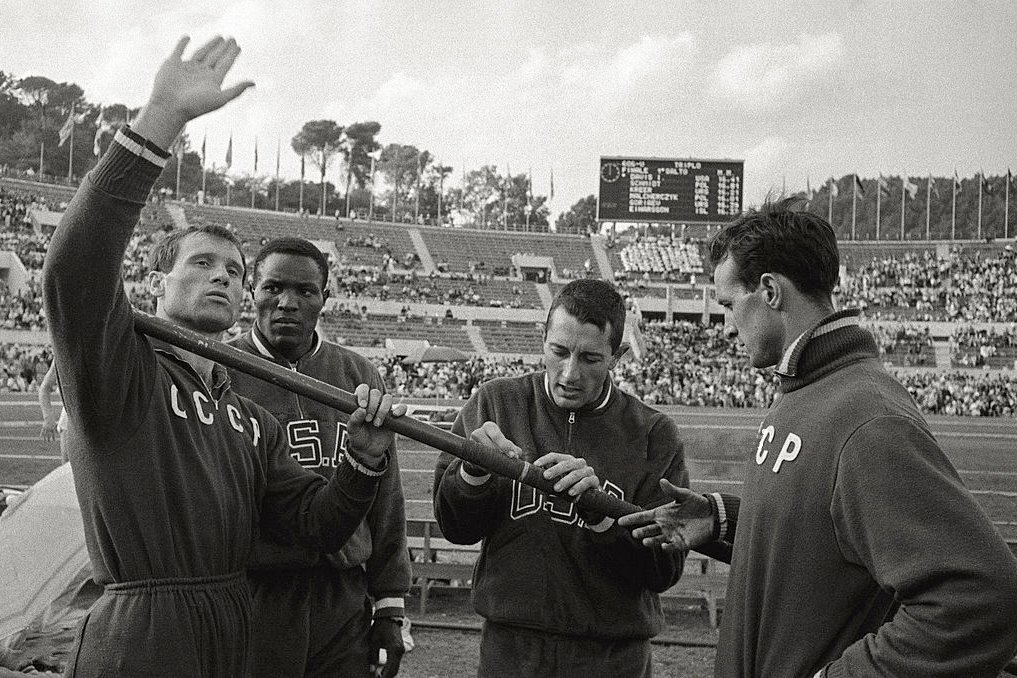
The decathlon uses the standard equipment of track and field: starting blocks, hurdles, jumping pits and a high jump landing area, a vaulting pole, and the shot, discus and javelin. The photograph above shows the pole vault leg of the decathlon at the 1960 Olympic Games in Rome.
All events are held in a stadium, usually on a synthetic track with throwing areas inside the oval, so the whole contest can be held in one venue over two days. Women’s hurdles are 100 meters rather than 110 meters.
Governing bodies and major competitions
World Athletics, formerly the IAAF, approves the scoring tables and ratifies records. The decathlon is a fixture of the Olympic Games and the World Athletics Championships, and many national and regional championships also include it.
At the Olympics, American decathletes won 14 gold medals between 1912 and 2016. Bob Mathias of the United States won consecutive golds in 1948 and 1952. Only two other decathletes have won two Olympic titles: Daley Thompson of Britain, in 1980 and 1984, and Ashton Eaton of the United States, in 2012 and 2016. Damian Warner of Canada won gold at the Tokyo Games in 2021.
Records and notable moments
The men’s world record is 9,126 points, set by Kevin Mayer of France on 15 and 16 September 2018 in Talence, France. His marks were 10.55 seconds, 7.80 meters, 16.00 meters, 2.05 meters and 48.42 seconds on the first day, and 13.75 seconds, 50.54 meters, 5.45 meters, 71.90 meters and 4 minutes 36.11 seconds on the second.
The previous record was 9,045 points by Ashton Eaton in Beijing in 2015. The Olympic record is 9,018 points by Damian Warner at Tokyo.
The record has risen in steps. Yang Chuan-kwang of Taiwan scored 9,121 in 1963, the first total above 9,000 on the old tables, which equals 8,010 on the current ones. Russ Hodge of the United States scored 8,230 in 1966, the first record set under the new scoring system. Daley Thompson scored 8,622 in 1980 and 8,798 in 1984, and Dan O’Brien of the United States scored 8,891 in 1992. Roman Sebrle of the Czech Republic scored 9,026 in 2001, the first total above 9,000 on the current tables. Eaton set 9,039 in 2012 and 9,045 in 2015 before Mayer’s mark. Eaton’s two records were six points apart, while Mayer’s total beat Eaton’s 2015 score by 81 points.
The women’s decathlon record is 8,358 points, set by Austra Skujyte of Lithuania in 2005.
Global reach of the decathlon
The record list shows how widely the event is contested. Record holders and Olympic champions have come from the United States, Britain, Estonia, Taiwan, the Czech Republic, France and Canada, and the women’s record belongs to a Lithuanian athlete.
Despite that spread, the United States dominates the Olympic gold medal count, and the training needed to compete in ten events is a specialty of its own. Long-term preparation for such a varied contest draws on ideas from strength and conditioning, and the event remains a showcase of all-round athletic skill.
More in Sports Coaching and Performance
Key facts
- The decathlon has ten events over two days: five on the first day and five on the second.1
- The modern decathlon made its Olympic debut at Stockholm in 1912, won by Jim Thorpe.1
- Kevin Mayer of France holds the men's world record of 9,126 points, set in Talence in 2018.2
- World Athletics, formerly the IAAF, approves the scoring tables and ratifies records.2
Related concepts
Quick checkWhat are the ten events of the decathlon?Show answer
Day one is the 100 meters, long jump, shot put, high jump and 400 meters. Day two is the 110-meter hurdles, discus, pole vault, javelin and 1,500 meters.
Sources
- World Athletics, Decathlon, https://worldathletics.org/disciplines/combined-event/decathlon
- Wikipedia, Decathlon (scoring, records and early history), https://en.wikipedia.org/wiki/Decathlon
Editorially reviewed by Specialty Digest Editorial TeamLast reviewed November 4, 2026Researched and drafted with AI assistanceReport an issue