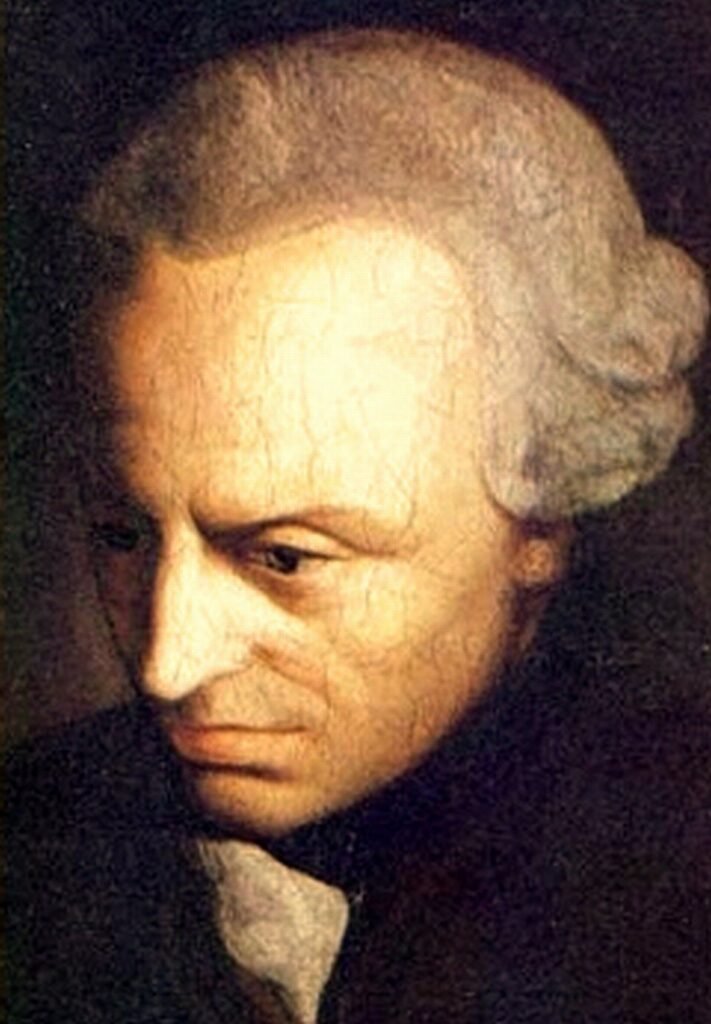
Immanuel Kant (1724 to 1804) was a German philosopher from Königsberg who argued that human knowledge is shaped by the structure of the mind and that moral duty rests on reason alone. His Critique of Pure Reason (1781) reshaped the study of knowledge and reality, and his ethics of duty remains a standard reference point in moral philosophy.
Early life of Immanuel Kant
Kant was born on April 22, 1724, in Königsberg, then the capital of East Prussia and now the Russian city of Kaliningrad. His father was a master harness maker, and his mother was the daughter of one. The family was never destitute, but his father’s trade was in decline during Kant’s youth, and relatives sometimes helped with money.
His parents were Pietists, members of an evangelical Lutheran movement that stressed personal devotion and inner reflection. Kant attended a Pietist school, the Collegium Fridericianum, from age eight to fifteen and disliked its forced soul-searching. He took refuge in the Latin classics. Scholars suggest that his later emphasis on reason and independence may partly reflect that early reaction.
He entered the University of Königsberg, known as the Albertina, where philosophy soon replaced classics as his main interest. His favorite teacher, Martin Knutzen, introduced him to the work of Isaac Newton. Kant’s first publication, in 1747, tried to settle a dispute between followers of Leibniz and followers of Newton over how to measure force.
After his parents died, Kant worked for about six years as a private tutor in the countryside. He returned to Königsberg in 1754 and began teaching at the university the next year. In 1755 he published a book on the origin of the solar system that developed what later became known as the nebular hypothesis, the idea that the Sun and planets formed from a rotating cloud of gas and dust. In 1770, at age 46, he finally became professor of logic and metaphysics. He then published very little for more than a decade, a period often called his silent decade.
Major contributions of Immanuel Kant
Critique of Pure Reason and transcendental idealism
In the early 1770s Kant was shaken by the radical skepticism of the Scottish philosopher David Hume, who questioned whether we can know that one event causes another. Kant spent years working out a reply. The result was the Critique of Pure Reason, published in 1781 and substantially revised in 1787. It asks what we can know independently of experience, which philosophers call a priori knowledge, and where the limits of that knowledge lie.
Earlier philosophers had generally assumed that our knowledge must conform to objects. Kant proposed the reverse: the objects we experience must conform to the way our minds structure experience. He compared this reversal to the revolution Copernicus brought to astronomy, so it is often called Kant’s Copernican revolution.
The result is a position called transcendental idealism. Space, time and basic concepts such as cause and effect are contributions of the mind. We therefore know the world as it appears to us, never as a “thing in itself.” This gives mathematics and natural science a secure footing, because they deal with appearances. It also rules out confident claims about God, the soul or the universe as a whole, which lie beyond possible experience. These questions place Kant at the center of both metaphysics, the study of what exists, and epistemology, the study of how we know.
Moral philosophy
Kant set out his ethics in the Groundwork of the Metaphysics of Morals (1785) and the Critique of Practical Reason (1788). He held that an action has moral worth only when it is done from duty, not from inclination or hope of reward. Moral duties apply as categorical imperatives: commands that bind everyone unconditionally, rather than advice of the form “if you want this, do that.”
His first and best-known formulation says to act only on a maxim, meaning a general rule behind your action, that you could at the same time will to become a universal law. A person who makes a false promise to get money fails this test. If everyone broke promises when convenient, promises would mean nothing, and the rule would defeat itself. A second formulation requires treating humanity, in yourself and in others, never merely as a means but always also as an end. Together these ideas anchor a duty-based approach to ethics that still shapes debates about rights, honesty and human dignity.
Aesthetics, politics and religion
The Critique of the Power of Judgment (1790) completed the set of three critiques. It deals with aesthetics, the philosophy of beauty, and with purpose in nature. In the 1780s and 1790s Kant also wrote essays on history and politics, including An Answer to the Question: What Is Enlightenment? (1784) and Toward Perpetual Peace (1795). The second is one of his main contributions to political philosophy.
His book Religion within the Bounds of Mere Reason (1793) drew a complaint from the Prussian authorities, and Kant promised King Friedrich Wilhelm II not to publish further on religion.
Later years and death
Kant retired from teaching in 1796 at age seventy-two. In his final years, dementia prevented him from completing a last book meant to link his philosophy to physical science. He died in 1804 at age 79. Although he had hoped for a small ceremony, thousands attended his funeral to honor the man they called the sage of Königsberg.
Legacy of Immanuel Kant
The Stanford Encyclopedia of Philosophy calls Kant the central figure in modern philosophy. He combined two earlier traditions, rationalism, which stresses reason as the source of knowledge, and empiricism, which stresses sensory experience. His synthesis set the terms for much of nineteenth and twentieth century philosophy, and it still influences metaphysics, epistemology, ethics, political philosophy and aesthetics today.
The distinction between how things appear and how they are in themselves remains a live question, and the duty-based approach to morality is still one of the main alternatives to judging actions by their consequences.
FAQs
When and where was Immanuel Kant born? He was born on April 22, 1724, in Königsberg, East Prussia, a city now called Kaliningrad in Russia.
What is Immanuel Kant best known for? He is best known for the Critique of Pure Reason, for transcendental idealism and for the categorical imperative, his central principle of ethics.
What is the categorical imperative? It is Kant’s rule that you should act only on principles you could will as universal laws and should treat people as ends in themselves, never merely as means.
More in Philosophy
Key facts
- Kant was born on April 22, 1724, in Königsberg, East Prussia, now Kaliningrad, Russia.1
- He became professor of logic and metaphysics at Königsberg in 1770 and retired from teaching in 1796.12
- The Critique of Pure Reason appeared in 1781 and was revised in 1787.2
- His main ethical works are the Groundwork (1785) and the Critique of Practical Reason (1788).2
- He died in 1804 at age 79.2
Related concepts
Quick checkWhat did Kant mean by a categorical imperative?Show answer
A moral command that binds everyone unconditionally, such as acting only on principles you could will as universal laws.
Sources
- Stanford Encyclopedia of Philosophy, Immanuel Kant, https://plato.stanford.edu/entries/kant/
- Internet Encyclopedia of Philosophy, Immanuel Kant, https://iep.utm.edu/kantview/
Editorially reviewed by Specialty Digest Editorial TeamLast reviewed November 4, 2026Researched and drafted with AI assistanceReport an issue