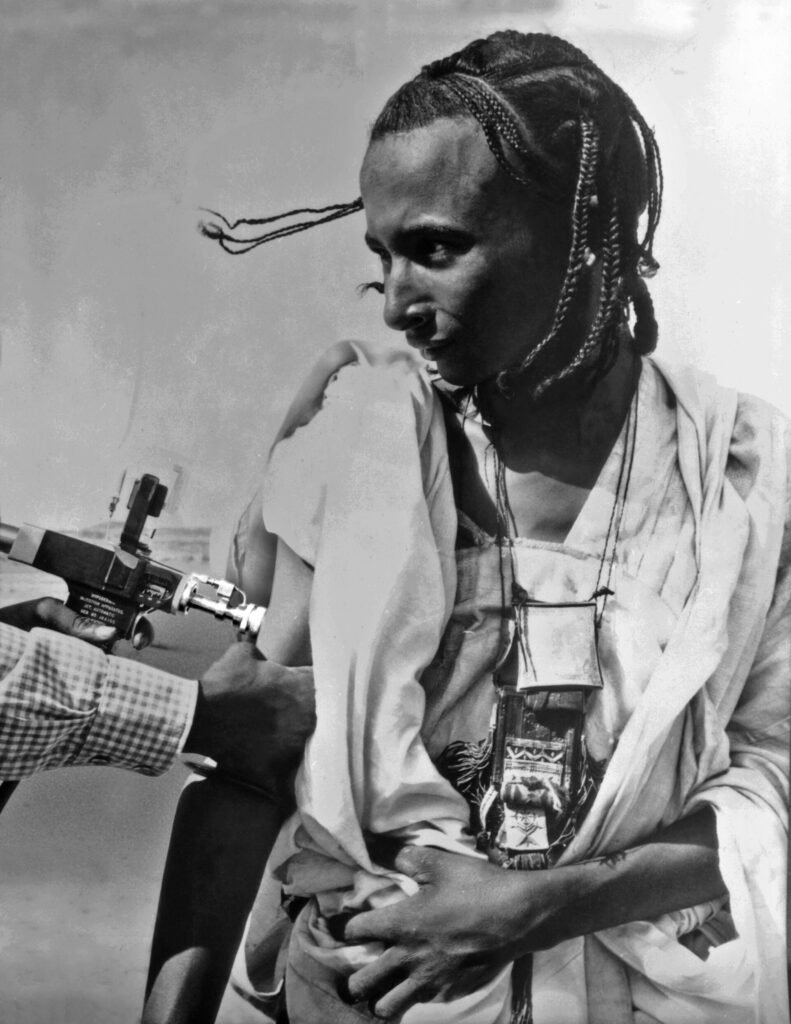
The eradication of smallpox was the worldwide public health campaign that ended natural transmission of the variola virus, which caused smallpox. The last known natural case occurred in Somalia in 1977, and the World Health Assembly declared the world free of the disease on May 8, 1980. According to the World Health Organization (WHO), it remains the only human infectious disease ever eradicated.
Background
Smallpox was an acute, contagious disease caused by the variola virus, a member of the orthopoxvirus family. WHO says it is believed to have existed for at least 3,000 years. Before eradication, about 3 in 10 people who caught it died, according to the CDC, and many survivors were left with permanent scars or blindness.
Early symptoms included high fever, fatigue and severe back pain. Two to three days later a rash began on the face and hands and spread across the body, with bumps that filled with fluid, then pus, then dried into crusts. The incubation period lasted 7 to 17 days, and people became infectious only once fever developed.
Early protection came from variolation, the deliberate exposure of healthy people to material from smallpox sores. It killed fewer people than natural infection but still carried risk. In 1796, the English doctor Edward Jenner observed that milkmaids who had caught cowpox did not catch smallpox, and he showed that inoculation with cowpox could protect other people. This produced the first successful vaccine. By the mid-twentieth century, vaccination had removed smallpox from much of the wealthy world. The CDC records its elimination from North America in 1952 and Europe in 1953, but it kept circulating in South America, Africa and Asia.
The idea of ending the disease everywhere is older than the campaign itself. WHO Director-General Brock Chisholm proposed a worldwide program in 1953, but it was tabled and then dropped, according to Ohio State University’s Origins project. In 1959 the Soviet deputy minister Viktor Zhdanov renewed the proposal, and WHO began a plan that year. The CDC reports that it lacked funds, staff, vaccine donations and national commitment, and smallpox still caused regular outbreaks in 1966. Even so, the share of the world’s people living in endemic regions fell from 59 percent to 31 percent between 1959 and 1966.
What happened
WHO launched the Intensified Eradication Program in 1967. Origins reports that the World Health Assembly approved it by only two votes. More than 50 nations contributed, and the United States and the Soviet Union cooperated despite the Cold War. The program targeted 43 countries with a combined population of more than 1 billion people. Donald A. Henderson, a CDC epidemiologist, led the global effort.
Three developments made the difference, according to the CDC. Laboratories in many endemic countries began producing more and better freeze-dried vaccine. Workers adopted the bifurcated needle, a two-pronged tool that stretches limited vaccine supplies. And countries built case surveillance systems to find outbreaks.
The original plan aimed to vaccinate more than 80 percent of people in endemic countries, a level meant to approach community protection, or herd immunity. Reaching everyone proved impossible where floods, famine, war and migration scattered people. American epidemiologist William Foege helped develop a faster method called surveillance and containment, often described as ring vaccination. Teams searched for cases, isolated patients, and vaccinated their contacts and neighbors, forming a ring of immunity around each outbreak. The method suited smallpox because the disease spread mainly through direct, fairly prolonged face-to-face contact, so a ring could realistically stop a chain of transmission.
Countries became smallpox-free one after another. The CDC lists South America as free by 1971, Asia by 1975 and Africa by 1977. In late 1975, three-year-old Rahima Banu of Bangladesh became the last person to catch the severe form, variola major. Guards were posted at her home, teams vaccinated every house within a 1.5-mile radius, and the program offered a reward to anyone who reported a case.
The last natural case was Ali Maow Maalin, a hospital cook in Merca, Somalia, who had the milder form, variola minor. He rode with two smallpox patients on October 12, 1977, and fell ill on October 22. Health workers first suspected malaria and then chickenpox, and the correct diagnosis came on October 30. He recovered, and Origins reports that about 55,000 people were vaccinated, starting with a network of 90 contacts. No further cases appeared.
One more death followed, and it came from a laboratory. In 1978 Janet Parker, a medical photographer at the University of Birmingham in England, caught smallpox in a building where the virus was studied. She died on September 11, 1978, and is recorded as the last person to die of smallpox.
Aftermath and significance
WHO recommended on October 26, 1979, that smallpox be considered eradicated, and the 33rd World Health Assembly formally accepted that recommendation on May 8, 1980. The CDC says many people consider it the biggest achievement in international public health. Origins describes it as the end of a chain of infection at least 3,500 years long and notes that smallpox may have caused as many as 300 million deaths in the 20th century alone. Such historical death figures are estimates.
The campaign is a landmark case in epidemiology because it showed that finding and containing cases could succeed where mass vaccination alone had fallen short.
Routine vaccination ended after eradication. The CDC says smallpox vaccines are not recommended for the general public today, though health officials would use them to control an outbreak. WHO keeps an emergency vaccine stockpile through its Smallpox Secretariat.
Live variola virus still exists in laboratories. Four countries held stocks in 1981, and by 1984 England and South Africa had destroyed their stocks or transferred them. Two sites now hold the virus under WHO supervision: the CDC in Atlanta, Georgia, and the VECTOR Institute in Koltsovo, Russia. In 1996 the World Health Assembly decided to destroy these stocks by June 1999, but WHO says they have been kept temporarily for essential research, overseen by an advisory committee that meets annually. The CDC calls a deliberate release unlikely, but public health authorities prepare for the possibility. This entry is a historical overview and not medical advice.
FAQs
When was smallpox declared eradicated? The World Health Assembly declared it eradicated on May 8, 1980, after the last natural case in 1977.
Who was the last person to catch smallpox naturally? Ali Maow Maalin of Somalia, in 1977. Rahima Banu of Bangladesh, in 1975, was the last to catch the more severe variola major form.
Does the smallpox virus still exist? Not in nature. Under WHO supervision, live variola virus is held at two laboratories, in Atlanta, Georgia, and Koltsovo, Russia.
Do people still get the smallpox vaccine? The CDC says smallpox vaccines are not recommended for the general public, because the disease has been eradicated.
More in Infectious Diseases
Key facts
- Smallpox was caused by the variola virus and killed about 3 in 10 people who caught it.3
- WHO launched the Intensified Eradication Program in 1967.2
- The last natural case, variola minor in Somalia, began in October 1977.2
- The World Health Assembly declared smallpox eradicated on May 8, 1980.1
- Live variola virus is held at two WHO-supervised laboratories, in Atlanta, Georgia, and Koltsovo, Russia.2
- Ring vaccination, or surveillance and containment, finished the job where mass vaccination alone fell short.4
This entry explains a medical term. It is not medical advice. If you are concerned about your health, speak with a qualified health professional.
Related concepts
Quick checkWhen did the World Health Assembly declare smallpox eradicated?Show answer
On May 8, 1980, about three years after the last known natural case in Somalia.
Sources
- World Health Organization, Smallpox, https://www.who.int/health-topics/smallpox
- Centers for Disease Control and Prevention, History of Smallpox, https://www.cdc.gov/smallpox/about/history.html
- Centers for Disease Control and Prevention, About Smallpox, https://www.cdc.gov/smallpox/about/index.html
- Ohio State University Origins, The WHO and the Eradication of Smallpox, https://origins.osu.edu/read/who-and-eradication-smallpox
Editorially reviewed by Specialty Digest Editorial TeamLast reviewed November 4, 2026Researched and drafted with AI assistanceReport an issue