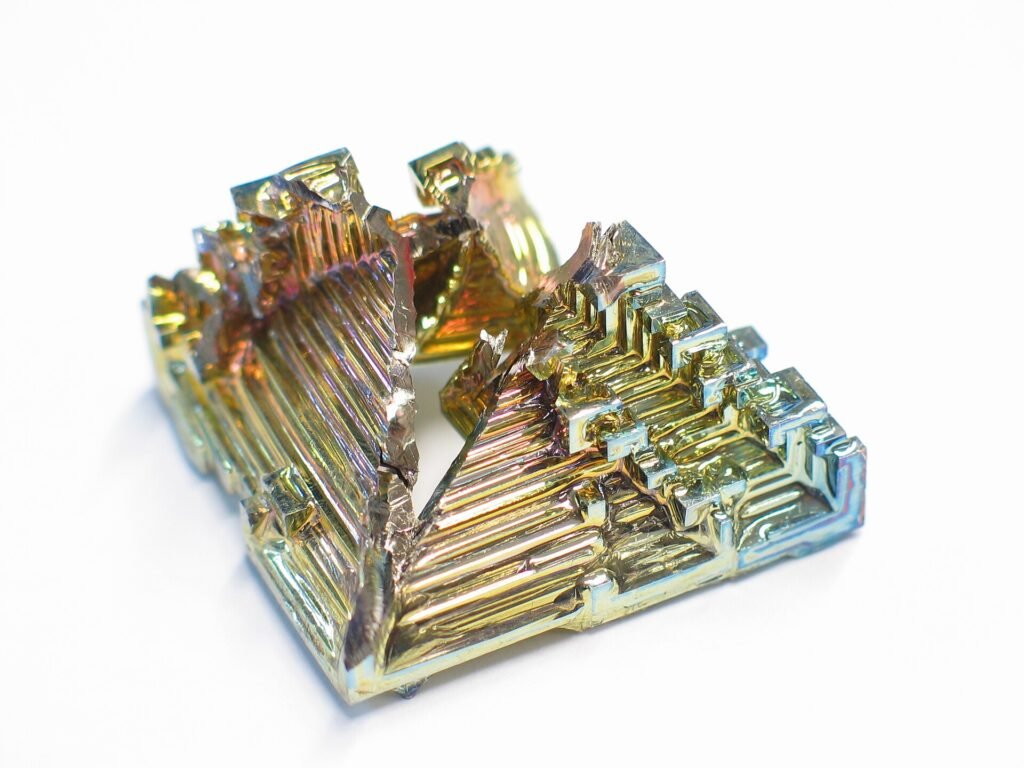
Bismuth is the chemical element with atomic number 83 and the symbol Bi. It is a high-density, silvery metal with a pink tinge, and it is brittle, so it is usually mixed with other metals to make it useful. Bismuth alloys melt at low temperatures and are used in fire detectors and fuses, while bismuth compounds appear in cosmetics, pigments and indigestion remedies.
History of bismuth
Bismuth was discovered by an unknown alchemist around the year 1400. Later that century it was alloyed with lead to make cast type for printers, and decorated caskets were being crafted in the metal. Because the discoverer is unknown, PubChem lists 1753, the year in which the element was finally proved distinct, as its date of discovery.
For centuries bismuth was confused with lead. It was likewise a heavy metal, and it melted at a relatively low temperature, which made it easy to work. Georgius Agricola speculated in the early 1500s that it was a distinctly different metal, and Caspar Neuman did the same in the early 1700s. Proof finally came in 1753 thanks to the work of Claude-Francois Geoffroy.
The Royal Society of Chemistry adds that bismuth was used as an alloying metal in the bronze of the Incas of South America around the year 1500. The metal was not mined as an ore but appears to have occurred as the native metal, meaning in uncombined form.
This sequence is typical of metals that were known long before their chemistry was understood: practical use came first, then speculation about the identity of the metal, and finally proof.
Properties of bismuth
PubChem, drawing on IUPAC data, gives bismuth a standard atomic weight of 208.98040. Its electron configuration is [Xe] 6s2 4f14 5d10 6p3. Bismuth sits in group 15 and period 6 of the periodic table and is classed as a post-transition metal. Its common oxidation states are +5 and +3, the charges its atoms usually carry in compounds. These two states reflect the five electrons in the outer shell, two in the 6s subshell and three in the 6p subshell, which can be given up in different numbers when bismuth forms compounds.
Bismuth is a solid with a density of 9.807 grams per cubic centimeter. It melts at 544.55 kelvin, about 271 degrees Celsius, and boils at 1837 kelvin, about 1564 degrees Celsius. Lead melts at 600.61 kelvin, so bismuth melts at a temperature roughly 56 degrees lower, which fits the way the two metals were once confused but eventually told apart.
The first ionization energy of bismuth, the energy needed to remove one electron from a neutral atom, is 7.289 electronvolts, or about 703 kilojoules per mole. Its electron affinity is 90.924 kilojoules per mole. The Royal Society of Chemistry lists a non-bonded atomic radius of 207 picometers and a covalent radius of 150 picometers. The two sources give electronegativity values of 2.02 and 1.9 on the Pauling scale.
Occurrence and production of bismuth
Native bismuth is found as the metal itself, in the way that gold and platinum can be. Bismuth occurs as the native metal and in ores such as bismuthinite and bismite. The major commercial source of bismuth is as a by-product of refining the ores of lead, copper, tin, silver and gold. That means the supply of bismuth depends on how much of these other metals is mined and refined.
A by-product is a material that is recovered alongside the main product of an industrial process. In this case the metals that are refined for their own value leave residues from which bismuth is then separated.
Uses of bismuth
Bismuth metal is brittle, so it is usually mixed with other metals to make it useful. Brittleness means that the metal breaks instead of bending when it is struck. Its alloys with tin or cadmium have low melting points and are used in fire detectors and extinguishers, electric fuses and solders. In each case the device needs a part that gives way at a modest and predictable temperature.
A fuse is a safety device in an electric circuit that breaks the circuit when too much current flows, and solder is a metal alloy that is melted to join metal parts. Low-melting solders can join components without exposing them to high temperatures.
Bismuth oxide is used as a yellow pigment in cosmetics and paints. Bismuth(III) chloride oxide, with the formula BiClO, gives a pearly effect to cosmetics.
Basic bismuth carbonate is taken in tablet or liquid form for indigestion, and is known as bismuth mixture. As with any medicine, its use is directed by clinicians and pharmacists, and the information here is general background.
Isotopes of bismuth
Bismuth has just one naturally occurring isotope, bismuth-209, which makes up 100 percent of natural bismuth. Like gold, bismuth is therefore a monoisotopic element, and its atomic weight of 208.98040 is essentially the mass of bismuth-209. An isotope is a form of an element whose atoms have the same number of protons but different numbers of neutrons.
The Royal Society of Chemistry lists bismuth-209 as radioactive, decaying by alpha emission with a half-life of 1.9 times 10 to the 19th years. That is more than a billion times the age of the universe, so bismuth behaves as a stable element in every practical sense.
Health and environmental effects of bismuth
The Royal Society of Chemistry states that bismuth has no known biological role and is non-toxic. This distinguishes it from its neighbor lead, which it resembles in weight and appearance but not in its effects on the body.
Bismuth compounds are used in products that people handle, such as cosmetics and indigestion remedies, as the uses described above show. This entry gives general background drawn from reference sources and is not advice.
Key facts
- Bismuth has atomic number 83, symbol Bi, and sits in group 15 and period 6 of the periodic table.2
- Bismuth was proved to be distinct from lead in 1753 by Claude-Francois Geoffroy.1
- Bismuth alloys with tin or cadmium have low melting points and are used in fire detectors and fuses.1
- The major commercial source of bismuth is as a by-product of refining lead, copper, tin, silver and gold ores.1
- Bismuth has one naturally occurring isotope, bismuth-209, which is very weakly radioactive.1
Related concepts
Quick checkWhy was bismuth confused with lead for so long?Show answer
Both are heavy metals that melt at relatively low temperatures and are easy to work. Proof that bismuth is a distinct element came in 1753.
Sources
- Royal Society of Chemistry, Periodic Table: Bismuth, https://periodic-table.rsc.org/element/83/bismuth
- National Center for Biotechnology Information, PubChem Periodic Table: Bismuth (element 83, including IUPAC-sourced atomic weight data), https://pubchem.ncbi.nlm.nih.gov/element/83
Editorially reviewed by Specialty Digest Editorial TeamLast reviewed November 4, 2026Researched and drafted with AI assistanceReport an issue