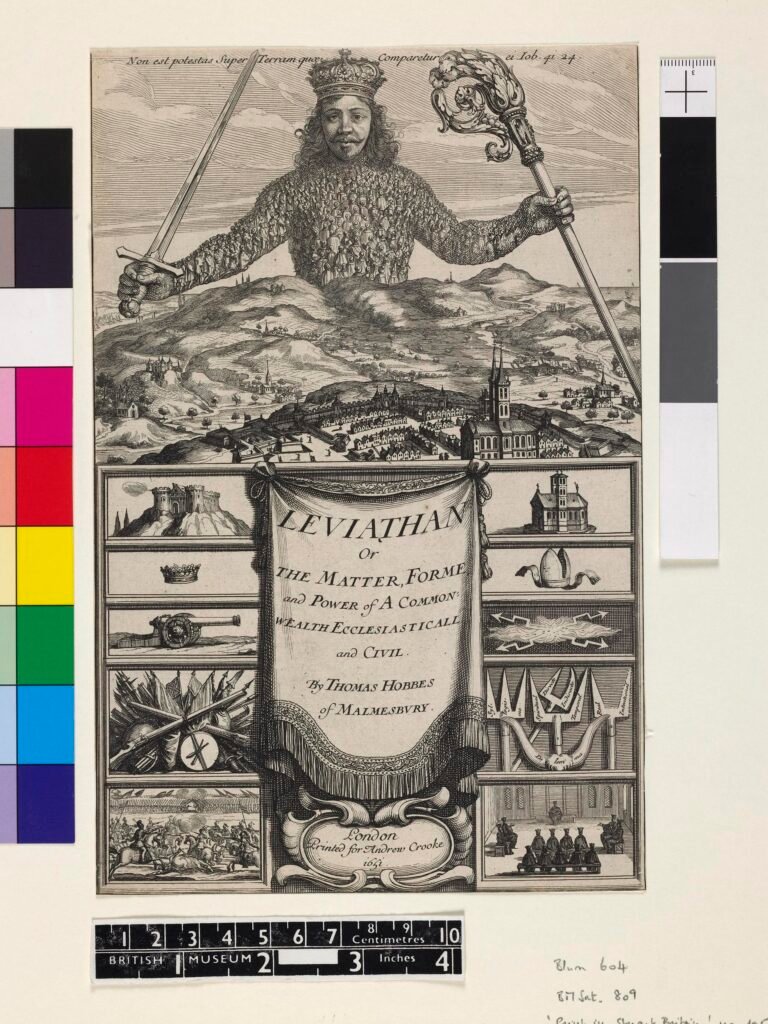
Leviathan is a work of political philosophy by the English thinker Thomas Hobbes, published in London in 1651. It argues that people living without a common authority would fall into constant conflict, and that they should therefore give up some of their freedom to a powerful sovereign who keeps the peace. Its title refers to a biblical sea monster, which Hobbes uses as an image of the state.
Background and creation of Leviathan
Hobbes wrote during the English civil wars, a period when disputes over the powers of king, Parliament and church tore the country apart. He was associated with the royalist side, and he had reason to fear punishment because his political philosophy defended absolute sovereignty. He left England late in 1640 and spent the next decade in exile in Paris, returning in 1651, the year Leviathan appeared.
The first edition was printed in London for the bookseller Andrew Crooke at the sign of the Green Dragon in St. Paul’s Churchyard. Its full title was Leviathan, or the Matter, Forme, and Power of a Common-Wealth Ecclesiasticall and Civill. The dedication is dated from Paris in April 1651 with two dates, 15 and 25 April, reflecting the gap between the English and continental calendars.
The book belongs to a larger project in which Hobbes tried to explain the natural world, human beings and the state from a few first principles about matter and motion. This ambition explains why Leviathan begins with a long study of human sensation and imagination before it turns to politics.
The famous frontispiece, usually attributed to the French engraver Abraham Bosse, shows a giant crowned figure rising above a landscape. His body is made of hundreds of tiny people, and he holds a sword in one hand and a bishop’s staff in the other, a picture of the combined civil and religious power Hobbes thought a sovereign needed.
Structure and arguments in Leviathan
Leviathan is divided into four parts: Of Man, Of Common-Wealth, Of a Christian Common-Wealth, and Of the Kingdom of Darkness. The first part describes human nature. Hobbes argues that thoughts and feelings arise from motions in the body, and he analyzes sense, imagination, speech, reason and the passions in mechanical terms.
The thirteenth chapter, on the natural condition of mankind, is the best-known passage. Hobbes says that people are roughly equal in strength and mind, so no one is safe from rivals. That equality produces competition, distrust and a hunger for reputation, and in a world without a common power the result is a war of everyone against everyone. In that condition, he writes, human life would be “solitary, poor, nasty, brutish, and short.”
To escape this state of nature, people must agree with one another to authorize a single person or assembly to act for all. The second part explains how such a commonwealth is created, whether by agreement among the people themselves or by conquest, and lists the rights of the sovereign, who judges disputes, makes laws and controls public teaching. Subjects, Hobbes argues, keep the right to defend their own lives, which gives the theory a limited protection for individuals.
The third and fourth parts turn to religion. Hobbes claims that Scripture does not conflict with the authority of a Christian sovereign, and he attacks religious claims to independent power, especially clerical and papal power, which he calls the kingdom of darkness.
Themes and interpretation of Leviathan
The main theme is the link between security and obedience. Hobbes argues that obedience is justified because the sovereign protects people from violent death, and that this duty lasts only as long as protection does. Authority therefore rests on consent and self-interest, not on divine right, which made the work radical in an age of kings who claimed to rule by God’s will.
A second theme is a pessimistic but not cruel view of human nature. Hobbes does not claim that people are inherently wicked. He says that in conditions of scarcity and uncertainty, even reasonable people act aggressively because each fears being attacked first. Peace therefore depends on institutions, not on goodwill alone.
Scholars disagree about how to read his legacy. Some stress his absolutism, since he wanted a sovereign whose decisions could not be legally challenged. Others emphasize his individualism, because his state exists to serve the interests of the people who create it. Both readings find support in the text.
Reception and legacy of Leviathan
The book pleased almost no one at first. Royalists disliked a theory that based sovereignty on protection rather than inheritance and God, and many clergy attacked its views on religion. Oxford University condemned the book in 1683, long after Hobbes had published most of his later works.
After returning to England, Hobbes kept publishing philosophical works, including De Corpore in 1655 and De Homine in 1658, and he spent his later years defending his ideas in a series of extended debates. Leviathan nevertheless remained the book by which he was best known, in part because its arguments could be adopted by very different camps within political ideology, from absolutism to liberal individualism.
Even so, Leviathan became a foundation of modern political theory. Later thinkers such as John Locke and Jean-Jacques Rousseau developed social contract theories partly in response to it. It also shaped the realist tradition in the study of international relations, which treats the world as a space of competing states without a higher authority. The word leviathan is now widely used to describe a powerful state or bureaucracy.
More in Government & Politics
Key facts
- Leviathan was first published in London in 1651 by Thomas Hobbes.2
- The first edition was printed for Andrew Crooke at the Green Dragon in St. Paul's Churchyard.2
- Hobbes lived in exile in Paris from late 1640 until 1651, when he returned to England.1
- The book has four parts: Of Man, Of Common-Wealth, Of a Christian Common-Wealth and Of the Kingdom of Darkness.2
- Chapter 13 describes human life in the state of nature as "solitary, poor, nasty, brutish, and short."2
- The dedication is dated from Paris in April 1651.2
Related concepts
In the news
Quick checkWho wrote Leviathan, and what year was it published?Show answer
Thomas Hobbes wrote it, and it was published in 1651.
Sources
- Stanford Encyclopedia of Philosophy, Thomas Hobbes (by Sharon Lloyd and Susanne Sreedhar), https://plato.stanford.edu/entries/hobbes/
- Project Gutenberg, Leviathan by Thomas Hobbes (ebook 3207, title page, dedication, contents and chapter 13), https://www.gutenberg.org/ebooks/3207
Editorially reviewed by Specialty Digest Editorial TeamLast reviewed November 5, 2026Researched and drafted with AI assistanceReport an issue