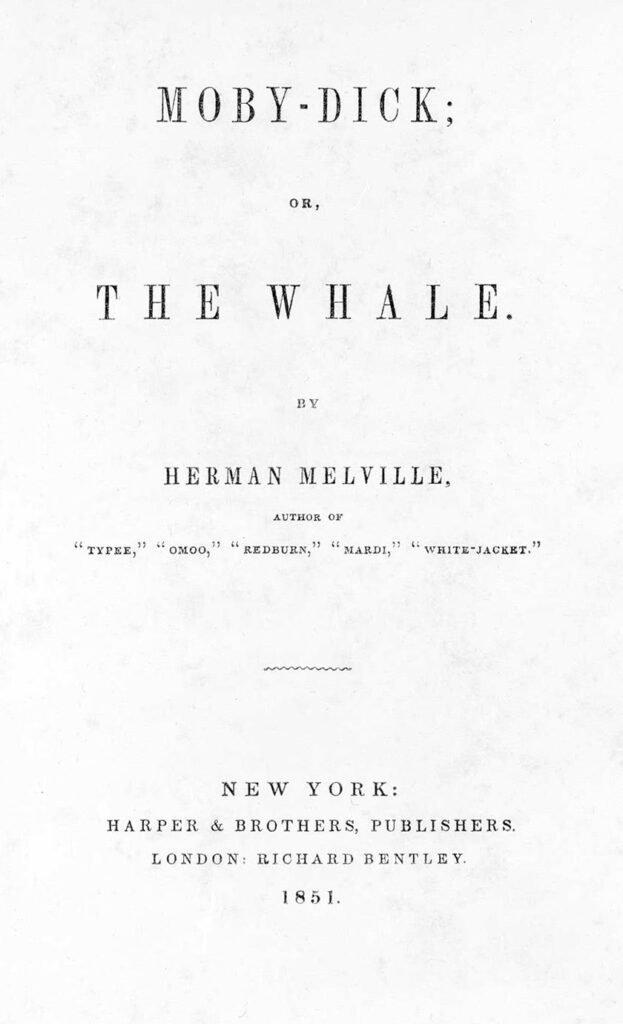
Moby-Dick; or, The Whale is an 1851 novel by the American writer Herman Melville (1819 to 1891). It is narrated by a sailor named Ishmael, who joins the whaling ship Pequod and watches its captain, Ahab, pursue the white sperm whale that took his leg. Part adventure, part encyclopedia of whaling, it is now counted among the greatest American novels.
Background and writing of Moby-Dick
Melville drew on his own experience as a sailor. He had sailed on the whaleship Acushnet, and the New Bedford Whaling Museum notes that, during an exchange of visits between ships at sea, he met a man named Chase who gave him a written account of his father’s experiences on the Essex, a ship sunk by a whale. Melville later wrote that reading the story, so near the latitude of the shipwreck, had a surprising effect on him.
Another source was the tale of Mocha Dick, a famous white whale that was said to have carried twenty harpoons in its body when it was finally captured. These influences fed into the story of a mad captain and his doomed ship.
According to Mystic Seaport Museum, Melville started writing the novel in 1850 at the family home in New York City, then moved that summer to Pittsfield, Massachusetts, to a house called Arrowhead. He worked through the winter in his study there and finished in the spring of 1851.
In Pittsfield he met his neighbor Nathaniel Hawthorne in 1850, and he reportedly made extensive changes to a manuscript that was almost complete. The book is dedicated to Hawthorne in token of admiration for his genius.
Publication of Moby-Dick
The novel was first published in London in 1851 under the title The Whale, in three volumes issued by Richard Bentley. The American edition, titled Moby-Dick; or, The Whale, followed in New York later that year.
The first American printing ran to 2,915 copies, and Melville earned about 1,259 dollars from the book, according to Mystic Seaport. Reviews at first were mixed and sometimes harsh.
Plot summary of Moby-Dick
The story opens with Ishmael, a schoolteacher turned sailor, who goes to sea from New England and shares a bed with the harpooneer Queequeg at an inn in New Bedford. The two become close friends and sign aboard the Pequod, a whaling ship out of Nantucket.
The crew includes the cautious first mate Starbuck, the cheerful second mate Stubb, and harpooneers from several parts of the world. Captain Ahab stays out of sight for days, then announces that he will pursue the whale Moby-Dick, who destroyed his leg on an earlier voyage.
The ship sails through the Atlantic, the Indian Ocean and the Pacific. Along the way it meets other whaling vessels, hunts and kills whales, and stops to process the catch, all while Ahab grows more fixated.
The final chase lasts three days. The whale destroys the Pequod, and Ahab, caught in his own harpoon line, is dragged under. As the New Bedford Whaling Museum summarizes it, only the narrator, Ishmael, survives to tell the story.
Before the voyage begins, the story pauses at a seamen’s chapel in New Bedford, where a preacher delivers a sermon on Jonah and the whale. The scene sets the tone of the book, in which storms, duty to God and the dangers of defiance are never far from the deck of the ship.
Later chapters, such as the one on the whiteness of the whale, show Ishmael trying to explain why a pale animal can inspire such fear. These pauses are central to the book, as they turn a hunting story into a reflection on meaning itself.
Characters in Moby-Dick
Ahab is a commanding, wounded and obsessive figure who turns a commercial voyage into a private mission of revenge. Ishmael is observant, humorous and curious, a narrator who also steps back to discuss whales and the sea.
Queequeg, a skilled harpooneer from a South Pacific island, shows courage and kindness that challenge the prejudices of the time. Starbuck is a decent man who sees Ahab’s danger and cannot stop him, while Stubb treats danger with jokes.
Themes in Moby-Dick
Obsession and revenge are the most obvious themes. Ahab’s quest destroys the ship and nearly the entire crew, and the novel can be read as a tragedy in which a single will drives a community to disaster.
The white whale is also the book’s central symbol. Readers have taken it as nature, fate, evil, or the limits of human knowledge, and Melville keeps its meaning open, so the novel works as an allegory that resists a single reading.
Work, community and the multiethnic crew form another thread. The Pequod’s workers come from many places, and Melville treats whaling as both a dangerous labor and a small society at sea.
Style and structure of Moby-Dick
The book is a great, sprawling work that moves between the main story and digressions on whales, whalecraft and many other subjects, as the New Bedford Whaling Museum describes it. These chapters on whale anatomy, hunting methods and the history of whaling slow the plot, but they also make the sea world vivid and give the voyage its depth.
Melville mixes narrative, drama, sermon and scientific description. The result is a form that does not fit neatly into any one genre of the nineteenth-century novel.
Reception and legacy of Moby-Dick
The mixed first reception contrasts with its later standing. The Whaling Museum notes that critics gave the book mixed, sometimes scathing reviews when it appeared, but that it is today considered one of the greatest of all American novels. A first edition is now valued at more than 60,000 dollars, according to Mystic Seaport.
The novel has inspired films, plays, operas, comics and countless references in other books. Fans mark it with public readings: Mystic Seaport holds a 24-hour Moby-Dick Marathon on the whaleship Charles W. Morgan around Melville’s birthday, and the New Bedford Whaling Museum holds its own marathon each January.
More in Literature
Key facts
- Moby-Dick was published in 1851, first in London as The Whale and then in New York.12
- The first American printing was 2,915 copies, and Melville earned about 1,259 dollars from the book.1
- Melville began writing in 1850 and finished at Arrowhead in Pittsfield, Massachusetts, in the spring of 1851.1
- The story drew on the sinking of the whaleship Essex, of which Melville was given a written account while at sea.2
- Reviews were mixed at first, and the novel is now considered one of the greatest American novels.2
Related concepts
Quick checkWho narrates Moby-Dick?Show answer
A sailor named Ishmael, the only member of the Pequod crew to survive the final encounter with the whale.
Sources
- Mystic Seaport Museum, 5 Things You Didn't Know About Moby-Dick, https://mysticseaport.org/news/5-things-you-didnt-know-about-moby-dick/
- New Bedford Whaling Museum, Art and Literature (Moby-Dick), https://www.whalingmuseum.org/research/research-resources/whaling-history/art-and-literature/
- Project Gutenberg, Moby Dick; Or, The Whale by Herman Melville (ebook record), https://www.gutenberg.org/ebooks/2701
Editorially reviewed by Specialty Digest Editorial TeamLast reviewed November 5, 2026Researched and drafted with AI assistanceReport an issue