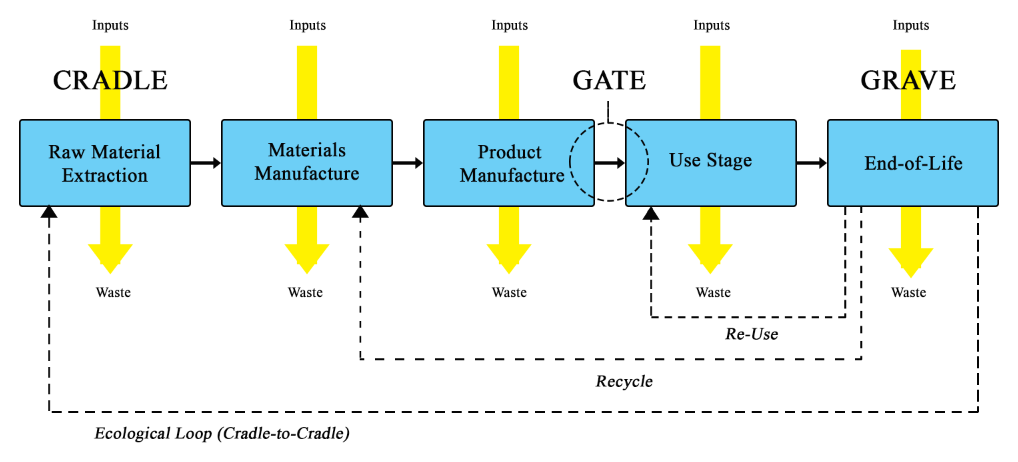
Life cycle assessment, often abbreviated LCA, is a systematic method for evaluating the environmental impacts of a product, process, or service across its entire life span, from raw material extraction through manufacturing, distribution, use, and eventual disposal or recycling. By accounting for impacts at every stage rather than focusing narrowly on a single point, such as the factory gate or the point of use, LCA aims to reveal trade-offs that a more limited analysis might miss entirely.
The method has become a standard tool in environmental policy, corporate sustainability reporting, and product design, allowing comparisons between alternative materials, technologies, or designs on a consistent basis. International standards, particularly those developed by the International Organization for Standardization, have helped establish shared conventions for how these assessments should be structured and reported.
Core Stages of a Life Cycle Assessment
A complete LCA begins with goal and scope definition, in which practitioners specify what question the assessment will answer, what system boundaries apply, and what functional unit will serve as the basis for comparison, such as one kilogram of material produced or one thousand uses of a product. Clear scope definition is essential, since different boundary choices can produce very different results even for ostensibly similar products.
The subsequent life cycle inventory stage compiles detailed data on all material and energy inputs and outputs at each stage of the product system, drawing on industry data, databases, and direct measurement. This inventory then feeds into life cycle impact assessment, which translates raw inputs and outputs into estimated effects across categories such as climate change, water use, and toxicity.
Cradle-to-Grave Versus Cradle-to-Cradle Analysis
A cradle-to-grave assessment traces a product from raw material extraction through final disposal, typically in a landfill or incinerator, capturing the full conventional life cycle of a linear economy product. A cradle-to-cradle assessment, by contrast, extends the analysis to include recycling or repurposing of materials into new products, reflecting circular economy principles that aim to keep materials in productive use rather than treating disposal as the inevitable endpoint.
Choosing between these framings can substantially change the conclusions an assessment reaches, since a product designed for easy disassembly and material recovery may perform much better under a cradle-to-cradle lens than its raw manufacturing footprint alone would suggest.
Common Impact Categories
Global warming potential, usually expressed in terms of carbon dioxide equivalents, is among the most widely reported LCA metrics, but comprehensive assessments typically also evaluate categories such as eutrophication potential, acidification potential, ozone depletion, water scarcity footprint, and various measures of human and ecological toxicity.
Reporting multiple impact categories rather than a single aggregate score helps decision-makers see trade-offs explicitly, since a material that performs well on carbon emissions might perform poorly on water use or toxicity, information that would be lost if results were collapsed into one overall number.
Applications in Product Design and Policy
Manufacturers use LCA findings to guide material selection, packaging design, and manufacturing process choices, often identifying unexpected hotspots where a seemingly minor design element turns out to drive a disproportionate share of total environmental impact. This has led some companies to redesign products specifically around LCA findings rather than relying on intuition about where impacts are likely to occur.
Governments increasingly draw on life cycle thinking when crafting environmental regulations, building codes, and procurement standards, particularly for the sustainability labeling of carbon footprints, embodied carbon in construction materials, and comparative environmental claims used in marketing.
Limitations and Methodological Challenges
LCA results depend heavily on data quality and the specific assumptions built into system boundaries, allocation methods, and functional units, meaning that two assessments of similar products can produce different conclusions if their underlying methodological choices diverge. This sensitivity has sometimes made LCA results a point of contention when competing products or materials are compared in marketing claims.
Data availability also varies considerably by region and industry, with well-established supply chains in wealthy economies generally supported by richer datasets than emerging materials or processes, introducing potential bias into comparative assessments that span different geographic contexts.
Software Tools and Databases
Conducting a rigorous LCA typically requires specialized software platforms that manage the extensive inventory data and apply standardized impact assessment methods consistently, since manual calculation across dozens of inputs and multiple impact categories would be impractical for all but the simplest product systems. These platforms draw on large background databases cataloging the environmental profile of common materials, energy sources, and transportation modes.
Open-access and commercial databases alike are continually updated as underlying industrial processes change, and practitioners must stay attentive to which database version and geographic region a given dataset represents, since using outdated or geographically mismatched data can meaningfully skew results.
Interest in streamlined or screening-level life cycle assessments has grown among smaller organizations that lack the resources for a full study, allowing them to apply the same underlying logic to identify major impact hotspots without committing to the most exhaustive and data-intensive version of the methodology.
FAQ
What is a functional unit in life cycle assessment?
A functional unit is the standardized basis of comparison used in an LCA, such as one liter of beverage packaged or one square meter of flooring installed, allowing different products or materials to be compared fairly on an equivalent basis.
Is life cycle assessment the same as a carbon footprint calculation?
A carbon footprint is typically one output of a broader LCA focused solely on greenhouse gas emissions, while a full life cycle assessment usually evaluates multiple environmental impact categories beyond climate change alone.
Who uses life cycle assessment results?
Manufacturers, policymakers, sustainability certification programs, and corporate buyers all use LCA findings to guide product design, regulation, environmental labeling, and purchasing decisions.
More in Environmental Science
Editorially reviewed by Specialty Digest Editorial TeamLast reviewed November 4, 2026Researched and drafted with AI assistanceReport an issue