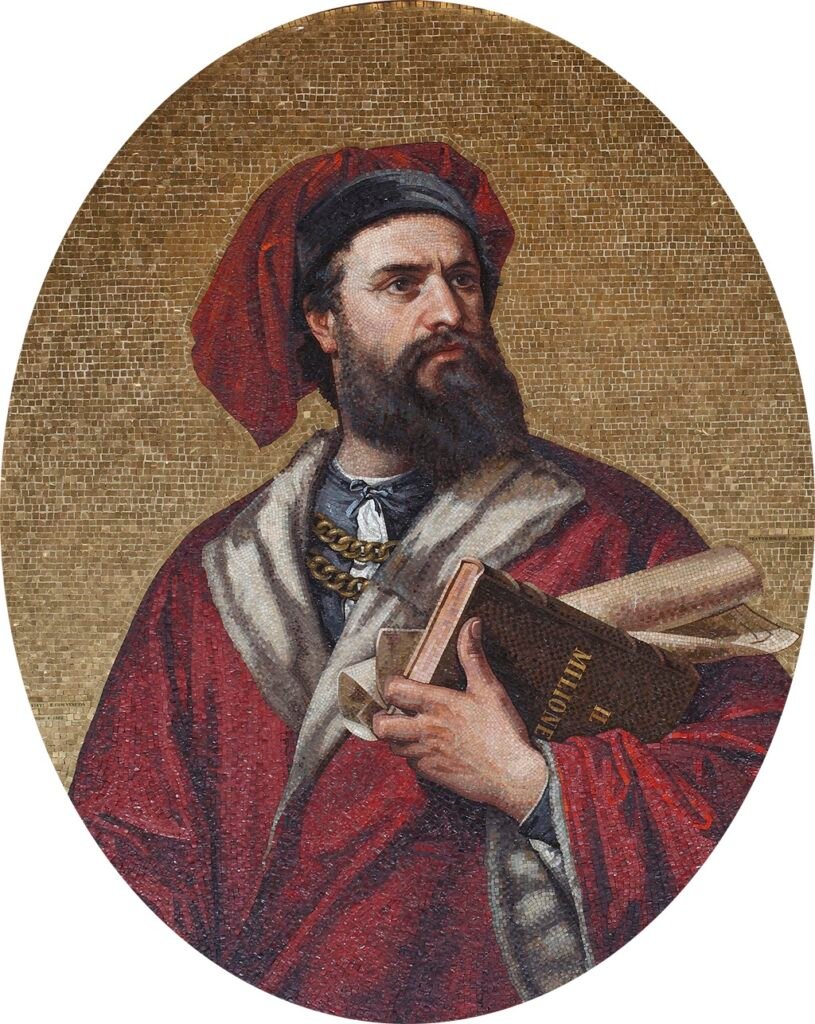
Marco Polo (c. 1254 to 1324) was a Venetian merchant and traveler who spent about 24 years away from Italy, most of them in Asia under Mongol rule. His book about those years, known as The Travels of Marco Polo or Il Milione, gave medieval Europeans their fullest early picture of China, Persia and India.
Early life of Marco Polo
Marco Polo was born around 1254 in Venice, then one of the leading trading ports of the Mediterranean. No document records the exact date. His father Niccolò and his uncle Maffeo were merchants who had left on a trading trip to the East before Marco was born, and relatives raised him in their absence.
His schooling centered on commerce, including foreign currencies, the appraisal of goods and the handling of cargo ships. Niccolò and Maffeo had by then crossed Asia and met Kublai Khan, the Mongol ruler of China. They came home in 1269 and met Marco, by then a teenager, for the first time.
Career and major work
In 1271, when Marco was about 17, he set out with his father and uncle for the Khan’s court. Two friars joined the party at the start, but the hardships of the road turned them back in Armenia. The Polos continued overland through Persia and Central Asia along Silk Road routes, sometimes pausing for months to recover from illness or to wait for an escorted caravan.
After a trek of about three and a half years, they reached Kublai Khan’s summer capital at Shangdu in 1275. Kublai took the young Venetian into his service and used him as an envoy to distant parts of the Mongol domains. Marco learned local languages and kept notes. Some accounts say he served for three years as a deputy governor of Yangzhou, although scholars disagree about what post he actually held.
By his own account the Polos stayed about 17 years in China, and Kublai was reluctant to let them go. The chance came around 1291 or 1292, when they were asked to escort a Mongol princess to Persia, where she was to marry the Mongol ruler Arghun. The party returned by sea, passing Vietnam, Sumatra, Sri Lanka and the Persian Gulf, and the Polos reached Venice in 1295, a year after Kublai Khan died. They had been away for 24 years.
Venice was then at war with its rival Genoa, and Marco served as a sea captain. The Genoese captured him in 1296 or 1298, depending on the source, and during his imprisonment he dictated his recollections to a fellow prisoner, the writer Rustichello of Pisa. Marco later went back to business, married and had three daughters. He died in 1324 and was buried near the church of San Lorenzo in Venice.
The Travels and its contributions
The finished book began to circulate around 1298. It is known in English as The Travels of Marco Polo and in Italian as Il Milione, a name linked to a nickname for Marco or for his branch of the family. Explanations of the nickname differ. About 120 versions of the narrative survive, and the text regarded as most authentic is translated from a 14th-century copy held in the French national library.
The prologue says the book combines what Marco saw himself with what others told him, so it mixes eyewitness description with hearsay. It describes paper money circulating in China and coal burned as household fuel, two practices unfamiliar to Europeans of the time. It also gave Europe names that were new to its readers, among them Cipangu (Japan), Java, Zanzibar and Ceylon, and it described features such as the Takla Makan Desert and the Yangtze River.
Polo was not the first European to reach China, since his father and uncle had gone before him. His account is, however, the best-known detailed record of the trip. It remains useful to historians as a view of Mongol rule and of trade across Asia in the late 13th century, as long as it is read with the caution that applies to any medieval text. His rendering of the name Cathay, derived from the Khitan people, became the usual European name for China for centuries.
Doubts about Marco Polo’s account
From early on, some readers thought the book exaggerated. It contains fantastic tales, including men with the features of dogs. Critics also point to omissions. Polo does not mention chopsticks, tea or the binding of girls’ feet. He does not mention the Great Wall, although the sections that existed in his day were in poor repair, and the wall was strengthened later under the Ming dynasty. Other omissions, such as Chinese writing and woodblock printing, are harder to explain.
The British sinologist Frances Wood pressed these gaps in her 1995 book Did Marco Polo Go to China? The case against her is that Polo’s itineraries, as laid out by the order of his chapters, are fundamentally accurate across Central Asia and China, and no one has shown that he copied them from an Arab or Chinese source. Doubts over place names have also been answered in part by Chinese records and archaeology. Most historians accept that he traveled in Asia, while treating individual details with care.
Some popular claims about Polo are myths. He did not bring pasta or ice cream to Italy. A well-known legend says he answered a request on his deathbed to admit that his book was false by saying he had not told even half of what he had seen. The story is a legend, not a documented fact.
Legacy of Marco Polo
The book was widely copied and translated, and it shaped how Europeans imagined the East. A surviving copy owned by Christopher Columbus carries marginal notes beside the passages about gold and red pearls in Cipangu, although scholars are unsure the handwriting is Columbus’s own. Columbus never came near Japan, and the golden palace Polo described has never been identified.
For readers today, Marco Polo stands as an early example of a merchant who became a writer on geography and culture. His reputation rests on the record of a long trip across Asia, not on every detail of the text. Venice honors him with a plaque on the site where his house stood, and the area nearby carries the name Corte del Milion.
Key facts
- Marco Polo was born around 1254 in Venice and died in 1324.1
- He left Venice for Asia in 1271 and returned in 1295 after 24 years away.1
- He reached Kublai Khan court at Shangdu in 1275 and served the Mongol ruler.1
- He dictated his book to Rustichello of Pisa while held by the Genoese.1
- Critics point to omissions such as tea and chopsticks, while others find his itineraries accurate.2
Related concepts
Quick checkDid Marco Polo really travel to China?Show answer
Most historians think he did. Critics note omissions such as chopsticks and tea, but his routes across Asia are broadly accurate and no source shows he copied them.
Sources
- World History Encyclopedia, Marco Polo, https://www.worldhistory.org/Marco_Polo/
- Smithsonian Magazine, Wonders and Whoppers, https://www.smithsonianmag.com/travel/wonders-and-whoppers-27166/
Editorially reviewed by Specialty Digest Editorial TeamLast reviewed November 4, 2026Researched and drafted with AI assistanceReport an issue