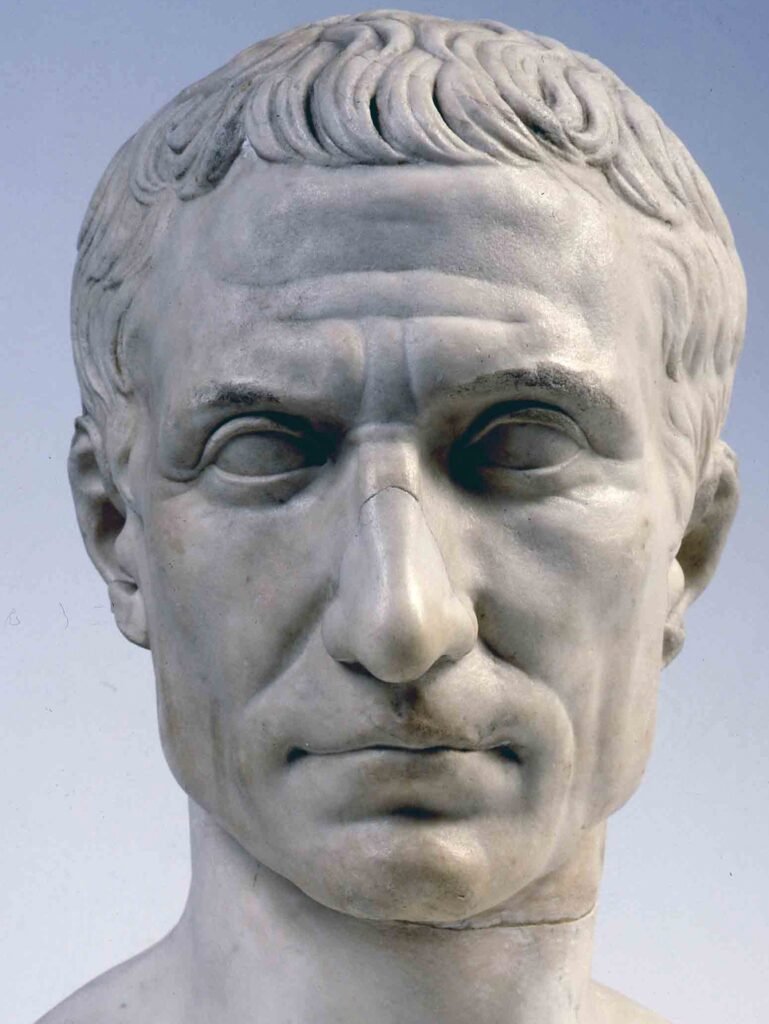
Gaius Julius Caesar was a Roman general, statesman and writer who lived from 100 BCE to 44 BCE. He conquered Gaul, won a civil war against his rival Pompey and became dictator of Rome. A group of senators assassinated him on 15 March 44 BCE, and the civil wars that followed ended the Roman Republic.
Early life of Julius Caesar
Caesar was born on 12 July 100 BCE, although the World History Encyclopedia notes that some sources give 102 BCE. His father, also named Gaius Julius Caesar, was a praetor who governed the province of Asia, and his mother, Aurelia Cotta, came from a noble family. Both parents favored the populares, the political tradition that supported broader rights for ordinary Romans, as opposed to the optimates, who defended the privileges of the nobility.
Caesar married Cornelia, the daughter of Lucius Cinna, a prominent populare leader. When the Roman ruler Sulla made himself dictator and purged his enemies, particularly the populares, Caesar’s connections put him at risk. After Cornelia died, Caesar married Pompeia, a granddaughter of Sulla, and he rose steadily through public office in Rome.
Career and major work of Julius Caesar
In 60 BCE Caesar made a political agreement with Pompey and the wealthy Marcus Licinius Crassus, which modern historians call the First Triumvirate. It was not a formal office, and the Romans did not use that name. Caesar became consul and pushed through measures favored by his partners, including land for the poor. He married Calpurnia, and his daughter Julia married Pompey to strengthen the alliance.
In 58 BCE Caesar left Rome for Gaul, where he defeated a number of tribes and secured the borders of the Roman provinces. He twice invaded Britain, the first Roman crossing to the island, and in 52 BCE he defeated the Gallic leader Vercingetorix at the Battle of Alesia, completing the conquest of Gaul. According to Suetonius, he wrote his own accounts of the Gallic War and of the civil war with Pompey. The authorship of the accounts of the wars in Alexandria, Africa and Spain is unknown.
After Julia died, the link between Caesar and Pompey weakened, and Pompey sided with the senate. When Caesar was ordered to return to Rome, he instead crossed the Rubicon River, the boundary of his province, with his legions in 49 BCE. This was an act of war. Suetonius describes him pausing at the river, aware of the step he was taking.
Caesar defeated Pompey at the Battle of Pharsalus in 48 BCE. Pompey fled to Egypt, where he was killed on landing. Egypt thus became part of the civil war. Caesar followed, became involved in the conflict between Cleopatra and her brother, and supported her claim to the throne. In 46 BCE he defeated the remaining opponents at Thapsus, in North Africa, and returned to Rome as its master.
Reforms and contributions of Julius Caesar
In 44 BCE Caesar was granted the title Dictator Perpetuus, meaning dictator for life. The World History Encyclopedia says he never held the title of emperor, despite a common belief. He proposed reforms of government and the tax system and carried out land redistribution, many of which had long been goals of the populares.
His best-known reform concerned the calendar. Suetonius reports that the old Roman year had 355 days and that the shortfall was made up by inserting an extra month after February, which the priests had managed poorly. Caesar reorganized the system, and the resulting calendar, with a 365-day year and a leap day every fourth year, is known as the Julian calendar. It remained the basis of the Western calendar for centuries.
Caesar also wrote. His accounts of his campaigns are among the best-known works of Latin prose. They are both a historical record and a political document, written by a leader with a stake in how his actions were viewed.
Assassination of Julius Caesar
Many senators, especially among the optimates, feared that Caesar was becoming too powerful and might abolish the senate and rule as a king. On 15 March 44 BCE, the Ides of March, he was assassinated in the Roman senate. Suetonius says the meeting took place in Pompey’s Hall, and the World History Encyclopedia says the attackers included Marcus Junius Brutus and Gaius Cassius Longinus.
Suetonius reports that Caesar was stabbed with 23 wounds. He cites the physician Antistius as saying that only the second wound, in the chest, would have been fatal. The conspirators had no plan for what to do afterward and let Mark Antony, Caesar’s cousin and right-hand man, live. Antony turned public opinion against the killers and, allied with Caesar’s heir, Octavian, defeated Brutus and Cassius at the Battle of Philippi in 42 BCE.
Legacy of Julius Caesar
Caesar named his grandnephew Octavian as heir, rather than the son he had with Cleopatra. Octavian eventually became the first Roman emperor, taking the name Augustus. The family name Caesar then became a title of Roman emperors and, through them, entered later languages in forms such as Kaiser and tsar. The month of July is named for Julius Caesar.
The Julian calendar influenced European timekeeping for more than 1,500 years. His campaigns extended Roman power over Gaul, and his civil war showed that an army loyal to its commander could decide the fate of the state.
Controversies and criticism of Julius Caesar
Caesar remains a divisive figure. Supporters point to his reforms and to his policies for the poor. Critics argue that he broke the law by marching on Rome, destroyed the republican system, and took power through force. His opponents, including Brutus and Cassius, claimed they acted to defend the republic.
The conquest of Gaul and the invasion of Britain were wars of expansion, motivated in part by wealth and glory, as the World History Encyclopedia notes. Because Caesar himself wrote the main account, historians read it with caution and compare it with other evidence.
Key facts
- Gaius Julius Caesar was born on 12 July 100 BCE, though some sources give 102 BCE.1
- He conquered Gaul between 58 and 52 BCE and defeated Vercingetorix at Alesia in 52 BCE.1
- He crossed the Rubicon in 49 BCE and defeated Pompey at Pharsalus in 48 BCE.1
- He was assassinated on 15 March 44 BCE, and Suetonius reports 23 wounds.2
- He reformed the Roman calendar, producing what is known as the Julian calendar.2
Related concepts
In the news
Quick checkWhen and how did Julius Caesar die?Show answer
He was assassinated by a group of senators on 15 March 44 BCE in Rome, stabbed with 23 wounds according to the ancient writer Suetonius.
Sources
- World History Encyclopedia, Julius Caesar, https://www.worldhistory.org/Julius_Caesar/
- Suetonius, Lives of the Caesars: Divus Julius, translated by J. C. Rolfe (Loeb Classical Library), LacusCurtius, https://penelope.uchicago.edu/Thayer/E/Roman/Texts/Suetonius/12Caesars/Julius*.html
Editorially reviewed by Specialty Digest Editorial TeamLast reviewed November 4, 2026Researched and drafted with AI assistanceReport an issue