Moundville Archaeological Park is a 185-acre Mississippian site on the Black Warrior River, about 14 miles south of Tuscaloosa in Hale County, Alabama. Founded around 1120, it contains 29 earthen mounds ranging from 3 to 57 feet high, and by 1300 it was the largest town in what is now Alabama [1]. Today the University of Alabama Museums administers the park and its museum. This entry explains who built the site, how it was used, how archaeologists have studied it and how to visit.
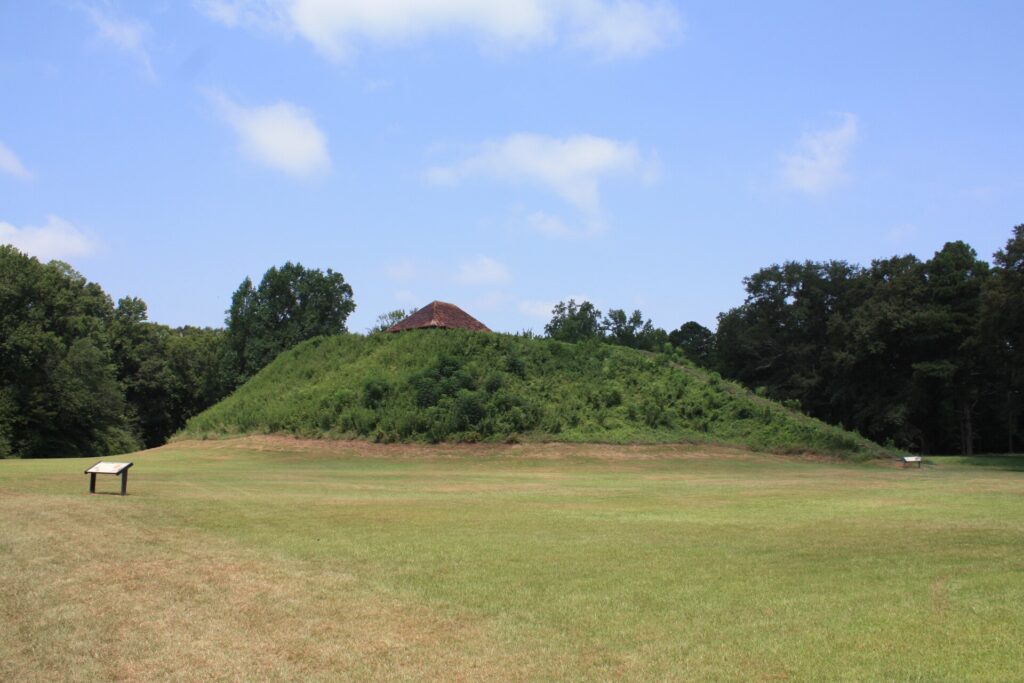
| Location | Black Warrior River, Hale County, Alabama |
|---|---|
| Area | 185 acres |
| Mounds | 29, from 3 to 57 feet high |
| Founded | About 1120 |
| Largest town in Alabama | By 1300 |
| Excavated share | About 14 percent |
| Designation | National Historic Landmark, 1964 |
| Administered by | University of Alabama Museums |
Who built Moundville?
Moundville was built by Mississippian peoples, farming communities who lived in the Southeast from about 1000 to 1550 CE. The people grew corn, beans and squash, organized themselves into chiefdoms, and built flat-topped earthen mounds as platforms for buildings and ceremonies. The Alabama people were part of the Moundville chiefdom, according to the Encyclopedia of Alabama, and other Native nations of the region may also trace their ancestry to Mississippian towns [1][2].
The town and its mounds
The site was laid out around a large central plaza, with mounds arranged around it, and a wall enclosed the town. Archaeologists estimate that about 1,000 people lived inside the wall, although more lived in surrounding farms. Between 1300 and 1450, most inhabitants left, and the mounds fell out of use, though the site remained a place of burial and memory. It was abandoned in the sixteenth century. The mounds vary in size, with the tallest rising 57 feet [1][3].
Craft and ritual
Objects found at Moundville include decorated pottery, copper, shell and stone ornaments, and engraved motifs showing hands, eyes, falcons and serpents. These images connect the site to a wider religious and artistic network across the Southeast, described in Mississippian Culture in Alabama. They suggest a society with leaders, craft specialists and shared ritual life [2][3].
History of study
Nathaniel T. Lupton mapped the site in 1869. In 1915, Alabama passed an antiquities law to protect archaeological sites. Walter B. Jones and David L. DeJarnette began the first scientific excavations in 1929, and Mound State Park was established in 1933. From 1933 to 1941 the Civilian Conservation Corps assisted with excavation of about 500,000 square feet, more than 2,000 burials and 75 house remains. Only about 14 percent of the site has been excavated, so much remains to be learned [1].
The museum and park
Today the park includes the Jones Archaeological Museum, which was renovated at a cost of $5 million and reopened in May 2010. About 40,000 people visit the park each year. A Native American festival is held at the park every fall. The site is designated a National Historic Landmark (1964), and it is protected under state and federal law [1][3].
Visiting and respectful behavior
Visitors can walk among the mounds, visit the museum and attend programs. The mounds are protected archaeological features, and removing objects from the site is not allowed. Because Moundville includes burial areas, visitors are asked to treat the site with respect. Visitors should check the University of Alabama Museums website for hours and fees [3].
Place in Alabama’s history
Moundville is the best-known archaeological site in Alabama, and it anchors the story of Native peoples before Europeans arrived. Read it alongside Indigenous Peoples of Alabama (Overview) and the main Alabama profile, which introduces the site to general readers [1].
FAQs
Where is Moundville? On the Black Warrior River in Hale County, about 14 miles south of Tuscaloosa.
How old is Moundville? It was founded around 1120 and was occupied for more than three centuries.
How many people lived at Moundville? About 1,000 behind its walls, according to archaeological estimates.
Who runs Moundville? The University of Alabama Museums.
Is it a National Historic Landmark? Yes, since 1964.
Sources
- Encyclopedia of Alabama: Moundville Archaeological Park
- Encyclopedia of Alabama: Mississippian Period
- University of Alabama Museums: Moundville Archaeological Park: Ancient Site
More in Archaeology
Key facts
Quick checkHow many mounds are at Moundville?Show answer
Twenty-nine, ranging from 3 to 57 feet high.
Sources
- Encyclopedia of Alabama. Moundville Archaeological Park. n.d. (accessed 2026-11-10)
- Encyclopedia of Alabama. Mississippian Period. n.d. (accessed 2026-11-10)
- University of Alabama Museums. Moundville Archaeological Park: Ancient Site. n.d. (accessed 2026-11-10)
Editorially reviewed by Specialty Digest Editorial TeamLast reviewed November 10, 2026Researched and drafted with AI assistanceReport an issue