Indigenous peoples of Alabama have lived in the region for more than 10,000 years, from the Paleoindian period through the present day. By the 1500s, several historic nations had formed, including the Cherokee, Choctaw, Creek (Muscogee) and Chickasaw, along with smaller groups such as the Alabama, Koasati (Coushatta) and Yuchi peoples [1]. The most visible traces of the deep past are earthen mounds, especially at Moundville. This overview follows the story from the earliest settlers to the nations that live in and beyond the state today.
| Time depth | More than 10,000 years |
|---|---|
| Main historic nations | Creek (Muscogee), Cherokee, Choctaw, Chickasaw |
| Smaller groups | Alabama, Koasati (Coushatta), Yuchi |
| Language family | Muskogean (most nations except Cherokee and Yuchi) |
| Federally recognized in Alabama | Poarch Band of Creek Indians |
| Major archaeological site | Moundville Archaeological Park |
The first peoples
Archaeologists divide the deep past into periods named for changes in technology and way of life. The Paleoindian period is the earliest, followed by the Archaic, Woodland and Mississippian periods. Early groups hunted and gathered, and over time they made pottery, built burial mounds and began to grow crops such as corn, beans and squash. Sites such as Russell Cave in the northeast show use across thousands of years [1].
Mound builders
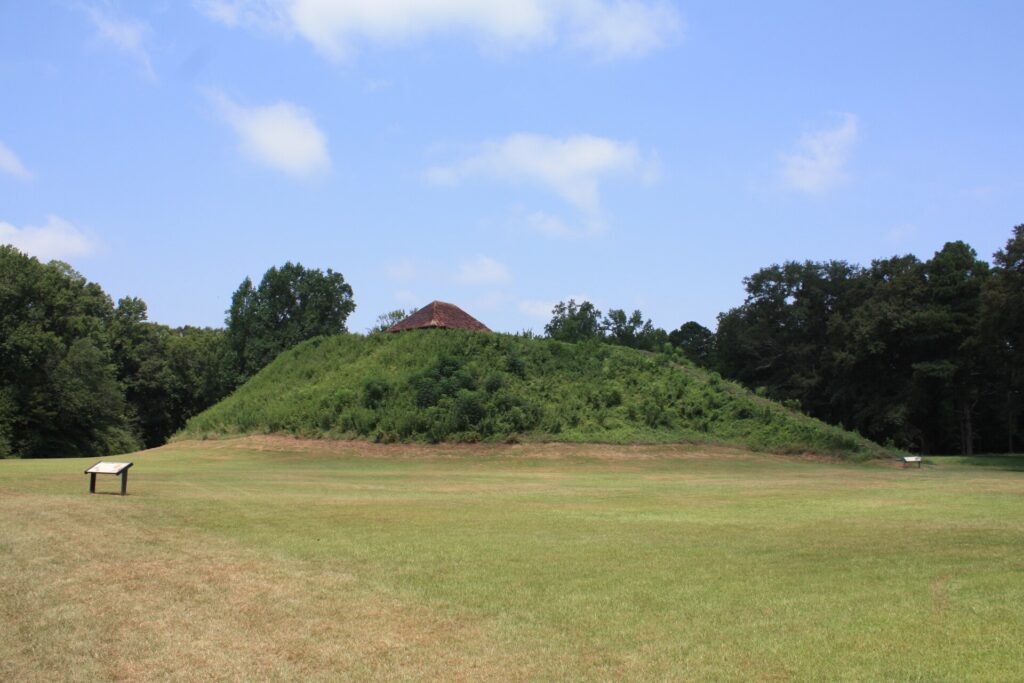
The Woodland period (about 1000 BCE to 1000 CE) brought burial mounds and trade over long distances. In the Mississippian period, from about 1000 to 1550 CE, farming communities organized into chiefdoms and built large flat-topped platform mounds around plazas. Moundville, on the Black Warrior River, is the largest such site in Alabama. These societies are the ancestors of many historic nations, and their story is told in Mississippian Culture in Alabama and Moundville Archaeological Site [3][6].
Historic nations
By the time Europeans arrived in strength, several nations occupied what is now Alabama. The Creeks, a confederacy of many towns, lived along the Coosa, Tallapoosa and Chattahoochee rivers. The Cherokees lived in the northeast, the Chickasaws in the northwest, and the Choctaws in the west and southwest. The Alabama and Koasati peoples lived in towns near the meeting of the Coosa and Tallapoosa rivers, and the Yuchi lived in several scattered communities [1][2][3][4][5].
Contact and change
The expedition led by Hernando de Soto in the early 1540s brought violence and European diseases that devastated many towns. In later centuries, trade with French, British and Spanish colonists changed everyday life, as nations exchanged deerskins for metal tools, cloth and guns. The nations also took part in colonial wars and, later, in the conflicts of the early United States, including the Creek War of 1813 and 1814 [1][2].
Treaties and removal
During the early 1800s, the United States negotiated a series of treaties that transferred Native land. Key agreements include the First Treaty of Washington (1805), the Treaty of Indian Springs (1825), the Treaty of Dancing Rabbit Creek (1830) and the Treaty of Cusseta (1832). After the Indian Removal Act of 1830, most Native people in Alabama were forced to move to Indian Territory, in what is now Oklahoma. The Cherokee removal began in 1838, and the Chickasaws, Choctaws and Creeks left in the 1830s [1][3][4][5].
Native nations today
Many descendants remained or later returned. The Poarch Band of Creek Indians, headquartered near Atmore, is the only federally recognized tribe in Alabama. The MOWA Band of Choctaw Indians in Mobile and Washington counties and several Cherokee groups hold state recognition. Large citizen populations of the Muscogee (Creek), Cherokee, Choctaw and Chickasaw nations live in Oklahoma, and the Alabama-Coushatta communities live in Texas, Louisiana and Oklahoma [2][3][4][7][8].
Lasting influence
Native heritage remains visible across the state. Place names such as Tuscaloosa, Tallapoosa, Coosa, Cheaha and the state’s own name come from Native languages; see Etymology of the Name Alabama and Mount Cheaha. Museums, festivals and parks teach Native history, including a fall festival at Moundville. The state’s broader story, from the first settlements to statehood, is in the main Alabama profile [1].
Terms and respectful usage
Writers use several terms for the first peoples of the continent, including Native American, American Indian and Indigenous. Most Native people prefer to be identified by the name of their own nation, such as Muscogee (Creek), Cherokee or Choctaw, when that is known. It is also helpful to write about Native peoples in the present tense where appropriate, because these nations continue to hold governments, languages and cultural practices. Where sources differ on dates or population numbers, this section follows the Encyclopedia of Alabama and notes the source [1].
Where to learn more
Museums and parks across Alabama teach Native history. Moundville Archaeological Park, run by the University of Alabama Museums, has a museum and a fall festival. Russell Cave National Monument in the northeast, managed by the National Park Service, interprets thousands of years of use. Horseshoe Bend National Military Park marks the 1814 battle that ended the Creek War. The Poarch Band of Creek Indians maintains a museum on its reservation. The Encyclopedia of Alabama collection on Native peoples lists dozens of articles on nations, sites, leaders, treaties and traditions such as the Green Corn Ceremony and stomp dances [1][7].
FAQs
How long have Native people lived in Alabama? For more than 10,000 years.
Which nations lived in Alabama? Mainly the Creek, Cherokee, Choctaw and Chickasaw, along with the Alabama, Koasati and Yuchi peoples.
Is there a federally recognized tribe in Alabama? Yes. The Poarch Band of Creek Indians is the only one.
What was the Indian Removal Act? A federal law of 1830 that led to the forced relocation of southeastern nations to Indian Territory.
Where is the largest mound site? Moundville, on the Black Warrior River.
Sources
- Encyclopedia of Alabama: Indigenous Alabamians (collection)
- Encyclopedia of Alabama: Creeks in Alabama
- Encyclopedia of Alabama: Cherokees in Alabama
- Encyclopedia of Alabama: Choctaws in Alabama
- Encyclopedia of Alabama: Chickasaws in Alabama
- Encyclopedia of Alabama: Mississippian Period
- Encyclopedia of Alabama: Poarch Creek Indians
- Encyclopedia of Alabama: Alabama-Coushattas in Alabama
More in Anthropology
Key facts
Quick checkHow long have Native peoples lived in Alabama?Show answer
For more than 10,000 years.
Sources
- Encyclopedia of Alabama. Indigenous Alabamians (collection). n.d. (accessed 2026-11-10)
- Encyclopedia of Alabama. Creeks in Alabama. n.d. (accessed 2026-11-10)
- Encyclopedia of Alabama. Cherokees in Alabama. n.d. (accessed 2026-11-10)
- Encyclopedia of Alabama. Choctaws in Alabama. n.d. (accessed 2026-11-10)
- Encyclopedia of Alabama. Chickasaws in Alabama. n.d. (accessed 2026-11-10)
- Encyclopedia of Alabama. Mississippian Period. n.d. (accessed 2026-11-10)
- Encyclopedia of Alabama. Poarch Creek Indians. n.d. (accessed 2026-11-10)
- Encyclopedia of Alabama. Alabama-Coushattas in Alabama. n.d. (accessed 2026-11-10)
Editorially reviewed by Specialty Digest Editorial TeamLast reviewed November 10, 2026Researched and drafted with AI assistanceReport an issue