Mississippian culture was a tradition of farming societies in the eastern United States between about 1000 and 1550 CE. In Alabama it appeared around 1100 CE and produced towns with earthen platform mounds, powerful chiefs, fine pottery and a distinctive religious art [1]. Moundville, on the Black Warrior River, is the state’s largest Mississippian site. Mississippian peoples are ancestors of many Native nations, including the Creeks, Alabama and Koasati. This entry explains how these societies lived, what they left behind and why their big towns declined.
| Time range | About 1000 to 1550 CE (reached Alabama about 1100 CE) |
|---|---|
| Main crops | Corn, beans, squash, sunflowers |
| Political form | Chiefdoms with inherited rank |
| Typical mound | Flat-topped platform under about 10 feet |
| Largest Alabama site | Moundville, 29 mounds |
| Decline | Largest sites declining by about 1450 |
| End of the tradition | After de Soto’s expedition, 1540 |
Farming and food
The Mississippian way of life rested on agriculture. Farmers grew corn, beans, squash and sunflowers, and the corn crop produced a storable surplus that let populations grow. Fields were cleared by burning and abandoned after a few seasons, since farmers did not use fertilizer. People also hunted deer, fished and gathered nuts and wild plants. A food surplus allowed some people to specialize in crafts, trade or ceremonial duties [1].
Mounds and towns
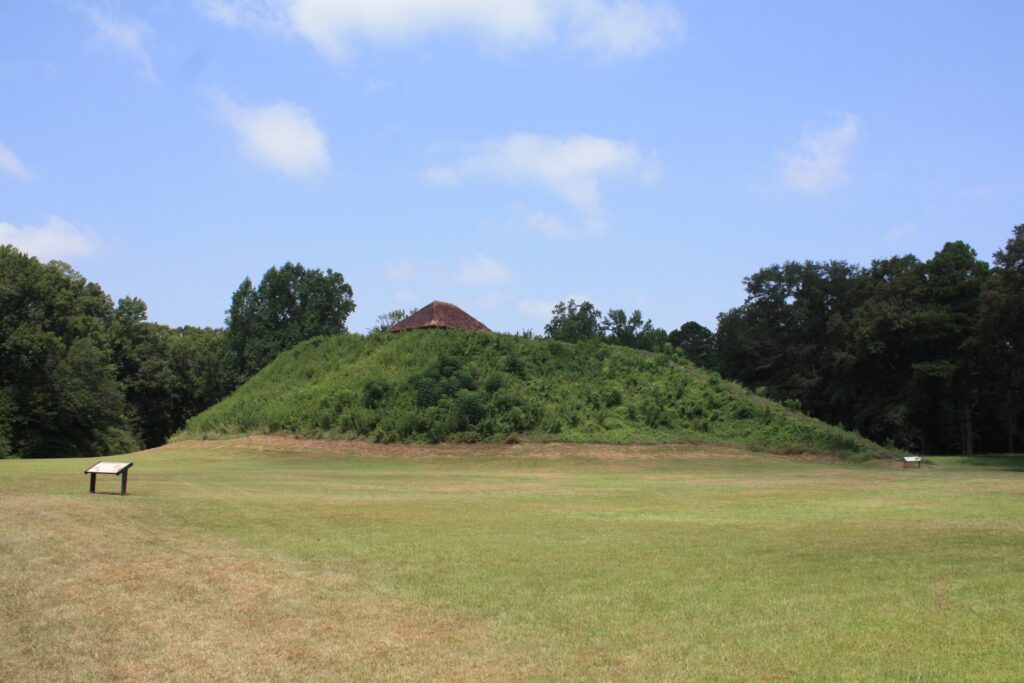
Most Mississippian mounds were flat-topped earthen platforms less than ten feet high, built to hold the houses of leaders or temples. The largest known mound, about 100 feet high, stands at Cahokia in Illinois. Alabama’s biggest site is Moundville, which has 29 mounds around a central plaza. A town was a ceremonial and political center, and a plaza served as a gathering place for dances, games and councils [1][2]. The site is the subject of Moundville Archaeological Site.
Chiefdoms
Mississippian society was organized into chiefdoms. Rank was usually inherited, though achievement could also win prestige. Powerful chiefs lived in capital towns, and smaller settlements paid them tribute in food and goods. Historians stress that these were towns led by chiefs, not cities ruled by kings and queens. The Alabama people, for example, were part of the Moundville chiefdom [1][3].
Pottery and art
Most Mississippian vessels are plain, but some have incised or stamped designs, lustrous black finishes, or paint in red, white and black. Common shapes include kettle-shaped cooking jars, bowls and bottles. Some pots are effigies in the form of animals or people, and some serving vessels have handles shaped like animal heads and tails. Copper, shell and pottery carry religious imagery such as weapons, falcons and winged serpents, which links Alabama sites to a wider network of belief across the Southeast [1].
Other Alabama sites
Besides Moundville, important Alabama sites include Lubbub Creek near Aliceville, with one mound; Koger’s Island and the Perry site along the Tennessee River near Florence; the area around Fort Toulouse and Fort Jackson near Wetumpka; and Bottle Creek in the Mobile-Tensaw River Delta near Stockton. Each shows a different part of a regional pattern of towns linked by rivers [1].
Decline and descendants
By about 1450, the largest sites were abandoned or declining. Drought, crop failure and warfare are possible causes, but the reasons remain unknown. The arrival of Hernando de Soto’s army in 1540 introduced diseases that killed thousands and ended the Mississippian tradition. Descendants reorganized into new communities, including the Creek confederacy, described in Muscogee (Creek) People in Alabama, and the Alabama and Koasati towns [1][4].
Why it matters today
Mississippian sites are protected by law and are visited by thousands each year. They help us understand how large communities organized without writing, and they remind us that Alabama’s history began many centuries before statehood. For context, readers can turn to the overview in Indigenous Peoples of Alabama (Overview) and the profile of Alabama [1].
How archaeologists study Mississippian sites
Archaeologists reconstruct Mississippian life from soil layers, postholes, pottery, animal bones and burned plant remains. Radiocarbon dating of charcoal gives dates, and mapping reveals the layout of mounds, plazas and houses. At Moundville, work by the Civilian Conservation Corps in the 1930s uncovered thousands of burials and house remains, and modern teams now use less destructive methods such as remote sensing. Because excavation destroys what it studies, only a small share of the site has been dug [2].
Reading the evidence carefully
Mississippian peoples left no written records, so most of what we know comes from objects and from later European accounts. The accounts of the de Soto expedition in the 1540s describe towns and chiefs but were written by outsiders. Scholars therefore compare archaeology, early records and the oral histories of descendant nations. Disagreements remain about how powerful chiefs were, how far their influence reached and why towns were abandoned. Where sources disagree, this entry follows the Encyclopedia of Alabama and notes that the cause is unknown [1][2].
FAQs
What was Mississippian culture? A farming and mound-building tradition of the eastern United States from about 1000 to 1550 CE.
What did Mississippian people grow? Corn, beans, squash and sunflowers.
What is the biggest Mississippian site in Alabama? Moundville.
Why did big Mississippian towns decline? The reasons are unknown; drought, crop failure and warfare are possibilities.
Who are their descendants? Many Southeastern nations, including the Creeks, Alabamas and Koasatis.
Sources
- Encyclopedia of Alabama: Mississippian Period
- Encyclopedia of Alabama: Moundville Archaeological Park
- Encyclopedia of Alabama: Alabama-Coushattas in Alabama
More in Archaeology
Key facts
Quick checkWhen did Mississippian culture reach Alabama?Show answer
Around 1100 CE.
Sources
- Encyclopedia of Alabama. Mississippian Period. n.d. (accessed 2026-11-10)
- Encyclopedia of Alabama. Moundville Archaeological Park. n.d. (accessed 2026-11-10)
- Encyclopedia of Alabama. Alabama-Coushattas in Alabama. n.d. (accessed 2026-11-10)
Editorially reviewed by Specialty Digest Editorial TeamLast reviewed November 10, 2026Researched and drafted with AI assistanceReport an issue