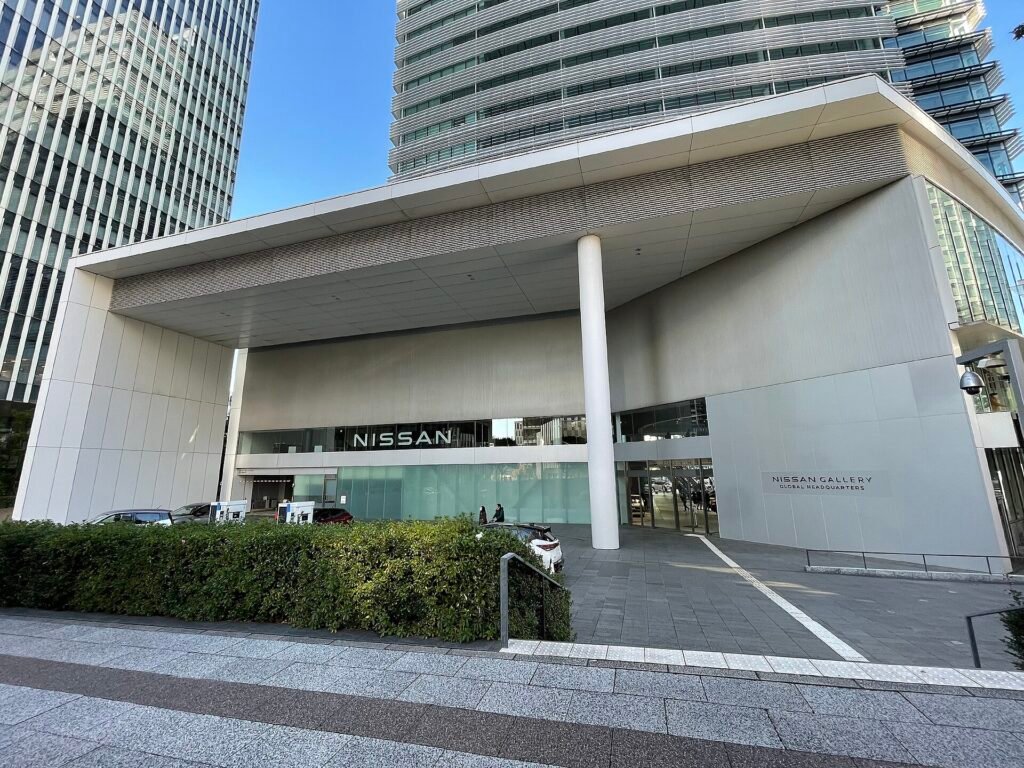
Nissan Motor Co., Ltd. is a Japanese automaker headquartered in Yokohama that sells vehicles under the Nissan and Infiniti brands. It was established on December 26, 1933, as Jidosha Seizo Co., Ltd., and in December 2010 it launched the Leaf, which it calls the world’s first mass-market all-electric car. At the end of March 2026, it had 120,079 employees on a consolidated basis.
History of Nissan
Nissan’s story begins before the company existed. In 1911, Masujiro Hashimoto founded the Kwaishinsha Motor Car Works in Tokyo, and in 1914 it built a small passenger car called the DAT, a name formed from the initials of three investors: Den, Aoyama and Takeuchi. The company later merged with another early maker, Jitsuyo Jidosha, in 1926 to form DAT Jidosha Seizo Co., Ltd.
The industrialist Yoshisuke Aikawa, who led the holding company Nihon Sangyo, took the business under the wing of his foundry, Tobata Casting, which became its parent in 1931. In 1932 the small car was renamed Datsun, with son changed to sun because the sound of son resembled a Japanese word meaning disadvantage. Jidosha Seizo Co., Ltd. was established in Yokohama on December 26, 1933, with paid-in capital of 10 million yen and Aikawa as its first president.
The company took the name Nissan Motor Co., Ltd. in June 1934. Its Yokohama plant was completed that May, and the first Datsuns were exported to Asia and Central and South America. In 1935 the plant turned out the first car built on a fully integrated assembly system, and in 1936 a new law to promote the domestic auto industry helped Japanese cars gradually replace imports on the country’s roads.
By the late 1990s Nissan faced what the company calls a management crisis, and it sought a strategic capital alliance with the French carmaker Renault. Renault raised its stake to 44.4 percent in 2002, and Nissan took 13.5 percent of Renault, a share it planned to raise to 15 percent. In April 2004 Nissan reported a record operating profit of 825 billion yen and an operating margin of 11.1 percent.
Products and services of Nissan
Nissan manufactures, sells and services automotive products, and its model history includes the Serena minivan of 1991, the Micra (March in Japan), the Cube of 1998, the X-Trail of 2000, the Fairlady Z of 2002, the Murano of 2002 and the GT-R of 2007. The Micra, released in 1992, was the first Japanese car to win the European Car of the Year award.
Electric vehicles have been central since the 1990s. Nissan began research on automotive lithium-ion batteries in 1992 and launched the Prairie Joy EV in 1997, which it calls the first commercial electric vehicle to use them. The Leaf followed in December 2010. The first model used a 24 kilowatt-hour battery and, according to Nissan, offered a range of 200 kilometers. A 2012 update raised the stated range to 228 kilometers, and in 2015 a 30 kilowatt-hour battery lifted it to 280 kilometers. The second-generation Leaf of 2017 added the e-Pedal for one-pedal driving, and Nissan states a range of 400 kilometers for that model.
The company also lists driver-assistance technology such as ProPILOT, an electrification system called e-POWER and a four-wheel control system called e-4ORCE, along with connected services. It records a series of firsts in its history, including active noise control in a mass-produced car in 1991, a rear-seat airbag system in 1993 and a lane keep assistance system in 2001.
Corporate structure and operations of Nissan
Nissan’s registered head office is in Kanagawa-ku, Yokohama, and its headquarters building is in Nishi-ku, Yokohama. Its paid-in capital was 605,813 million yen as of March 31, 2026, and it had 524,969 shareholders. It had 23,174 employees on a non-consolidated basis and 120,079 on a consolidated basis, which includes its subsidiaries. Ivan Espinosa is president and chief executive officer.
The company is part of the Renault-Nissan-Mitsubishi Alliance, a partnership among three carmakers that share some technology and platforms while remaining separate companies. Its current business plan is called Re:Nissan, which it describes as a recovery plan. Nissan also has major production sites in Japan and overseas, and in 1992 its British subsidiary began building the Micra in the United Kingdom.
The company has also worked on cleaner engines. In 2000 it began selling the Sentra CA in California as a super ultra-low emission vehicle, and in 2003 the Bluebird Sylphy became the first Japanese vehicle certified as a super ultra-low emission vehicle. Overseas production grew in the 1990s and 2000s. Nissan Motor Manufacturing Corporation U.S.A. began producing the Altima in 1992, a plant in Canton, Mississippi opened in 2003, and Nissan opened a joint venture with Dongfeng in China in 2003.
Impact of Nissan
The Leaf is the clearest mark Nissan has left on the industry. It won European Car of the Year 2011, World Car of the Year 2011 and Japan Car of the Year 2011-2012, and its sales passed 100,000 in 2014 and reached about 200,000 around its fifth anniversary in 2015. More than half a million had been sold by 2020, and it was driven in 59 markets. When it arrived, Japan had about 200 quick chargers of the CHAdeMO standard, and Nissan says there are now more than 30,000 around the world. In 2012 it introduced a system to let customers send power from the car back to the home, and Leaf batteries have been used to supply emergency power during natural disasters and to help stabilize a power network in a smart grid project on the island of Maui.
The company’s approach also reflects the wider story of the electric vehicle, in which cost, range and charging networks all had to improve together. Nissan operates alongside other large automakers such as Toyota within the industry of Japan.
More in Management
Key facts
- Jidosha Seizo Co., Ltd., the predecessor of Nissan, was established in Yokohama on December 26, 1933, and renamed Nissan Motor Co., Ltd. in 1934.1
- The Datsun name dates from 1932, and DAT, the first car, was built in 1914.1
- Nissan launched the Leaf in December 2010, which it calls the world's first mass-market all-electric car.2
- Nissan had 120,079 employees on a consolidated basis as of March 31, 2026.3
- Nissan is part of the Renault-Nissan-Mitsubishi Alliance and formed a capital alliance with Renault after a management crisis in the late 1990s.1
Related concepts
Quick checkWhat was the first mass-market electric car from Nissan?Show answer
The Nissan Leaf, launched in December 2010. Nissan calls it the first mass-market all-electric car, and more than half a million had been sold by December 2020.
Sources
- [1] Nissan Motor Corporation, Nissan's Beginnings, 1930s and 1990s and 2000s history pages, https://www2.nissan-global.com/EN/COMPANY/PROFILE/HERITAGE/HISTORY/
- [2] Nissan Motor Corporation, A decade of innovation: the LEAF's incredible journey (December 4, 2020), https://www.nissan-global.com/EN/STORIES/RELEASES/nissan-leaf-10years/
- [3] Nissan Motor Corporation, Company Outline as of March 31, 2026, https://www.nissan-global.com/EN/COMPANY/PROFILE/
Editorially reviewed by Specialty Digest Editorial TeamLast reviewed November 4, 2026Researched and drafted with AI assistanceReport an issue