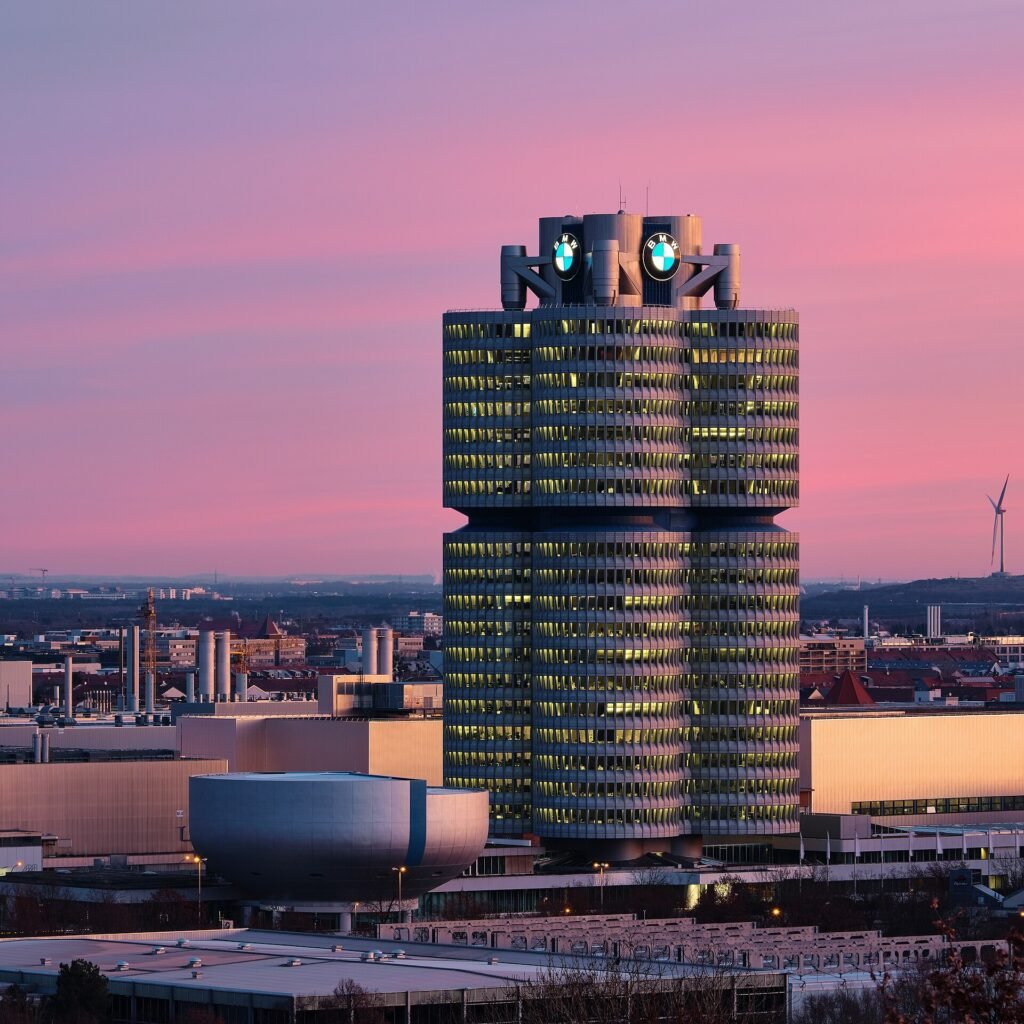
BMW is a German manufacturer of automobiles and motorcycles based in Munich, with an official founding date of 1916. The BMW Group sells vehicles under the BMW, MINI and Rolls-Royce brands, and it delivered about 2.46 million cars in 2025.
History of BMW
The company traces its roots to two aviation firms, Flugmaschinenfabrik Gustav Otto and Rapp Motorenwerke. In 1917 Rapp Motorenwerke was renamed Bayerische Motoren Werke, which means Bavarian Motor Works, and every BMW product has carried the blue-and-white logo since then.
Aircraft engines were central to the early business, and after World War I the company turned to railway brakes. It launched its first motorcycle, the R 32, in 1923. In 1928 it entered car production by taking over the Fahrzeugfabrik Eisenach, a vehicle factory in Thuringia.
Allied forces dismantled BMW’s plants after World War II, and the restart came with the R 24 motorcycle in 1948 and the BMW 501 car in 1951. In 1959 shareholders and the workforce rejected a takeover offer from Daimler-Benz, and BMW stayed independent.
BMW bought the Rover Group in 1994 and sold it in 2000, but it kept the MINI brand and relaunched it in 2001. It acquired the Rolls-Royce brand and naming rights in 1998 and took full responsibility for Rolls-Royce Motor Cars in 2002. In 2013 the BMW i3 became the group’s first series-produced fully electric model.
Products and services of BMW
The group’s brands are BMW, MINI, Rolls-Royce and BMW Motorrad, which makes motorcycles. The BMW brand also includes BMW M, the high-performance line operated by BMW M GmbH.
The group delivered 2,463,715 vehicles in 2025, up 0.5 percent from 2024, according to provisional figures. The BMW brand delivered 2,169,761 vehicles, down 1.4 percent, and that total includes 213,457 from BMW M GmbH, up 3.3 percent. MINI delivered 288,290, up 17.7 percent, and Rolls-Royce delivered 5,664, down 0.8 percent.
Electrified vehicles, which combine battery-electric cars and plug-in hybrids, reached about 642,000 deliveries, roughly 26 percent of the group’s car sales. A battery-electric car runs only on a battery, while a hybrid vehicle pairs a battery with a combustion engine. Fully electric vehicles numbered 442,072, up 3.6 percent and about 18 percent of group sales.
By simple division of the delivery figures, the BMW brand accounted for about 88 percent of the group total, MINI for about 12 percent and Rolls-Royce for a fraction of 1 percent. BMW M GmbH vehicles were about 10 percent of the BMW brand total. MINI posted the fastest growth of the three brands in 2025.
BMW also reports production separately from deliveries. In 2025 its plants built 2,456,561 BMW, MINI and Rolls-Royce automobiles.
Corporate structure and operations
The company is headquartered in Munich. BMW’s 2025 report counts 154,540 employees at the end of the year and 32 production locations in 15 countries. Group profit before tax was 10.236 billion euros, a figure stated before income taxes are deducted.
The BMW and MINI brands sold 1,016,360 vehicles in Europe in 2025, up 7.3 percent, including 290,742 registrations in Germany, up 8.7 percent. Battery-electric cars made up roughly a quarter of European sales, and battery-electric and plug-in hybrid cars together exceeded 40 percent.
Measured against the 2,458,051 combined BMW and MINI deliveries, Europe took about 41 percent, Asia about 35 percent and the Americas about 21 percent. These shares come from simple division and leave out smaller regions.
Sales in Asia fell 9.3 percent to 871,550, and sales in China fell 12.5 percent to 625,527. In the Americas the two brands sold 508,221 vehicles, up 5.7 percent, including 417,638 in the United States, up 5.0 percent.
Impact of BMW
BMW’s independence in 1959, after workers and shareholders turned down a takeover, shaped the company that exists today as a separate rival to Daimler-Benz, now Mercedes-Benz Group. The group’s blue-and-white roundel has appeared on its products since 1917.
BMW’s figures also show how the market for the automobile has moved. In 2025 China, the United States and Germany were its three largest single-country markets for the BMW and MINI brands among the figures reported, and electrified models were about a quarter of group sales.
The 2013 i3 began the group’s series production of fully electric cars, and by 2025 fully electric models were about 18 percent of group sales. MINI, relaunched in 2001 after the Rover sale, grew 17.7 percent in 2025, more than two decades after BMW chose to keep the brand.
Criticism and controversies
BMW’s own history pages describe the company’s role under National Socialism. BMW became a key player in Germany’s war economy and shifted toward aircraft engines, which produced most of its revenue. Aircraft-engine production sat in a subsidiary, BMW Flugmotorenbau GmbH, which did not have to publish its figures, so the growing orders did not appear on the balance sheet. In 1941 the government ordered car production to stop. The workforce grew from 6,514 in 1933 to 56,213 in 1944, and new plants opened in Munich-Allach in 1936 and Eisenach-Dürrerhof in 1937. Both were planned as camouflaged plants, and Berlin-area plants came through the takeover of BRAMO in 1939.
The company used forced labor. Polish prisoners of war worked in Eisenach from late 1939, SS prisoners from 1941 and concentration camp prisoners from 1942, with satellite camps at Allach and Dürrerhof. Prisoners from Dachau carried out final checks on aircraft engines at Allach. By the end of 1944 about 29,000 forced laborers, more than half of the workforce, worked for BMW, and mortality was especially high among Eastern workers and camp prisoners.
BMW says it was long in denial and began confronting this history in the early 1980s. In the late 1990s it became a founding member of the foundation Remembrance, Responsibility, Future, which has paid compensation to forced laborers. Two independent academic dissertations have studied the period, and the BMW Museum has had a Place of Remembrance on forced labor since June 2020. The company states that it bears a major share of the responsibility for these crimes. Some documents from the period are available through the BMW Group Archive.
More in Management
Key facts
- BMW traces its official founding to 1916, and Rapp Motorenwerke was renamed Bayerische Motoren Werke in 1917.1
- BMW launched its first motorcycle, the R 32, in 1923 and began car production in 1928.1
- In 1959 shareholders and the workforce rejected a takeover offer from Daimler-Benz.1
- The BMW Group delivered 2,463,715 vehicles in 2025: 2,169,761 BMW, 288,290 MINI and 5,664 Rolls-Royce.3
- BMW reported 154,540 employees and 32 production locations in 15 countries at the end of 2025.2
Related concepts
Quick checkWhat does the name BMW stand for?Show answer
BMW stands for Bayerische Motoren Werke, or Bavarian Motor Works, the name given to the former Rapp Motorenwerke in 1917.
Sources
- 1. BMW Group, History (bmwgroup.com), https://www.bmwgroup.com/en/company/history.html
- 2. BMW Group, Management Report 2025, https://www.bmwgroup.com/en/report/2025/management-report/index.html
- 3. BMW Group Newsroom, BMW Group vehicle sales grew in 2025, https://newsroom.bmwgroup.com/global/bmw-group-vehicle-sales-grew-in-2025---strong-performance-particularly-in-europe-and-the-us-and-with-electrified-models
- 4. BMW Group, BMW during the era of national socialism, https://www.bmwgroup.com/en/company/history/BMW-during-the-era-of-national-socialism.html
Editorially reviewed by Specialty Digest Editorial TeamLast reviewed November 4, 2026Researched and drafted with AI assistanceReport an issue