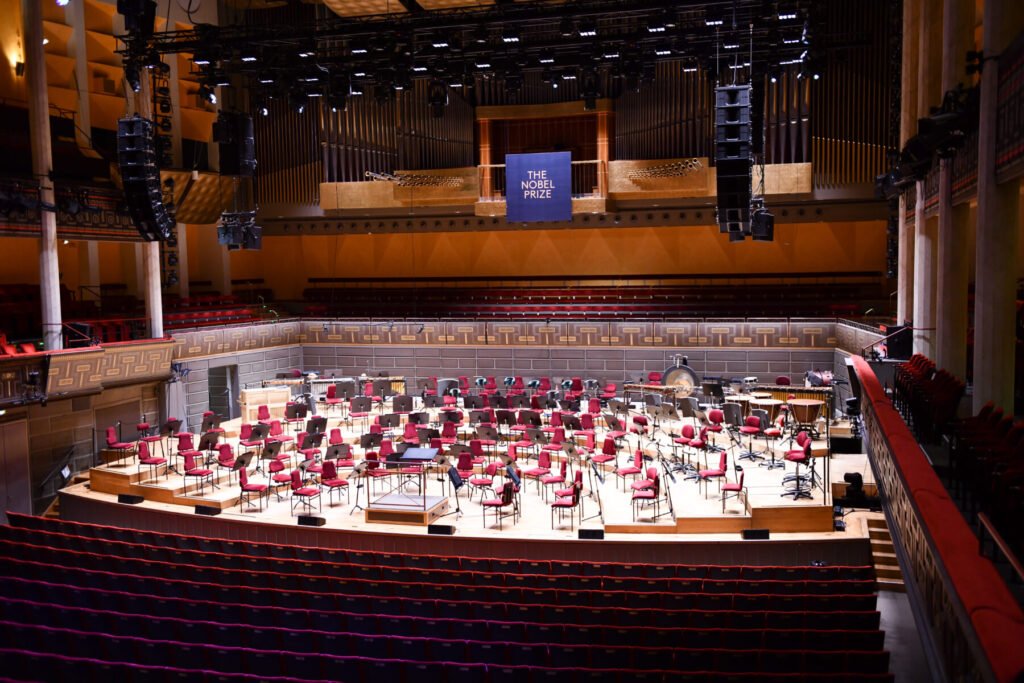
The Nobel Foundation is the institution, founded in 1900, that manages the fortune left by Alfred Nobel and looks after the practical side of the Nobel Prizes. Its board has its registered office in Stockholm, while separate prize-awarding institutions in Sweden and Norway choose the laureates.
History of the Nobel Foundation
Alfred Nobel, the inventor of dynamite, signed his third and last will on 27 November 1895 at the Swedish-Norwegian Club in Paris. When the will was opened after his death, it caused controversy in Sweden and internationally, because Nobel had left much of his wealth to establish a prize. His family opposed the plan, and the prize-awarding bodies he had named at first refused to do what the will asked.
It took five years before the first Nobel Prizes could be awarded, in 1901. Ragnar Sohlman, the executor of the will, helped carry it out. The Nobel Foundation was established in 1900, four years after Nobel’s death, mainly to invest his fortune but also to manage what the Foundation calls the immaterial value of the Nobel Prize.
The Foundation’s own history divides its development into three broad phases. During the first, from 1900 to the 1920s, there was an ambition to make the Foundation a unified institution. The prize-awarding bodies, however, were more interested in tying the Nobel Institutes closely to themselves.
In 1968 Sweden’s central bank, Sveriges Riksbank, marked its 300th anniversary by creating a prize in economic sciences. The Nobel Foundation agreed to administer it, and the Foundation said at the time that this was an ad hoc decision rather than the opening of the way for further new prizes. In later decades it turned away repeated requests for additional prizes.
Structure and prize-awarding bodies
The Foundation is led by a Board of Directors with seven members and two deputies, who are Swedish or Norwegian citizens. The trustees of the prize-awarding bodies elect them for terms of two years counting from 1 May. The Board chooses a chairman, a vice-chairman and an executive director from among its members.
The statutes also provide for trustees elected by the prize-awarding bodies and for six auditors. The government appoints one of them as chairman of the auditors, and the prize-awarding bodies and the trustees each elect one. The Board submits an annual report to the chairman of the auditors before the end of February each year.
The laureates are chosen not by the Foundation but by the institutions named in its statutes. They are the Royal Swedish Academy of Sciences, the Nobel Assembly at Karolinska Institutet, the Swedish Academy and the Nobel Committee of the Norwegian Parliament, the Storting. Special statutes cover each body, and further statutes, approved in December 1968, cover the Sveriges Riksbank Prize in Economic Sciences in Memory of Alfred Nobel.
What the Nobel Foundation does
The first object of the Foundation is to carry out the will. The will says that the capital shall be invested in safe securities and that the interest shall be distributed each year as prizes to those who have conferred the greatest benefit to humankind. It names five fields: physics, chemistry, physiology or medicine, literature and peace. It also says that nationality should play no part, so the prize can go to the worthiest person whether or not they are Scandinavian.
The statutes set the main rules. Nominators must be competent to nominate, self-nominations are not allowed, and nominations must arrive by 1 February. A prize cannot be awarded after death, a prize can be shared, and there is no appeal against a decision. The statutes also set out rules on secrecy and on the Nobel lectures.
The Foundation also looks after the ceremonies. The prizes are presented each year on 10 December, and the first ceremony was held in 1901. All prizes are awarded in Stockholm except the Peace Prize, which is presented in Oslo. The only change to the schedule came for the 1919 prizes, which were presented in June of the following year.
Funding and governance of the Foundation
The Foundation’s money comes from the capital that Nobel left, which it invests. In the 1970s the Foundation began a modernization with the goal of restoring the fortune to its 1901 value, and the Foundation says this was not because the money mattered for the prize’s status, since its executive director at the time believed the prestige of the prize had transcended its monetary value.
The prize in economic sciences is financed differently. Sveriges Riksbank makes an annual donation to the Foundation that covers the prize amount, the administrative costs of choosing the laureates and a share of the costs of the festivities.
For one dated example, the Foundation reported that its total invested capital was 4.241 billion Swedish kronor at the end of 2016, after a 6.9 percent return on portfolio capital that year. At the time about half of the portfolio capital was in equities, 17 percent in fixed income and 33 percent in alternative assets. This entry does not give a current figure, because the latest annual report could not be read in full.
Criticism and controversies
Controversy began with the will itself, which Nobel’s relatives and some of the institutions he named resisted. The Foundation’s history also records a long record of outside attempts to add new prizes after 1968, all of which the Foundation rejected.
The prize in economic sciences remains a point of discussion. It is not one of the five prizes named in the will, and the Foundation’s history notes that it should be called the prize in economic sciences rather than a Nobel Prize in the strict sense. It is awarded by one of the Nobel prize-awarding institutions and follows the same thorough selection process as the Nobel Prizes.
Legacy and impact
The Foundation’s history describes its role as twofold: investing Nobel’s fortune and managing the immaterial value of the prize, meaning its reputation and ceremonies. Since 1901 the awards have been presented in the same two Nordic capitals, in Sweden and Norway, on 10 December.
Key facts
- Alfred Nobel signed his last will on 27 November 1895 in Paris.2
- The Nobel Foundation was founded in 1900, four years after Alfred Nobel's death.1
- The first Nobel Prizes were awarded in 1901.21
- The Foundation's Board of Directors has seven members and two deputies, who are Swedish or Norwegian citizens.3
- The Sveriges Riksbank Prize in Economic Sciences in Memory of Alfred Nobel dates from 1968.13
- The Foundation's total invested capital was 4.241 billion Swedish kronor at the end of 2016.4
Related concepts
Quick checkWho chooses the Nobel laureates?Show answer
The prize-awarding institutions named in the statutes choose them, not the Nobel Foundation, which manages the capital and the practical side of the prizes.
Sources
- Nobel Prize Outreach. We're in this forever: the history of the Nobel Foundation. Undated (accessed 4 November 2026)
- Nobel Prize Outreach. Alfred Nobel's will. Undated (accessed 4 November 2026)
- Nobel Foundation. Statutes of the Nobel Foundation. Undated (accessed 4 November 2026)
- Nobel Foundation. The Nobel Foundation's 2016 asset management and earnings. 2017 (accessed 4 November 2026)
- Nobel Prize Outreach. About the Nobel Prize. Undated (accessed 4 November 2026)
Editorially reviewed by Specialty Digest Editorial TeamLast reviewed November 4, 2026Researched and drafted with AI assistanceReport an issue