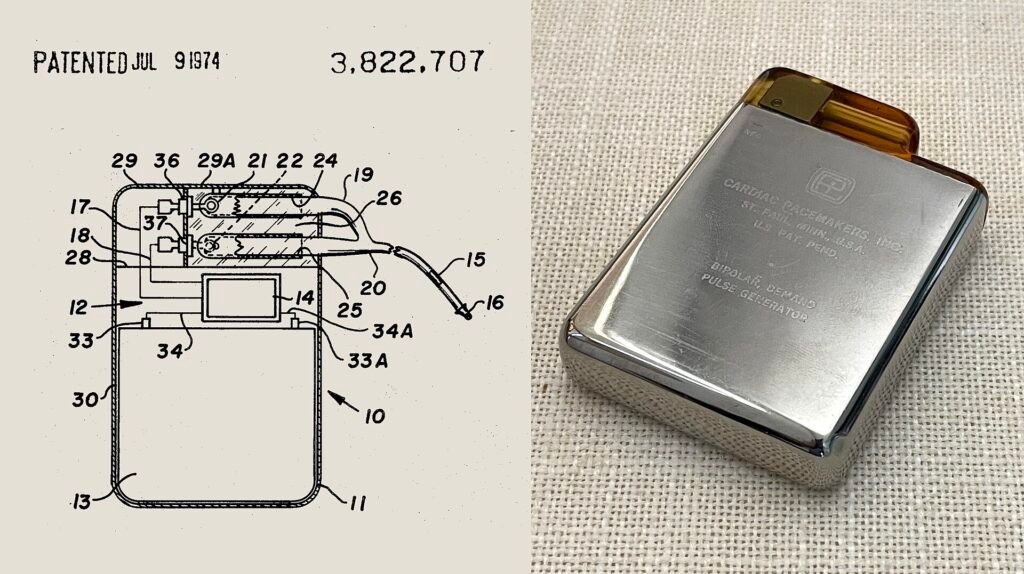
A pacemaker is a small electrical device that sends pulses to the heart to help it beat at a steady rate or keep its chambers in step. The first fully implanted unit was placed in a patient in Sweden in 1958, and a more durable American design followed in 1960. This article is general background on the device and is not medical advice.
History of the pacemaker
The first pacemaker is dated to 1950, when John Hopps, John Callaghan and Wilfred Bigelow built a device to stimulate the heart from outside the body. Early external models needed a painful shock, and later wires placed under the skin reduced the intensity to about 2 volts.
In Sweden, Rune Elmqvist designed a pacemaker and Dr. Åke Senning performed the first entirely internal implant in late 1958. The device was set in a tin that had held shoe polish, which served as a mold. It lasted only a few hours and was replaced the next morning, and the patient went on to receive 26 pacemakers over a lifetime that reached 86 years.
In the United States, Wilson Greatbatch was building an oscillator to record fast heart rhythms when he wired in a 1 megohm resistor instead of a 10 kilohm one. The circuit gave short pulses with low current, which suggested a way to pace the heart. On May 7, 1958, he took a device to William Chardack at the Veterans Hospital in Buffalo, New York, and Chardack and Andrew Gage tested it in a dog.
In April 1960 Chardack performed the first successful human implant of the Greatbatch pacemaker, and he and his colleagues implanted units in ten patients that year. Greatbatch sold the rights to the implantable pulse generator to Medtronic in 1961. Transvenous implantation, in which a lead is threaded through a vein, became possible in 1962.
Inventor and origins of the pacemaker
The pacemaker has several inventors on two continents. Hopps, Callaghan and Bigelow made the first external device, Elmqvist and Senning produced the first fully internal implant, and Greatbatch and Chardack developed the design that led to long-term use. An improved Elmqvist unit was also implanted in Montevideo, Uruguay, in February 1960, and it worked for nine months.
Accounts differ on small points. One history calls Senning’s 1958 implant an attempt and says it failed after three hours, while another says it lasted a few hours and was replaced the next day. Early battery life is also reported differently, with the original Chardack and Greatbatch cells lasting three to five years in one account and the earlier mercury-zinc cell about two years in another.
How a pacemaker works
A pacemaker delivers periodic doses of electrical stimulation to or near the heart. It mimics the signals normally produced by the sinoatrial node, the natural pacemaker in the right atrium. The National Heart, Lung, and Blood Institute (NHLBI) says pacemakers send electrical pulses to help the heart beat at a normal rate and rhythm.
Modern pacemakers sense movement and changes in breathing and adjust the heart rate to the level of activity. A permanent pacemaker is placed in the chest or abdomen, and a doctor may check it remotely and schedule regular visits to review its activity. NHLBI adds that people with pacemakers may need to avoid certain electrical devices or devices with strong magnetic fields.
Types of pacemakers
NHLBI separates temporary from permanent pacemakers. A temporary pacemaker is normally inserted through a vein in the neck and remains outside the body, while a permanent one is placed under the skin of the chest or abdomen. Early devices were external, and the fully implantable design arrived with the Swedish and American units of 1958 to 1960.
Pacemakers also differ in purpose. Some treat a heartbeat that is too slow, and some are used to help the heart chambers beat in sync so the heart can pump blood more efficiently. This second use may be needed in people with heart failure. Chardack later developed reliable pacing leads with a coiled-spring design.
Impact of the pacemaker
Batteries limited the first pacemakers. The Chardack and Greatbatch device used mercury batteries, and Greatbatch founded a battery company in 1970. By 1972 he had a sealed lithium-iodide cell with a life of about 10 years, compared with about 2 years for the earlier mercury-zinc cell. The lithium-iodide battery is now a standard cell for pacemakers, and it greatly extended pacemaker lifespans. The cell is built around lithium, a metal that is also used for energy storage in other devices.
Greatbatch holds over 325 patents and is a member of the National Inventors Hall of Fame. The older cells that powered his first device contained mercury, which the lithium-iodide cell later replaced as the standard pacemaker battery.
Uses of pacemakers today
NHLBI says pacemakers are used to treat certain types of arrhythmias, as well as heart failure, which occurs when the heart cannot pump enough blood to the body. The most common reason people get a pacemaker is a heartbeat that is too slow, called bradycardia, or one that pauses and causes fainting spells or other symptoms. In some cases a pacemaker may also be used to prevent or treat a heartbeat that is too fast or irregular.
NHLBI lists several possible underlying causes, including problems with electrical signaling in the heart, beta blockers that slow the heartbeat too much, certain congenital heart defects, a heart attack and a heart transplant. Not everyone with an arrhythmia needs a pacemaker, and decisions about treatment belong to clinicians. A hospital stay for the procedure may last a few hours or overnight, and many people return to regular activities within a few days.
More in Cardiology
Key facts
- Array
This entry explains a medical term. It is not medical advice. If you are concerned about your health, speak with a qualified health professional.
Related concepts
Quick checkWho invented the pacemaker?Show answer
Several people. Hopps, Callaghan and Bigelow built an external device in 1950, Elmqvist and Senning made the first internal implant in Sweden in 1958, and Greatbatch and Chardack developed the implant first used successfully in the United States in 1960.
Sources
- Array
Editorially reviewed by Specialty Digest Editorial TeamLast reviewed November 4, 2026Researched and drafted with AI assistanceReport an issue