The discovery of blood circulation was the demonstration, published by the English physician William Harvey in 1628, that the heart pumps blood in a continuous loop around the body. Before Harvey, most physicians believed the body made blood from food and used it up. His short book De Motu Cordis overturned a view of the heart and blood that had guided medicine for roughly fourteen centuries. Because it rested on experiments and measurement, it is a landmark in the history of medicine and of physiology, the study of how living bodies work.
Background to the discovery of blood circulation
The accepted model came from Galen, a Greek physician who lived from 129 to about 199 and whose ideas dominated medicine through the Middle Ages and Renaissance. In Galenic medicine, blood was one of four humors whose balance determined health. It was not thought to circulate. Instead, the liver was believed to produce dark venous blood to nourish the body, where it was consumed and replaced. Bright arterial blood carried pneuma, a vital spirit picked up from air in the lungs. A small amount of blood was thought to seep between the two sides of the heart through the wall between them, called the septum. The heart was not seen as the force that moved blood.
Renaissance anatomists corrected many details. Andreas Vesalius published his great book on human anatomy in 1543, and Realdo Colombo raised doubts about Galen’s account of the heart. Yet dissection alone could not show how the heart moves or how blood travels. The Galenic model also lasted because its weak point was invisible. Oxygen-rich arterial blood really does turn into depleted venous blood, but it does so in capillaries, vessels too small to see without a microscope.
One crucial clue came from Padua. Harvey, born in Folkestone, Kent, on April 1, 1578, earned his medical degree there in 1602. His teacher Hieronymus Fabricius had described the little valves inside veins in 1603 but did not understand their purpose. Harvey later became a fellow of the College of Physicians in London, lectured there and served as physician to James I from 1618.
How blood circulation was discovered
The exact path of Harvey’s thinking is partly speculation, because his notes and papers were lost in the Great Fire of London in 1666. Historians date the crucial chapters of his book to about 1617 to 1619. By his own account, thinking about the valves in veins first led him to doubt Galen. The valves let blood move only toward the heart, and arteries have no such valves. Blood therefore had to pass somehow from arteries to veins and return to the heart, which implied a circle.
Harvey tested the idea with direct observation. He studied the hearts of fishes, amphibians, reptiles, birds and mammals. Hearts in cold-blooded animals beat slowly enough to watch, and dying mammals’ hearts slow down before they stop. These studies showed that the heart’s contraction, called systole, is its active phase and that the two ventricles contract together. He found no holes in the septum. A heart removed from a living animal kept beating, showing that it works as a pump rather than a sucking organ.
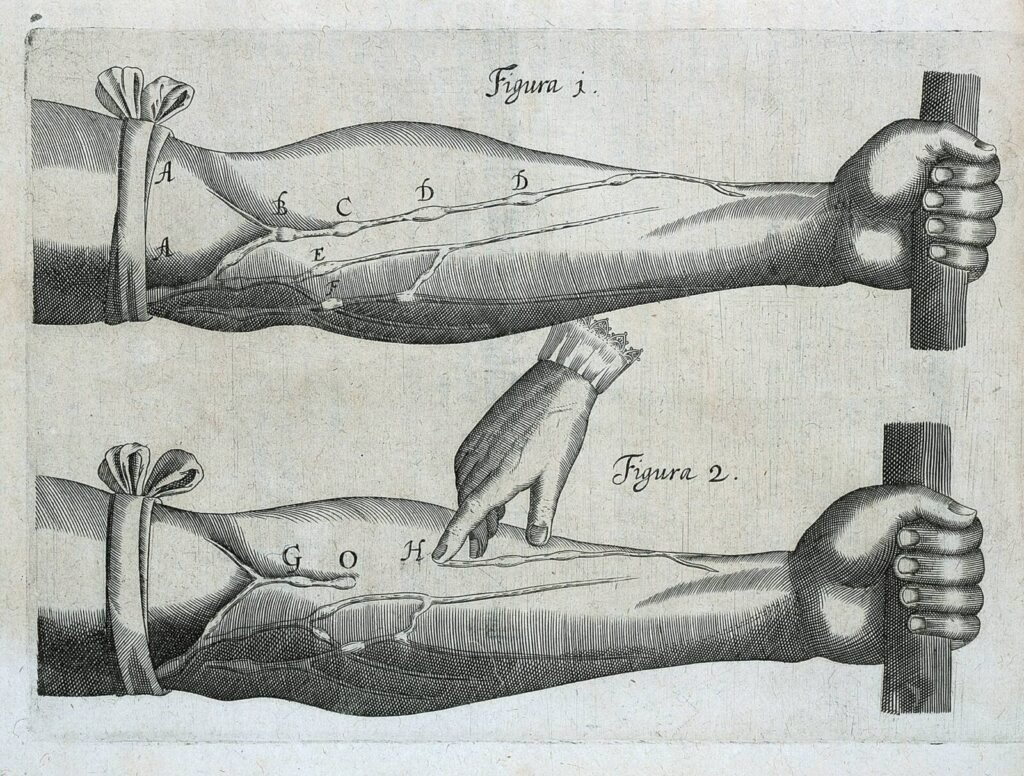
His best-known demonstration used the veins of the arm. By tying a band around the arm and pressing a finger along a vein, he showed that blood could be pushed toward the heart past a valve but not the other way. These are the only experiments illustrated in his book.
Harvey also reasoned with numbers. Even with cautious estimates of the heart’s size and rate, the amount of blood leaving it each hour came to roughly 1,000 fluid ounces, or almost 8 gallons. That is far more than the body could make from food, and more than the body holds. The same blood must therefore return to the heart again and again. Harvey summed up the finding in his thirteenth chapter: the blood moves in a circle, and the heart’s job is to drive it.
One gap remained. Harvey proposed that tiny passages link arteries and veins, but he could not see them. Marcello Malpighi observed these capillaries under a microscope in the early 1660s, after Harvey’s death, which completed the picture.
Impact of the discovery of blood circulation
De Motu Cordis was published in Frankfurt when Harvey was 50. It set off heated debate. Critics included the French physician Jean Riolan, who tried to reconcile Harvey with Galen by allowing a slow small circuit through the heart and lungs. The philosopher René Descartes accepted circulation but disputed Harvey’s account of how the heart works. Their alternatives did not last against experimental evidence, and circulation became mainstream knowledge within about four decades of publication.
The discovery changed medicine in two ways. Theoretically, it was a death blow to Galenic physiology, because blood is neither made in the liver nor consumed in the tissues. Practically, it undermined the reasoning behind bloodletting, which aimed to drain a supposed excess of blood and restore humoral balance. It also gave physicians a sound basis for studying the heart and vessels, which led eventually to measures such as blood pressure, to recording the heart’s electrical activity with the electrocardiogram and to surgery as dramatic as the first human heart transplant in 1967.
Historians add a note of caution. Harvey was not a modern mechanist. He remained a convinced Aristotelian, his explanations were mostly qualitative, and he never compared the heart to a machine. His method still counted as new, because he combined dissection, experiment on living animals and calculation to settle a question that tradition could not. Harvey died on June 3, 1657, at age 79.
FAQs
Who discovered blood circulation? William Harvey, an English physician, described the circulation of blood in his 1628 book De Motu Cordis.
What did people believe before Harvey? Following Galen, they thought the liver continually made blood from food and that tissues consumed it, with little exchange between the heart’s two sides.
How did Harvey prove blood circulates? He combined animal dissection, experiments on the valves in veins and a calculation showing the heart moves more blood than food could supply.
Who discovered capillaries? Marcello Malpighi observed them under a microscope in the early 1660s, supplying the link Harvey had predicted.
More in Cardiology
Key facts
- William Harvey published Exercitatio Anatomica de Motu Cordis et Sanguinis in Animalibus at Frankfurt in 1628.12
- Harvey estimated that the heart expels about 1,000 fluid ounces of blood per hour, far more than food could supply.2
- The valves in veins, described by Fabricius in 1603, were a key clue.2
- Marcello Malpighi observed capillaries in the early 1660s.12
- Harvey was born on April 1, 1578, and died on June 3, 1657.1
Related concepts
Quick checkWhat evidence led Harvey to conclude that blood circulates?Show answer
Venous valves that allow flow only toward the heart, animal dissections, and a calculation showing the heart moves more blood than food could supply.
Sources
- Ribatti D., William Harvey and the discovery of the circulation of the blood, Journal of Angiogenesis Research 2009, https://pmc.ncbi.nlm.nih.gov/articles/PMC2776239
- EBSCO Research Starters, Discovery of Blood Circulation, https://www.ebsco.com/research-starters/health-and-medicine/discovery-blood-circulation
Editorially reviewed by Specialty Digest Editorial TeamLast reviewed November 4, 2026Researched and drafted with AI assistanceReport an issue