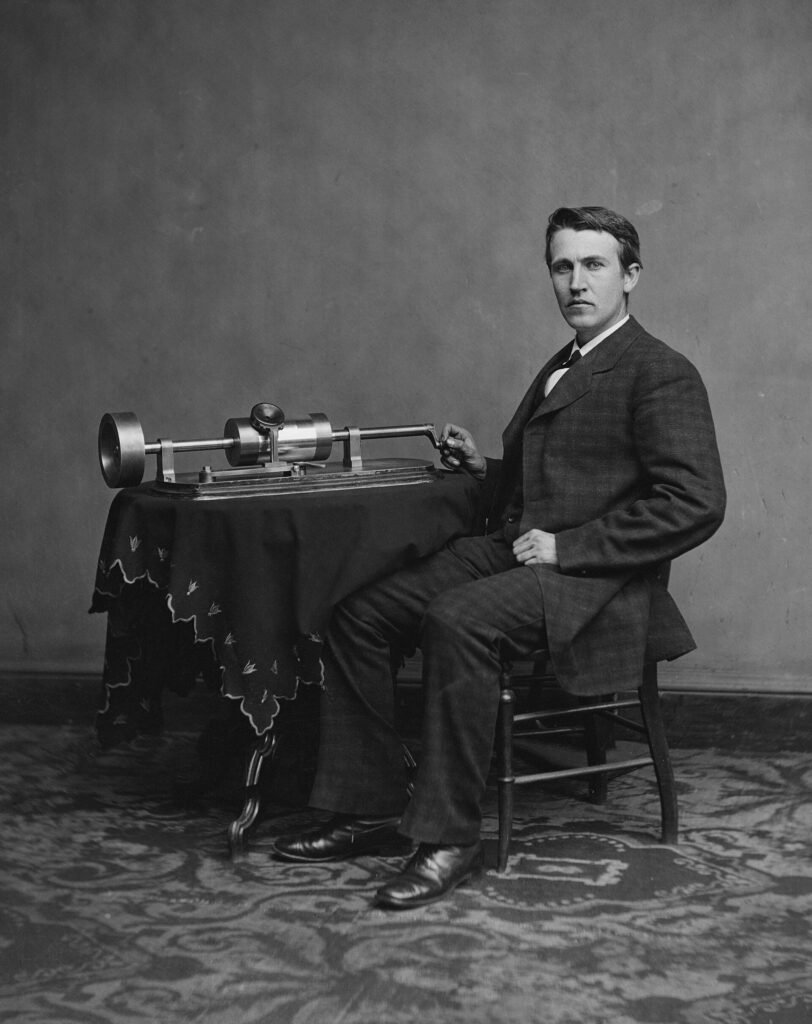
The phonograph is a machine that records sound as a groove on a rotating surface and plays it back by tracing the groove with a needle. Thomas Edison built the first working model in December 1877, using a hand-cranked cylinder wrapped in tin foil.
History of the phonograph
Edison began with the telephone, not with music. According to the Engineering and Technology History Wiki (ETHW), he first saw the phonograph as a telephone recorder and thought that recording sound would be as useful in business as the telephone. His earliest experiments attached a stylus to a telephone receiver so that its vibrations carved a groove in a strip of wax-coated paper. When replayed, the strip almost reproduced the original sounds, but the experiments did not produce a satisfactory machine.
He then tried to record sound directly from the air. His assistants built a device like a modified phonautograph, a scientific instrument that traced sound waves on paper or glass. It pressed the sound into a groove on a sheet of tin foil wrapped around a cylinder. Edison drew a sketch of the phonograph on November 29, 1877, and a working model followed a few days later, built by his machinist, John Kruesi.
The first test, in December 1877, was a surprise. Edison recited the nursery rhyme “Mary Had a Little Lamb” into the horn, and a distorted but recognizable version of his words came back when the foil was cranked under the needle again. He showed the device to Scientific American on December 7, filed for a patent on December 15 and saw it announced publicly on December 22.
In 1878 he demonstrated the machine to the National Academy of Sciences and to President Rutherford B. Hayes, and paying audiences came to hear it. In April 1878 he licensed the right to sell it as a dictation machine for offices. Sales were poor, however, and production stopped. He returned to the phonograph in 1888 and applied for seventeen patents on new sound technology, according to the Smithsonian’s National Museum of American History. The museum adds that tin foil recordings disintegrated quickly with repeated playing and that their sound quality left much room for improvement. Edison’s sketch for the first machine and a poster for a public demonstration in 1878 still survive in museum collections.
Inventor and origins of the phonograph
Edison is credited with the phonograph, but the idea did not come from nowhere. The National Museum of American History notes that a phonautograph had been developed about twenty years before. It recorded sound waves with a stylus but could not play them back. Edison reversed that process to allow playback, and the museum describes his phonograph as the first instrument that could both record and play back sound.
The ETHW adds that Edison used ideas from a patent filing on telephone improvements dated July 30, 1877, which described recording sound as indentations in a groove on tape or on tin foil wrapped around a cylinder.
How a phonograph works
The tin foil phonograph that Kruesi built to Edison’s drawing, now held at the Thomas Edison National Historical Park, shows the principle. A sheet of tin foil was wrapped around a grooved drum. A person shouted into a recording horn, and sound waves made a diaphragm vibrate. A stylus mounted at its center, moving up and down, pressed a groove into the foil as the user turned a crank. The groove ran along the cylinder in a spiral.
To play the sound back, the horn was moved to a second diaphragm and the crank was turned in reverse to bring the foil back to the start. A stylus joined to that diaphragm by a thin wire followed the groove, and the vibrations it picked up were turned back into sound by the diaphragm and horn. The National Park Service says the tin foil would tear after just a few plays, which is why those first recordings cannot be played today.
Types and variants of the phonograph
The first form was the tin foil cylinder phonograph of 1877. The ETHW reports that the earliest surviving cylinder recordings date from almost ten years later, after Edison introduced a greatly improved wax cylinder. The National Park Service adds that the first records after tin foil were cylinders, with the sound on the outside, and later records were shaped like discs.
Edison also separated the machine into two markets. The National Museum of American History says he licensed an office dictation machine in 1878, while the Google Arts and Culture entry for the Edison park says he made entertainment phonographs and recordings until 1929 and business phonographs for office use until the 1960s.
Impact of the phonograph
The museum record at the Edison park states that the process of preserving and retrieving sound, including the entire recording industry, derives from this one instrument. That is a strong claim from the institution that holds the original, and it reflects how directly later systems built on the idea of storing sound as a physical trace.
Edison himself kept working on the machine. The National Park Service says he called it his favorite invention and improved it over and over for the next fifty years. Almost all of the earliest tin foil records are lost, according to the ETHW, and the few that remain are stored at the Edison National Historic Site in New Jersey. They have never been played.
Uses today
The machines, cylinders and discs are collected, restored and displayed in museums. The Thomas Edison National Historical Park in West Orange, New Jersey, preserves the Edison collection. The phonograph also led to later recording and playback systems, and its beginnings in telephone research are covered in the entry on the telephone. Another invention associated with Edison is covered in the entry on the light bulb.
Key facts
- Array
Related concepts
Quick checkWho invented the phonograph?Show answer
Thomas Edison built the first phonograph in December 1877. An earlier device, the phonautograph, recorded sound but could not play it back, so Edison is credited with the first machine to do both.
Sources
- Array
Editorially reviewed by Specialty Digest Editorial TeamLast reviewed November 4, 2026Researched and drafted with AI assistanceReport an issue