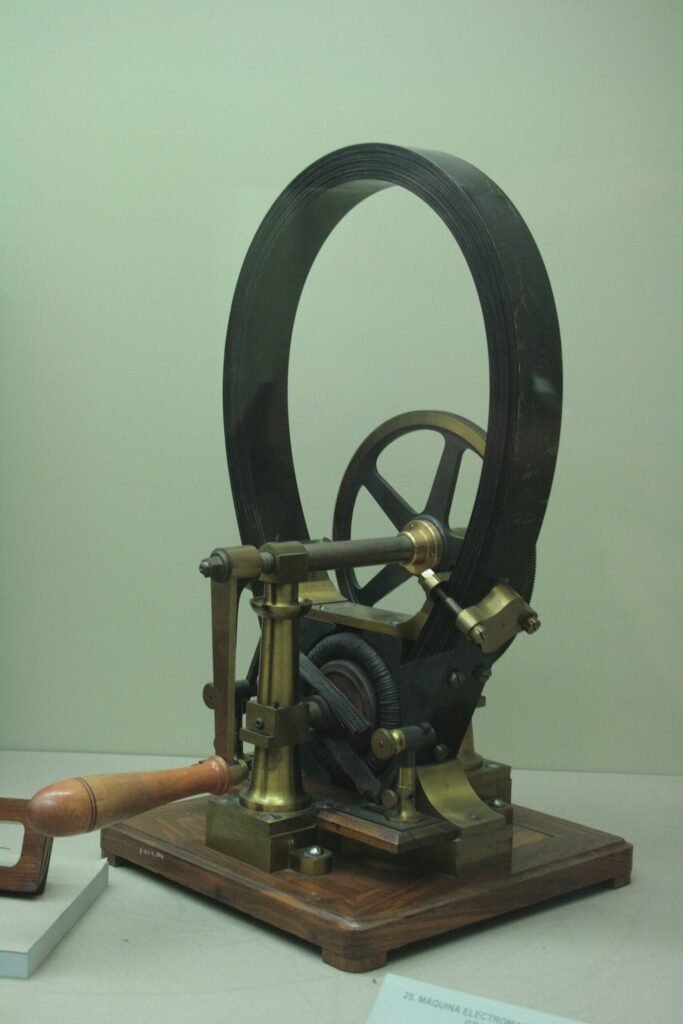
An electric generator is a machine that converts mechanical energy into electrical energy. Most electricity is made by generators based on electromagnetic induction, which Michael Faraday discovered in 1831, and the first practical dynamos followed in 1832 and 1871.
History of the electric generator
On August 29, 1831, Michael Faraday carried out what the Linda Hall Library calls perhaps his most famous experiment, in his laboratory at the Royal Institution in London. He wrapped a wire around an iron ring and connected it to a battery through a switch. A second wire wound on the other side of the ring led to a galvanometer, an instrument that detects electric current. When he closed the switch, the meter flickered for a moment and returned to zero, and it flickered again when he opened the switch.
Faraday had found electromagnetic induction: a changing electric current produces a changing magnetic field, which induces a current in a nearby wire. The key is change or motion, because a steady current or a still magnet does nothing. The Linda Hall Library says that induction made possible the first electric generator, in which a rotating magnet induces a continuous current, and the first electric motor. The U.S. Energy Information Administration (EIA) names Faraday’s first generator the Faraday disk.
In 1832 the Frenchman Hippolyte Pixii built what the SPARK Museum of Electrical Invention in Bellingham, Washington, calls the first direct-current dynamo, using Faraday’s principles. A hand crank spun a permanent magnet past an iron core wound with wire. Each pass of a pole produced a pulse of alternating current. To turn the pulses into direct current, Pixii developed a commutator, a device that reverses the connections at the right moment. The museum holds his patent model.
The next major step came in 1871, when Zenobe Gramme invented a dynamo strong enough for industry. The SPARK Museum says it took the generator from the level of experiment to the level of productive machinery and that it was the first to be used in manufacturing and farming. With the engineer Hippolyte Fontaine, Gramme founded a factory to build the machines. Today the design of many direct-current electric motors still follows his.
Inventor and origins of the electric generator
The credit is shared across a sequence. Faraday discovered the principle and built the first generator, according to the EIA, and the Linda Hall Library emphasizes that induction was the real breakthrough. Pixii turned it into a working dynamo with a commutator, and Gramme made the dynamo industrial. Faraday’s contemporary Joseph Henry, who built an early electromagnetic motor in 1831, is also called a founder of the electrical industry by the SPARK Museum, although the museum does not credit him with the generator.
Faraday published 29 papers on electromagnetism in the Philosophical Transactions between 1831 and 1838, and James Clerk Maxwell incorporated much of his work in a definitive theory of electromagnetism in the 1860s.
How an electric generator works
A generator needs three things: a magnetic field, a conductor such as a coil of wire, and motion between them. The EIA describes the basic electromagnetic generator as a set of insulated wire coils forming a stationary cylinder, called the stator, which surrounds a rotating shaft, called the rotor. Turning the rotor makes a current flow in each section of the coil, and the currents combine into one large current. This current is the electricity that is sent to consumers.
Electromagnetic generators use an electromagnet, which is a magnet produced by electricity, rather than a traditional magnet. A source of motion, called a prime mover, turns the rotor. The EIA says electromagnetic generators driven by prime movers account for nearly all U.S. electricity generation.
In most power plants the prime mover is a turbine. A moving fluid, which may be water, steam, combustion gases or air, pushes blades mounted on a rotor shaft and spins the shaft of a generator. The generator then converts the mechanical energy of the rotor into electrical energy.
Types and variants of the electric generator
Early dynamos were direct-current machines, with Pixii’s hand-cranked device and Gramme’s ring design as the best-known examples. Modern generators are described by the kind of turbine that drives them. Steam turbines, combustion or gas turbines, hydroelectric turbines and wind turbines are the main types the EIA lists.
Steam turbines generate most of the world’s electricity, and they accounted for about 42 percent of U.S. electricity generation in 2022. A boiler burns fuel to make steam, as in plants that burn fossil fuels. Nuclear reactors, as covered in the entry on nuclear power, make steam from reactor heat, and solar thermal and most geothermal plants, including those discussed in the entry on geothermal energy, also use steam turbines. Combustion gas turbines resemble jet engines and burn gaseous or liquid fuels to turn their blades.
Generators can also be driven by flowing water or by wind. These are the subject of the entries on hydropower and the wind turbine.
Impact of the electric generator
The generator changed electricity from a laboratory curiosity into a large-scale source of power. The battery described in the entry on the electric battery gave experimenters a steady current. Generators made it possible to produce electricity from motion at the scale of power plants, which is why industrial electricity depends on them.
The same principle also runs in reverse. The Linda Hall Library notes that induction led to the electric motor, in which a current in a coil makes it rotate, and the SPARK Museum says Gramme’s design still underlies many direct-current motors. The entry on the electric motor covers that side of the story.
Uses today
Generators are at the center of every power plant, where they feed the grid described in the entry on the power grid. The EIA notes that there are many different types of generators, and it says most U.S. and world electricity generation comes from power plants that use a turbine to drive a generator. The details vary from one fuel and plant to another, but the physical principle is the one Faraday demonstrated in 1831.
More in Electrical Engineering
Key facts
- Array
Related concepts
Quick checkWho invented the electric generator?Show answer
Michael Faraday discovered electromagnetic induction in 1831 and built the first generator. Hippolyte Pixii made a working dynamo in 1832, and Zenobe Gramme made an industrial one in 1871.
Sources
- Array
Editorially reviewed by Specialty Digest Editorial TeamLast reviewed November 4, 2026Researched and drafted with AI assistanceReport an issue