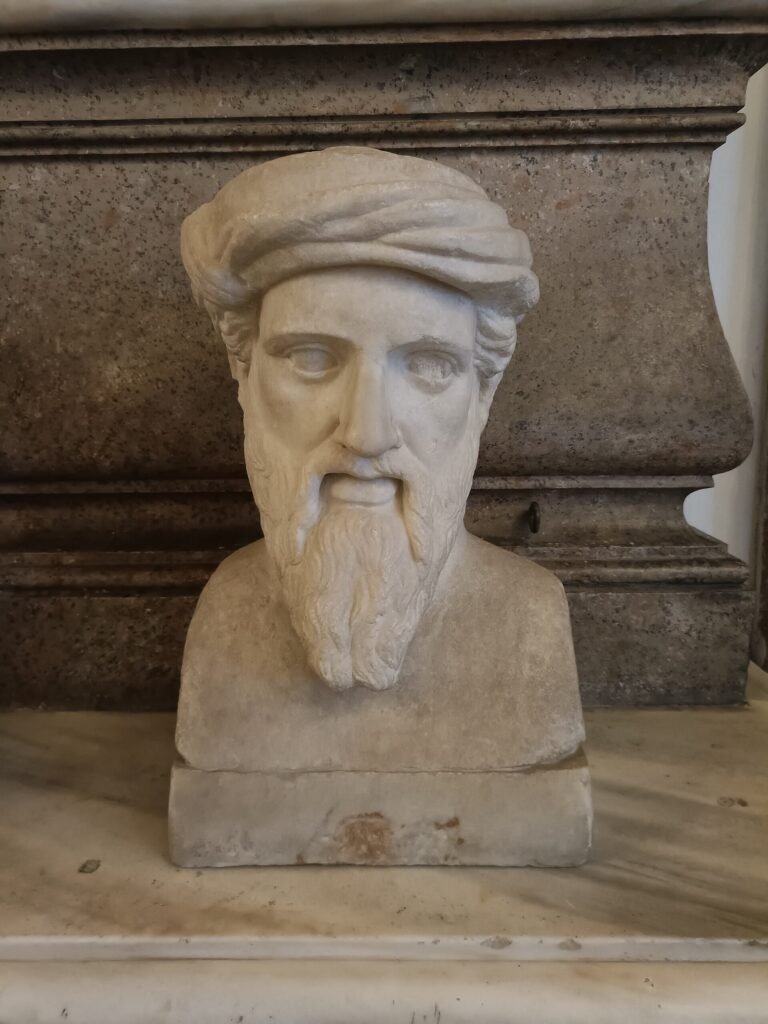
Pythagoras was a Greek philosopher from the island of Samos who lived from about 570 BCE to about 490 BCE and founded a religious and philosophical community at Croton in southern Italy. He wrote nothing himself, and nearly everything said about him was recorded long after his death. He is remembered for the theorem that bears his name, though his connection to it is more complicated than it seems.
Early life of Pythagoras
Pythagoras was born on Samos, an island off the coast of modern Turkey, around 570 BCE. According to the MacTutor biography, his father, Mnesarchus, was a merchant from Tyre, and his mother, Pythais, was a native of Samos. He was well educated, learning to play the lyre and to recite Homer, and he traveled widely as a child with his father.
MacTutor names several teachers who influenced him, including the philosopher Pherekydes and the thinkers of Miletus. Thales, it says, advised him to travel to Egypt, and Pythagoras also attended lectures by Thales’s pupil Anaximander. Later accounts say he went to Egypt around 535 BCE and then to Babylon, returning to Samos around 520 BCE. These travel stories come from writers who lived centuries later, so they should be read with care.
Career and major work of Pythagoras
The Stanford Encyclopedia of Philosophy says Pythagoras emigrated at about the age of forty to Croton, a Greek city in southern Italy, and that most of his philosophical activity took place there. He gathered a community of followers that was half religious and half scholarly. MacTutor says it had an inner circle called the mathematikoi, who lived together without personal possessions, and an outer circle called the akousmatics, who lived in their own homes. Both men and women could join.
The society became caught up in local politics. MacTutor reports that around 510 BCE Croton defeated its neighbor Sybaris, and that Pythagoras may have been involved in the dispute. Around 508 BCE a nobleman named Cylon attacked the Pythagorean society. Pythagoras escaped to Metapontium, where most authors say he died, and some say he took his own life after the attack.
The Stanford Encyclopedia of Philosophy adds that sources disagree about the practices of the group. One early writer says Pythagoras ate meat, while another portrays him as avoiding it entirely. This is typical of a tradition that was already inconsistent within a few generations of his death.
Ideas and contributions of Pythagoras
The earliest evidence suggests that Pythagoras was famous less for mathematics than for his teachings about the soul. According to the Stanford Encyclopedia of Philosophy, he was known as an expert on the fate of the soul after death, who held that the soul was immortal and passed through a series of reincarnations. He was also known as a teacher of religious ritual and as the founder of a strict way of life, which included forbidding the eating of beans.
Number and music were central to the Pythagorean outlook. MacTutor reports that Pythagoras noticed that vibrating strings give harmonious tones when their lengths are in simple whole-number ratios, and that this finding contributed to a mathematical theory of music. From such observations came the belief that all things are numbers and that the cosmos is a scale. The link between numbers and tones is an early example of what later became the study of harmony.
Mathematical work is linked to the Pythagoreans in general. MacTutor says they studied properties of numbers such as even, odd and triangular numbers, and that Pythagoras may have known how to construct the first three regular solids. The discovery of irrational numbers is also attributed to the Pythagoreans, but MacTutor considers it unlikely to have been made by Pythagoras himself, since it went against the doctrine that all things are numbers.
The Pythagorean theorem
The theorem states that in a right-angled triangle the square on the hypotenuse equals the sum of the squares on the other two sides. MacTutor notes that the Babylonians knew this relationship about 1,000 years before Pythagoras, although he may have been the first to prove it.
Other scholars are more doubtful. The Stanford Encyclopedia of Philosophy states that Pythagoras valued relationships between numbers like those in the theorem but that he probably did not prove it. The first surviving proof is found in the Elements of Euclid, who lived about two centuries later. The name of the theorem therefore reflects tradition more than documented authorship.
Legacy of Pythagoras
Pythagorean ideas shaped later Greek thought. The Internet Encyclopedia of Philosophy lists the Pythagoreans among the influences on Plato, whose dialogues discuss the immortal soul, rebirth and the role of mathematics in understanding reality. The belief that numbers and ratios underlie the order of the world remained an important theme in Western philosophy and science.
The theorem that carries his name is taught in schools throughout the world, and the word Pythagorean is still used for the number triples, such as 3, 4 and 5, that fit it.
The Pythagorean question
Historians call the problem of recovering the real Pythagoras the Pythagorean question. As the Stanford Encyclopedia of Philosophy explains, Pythagoras wrote nothing, and no extended account was written during his lifetime. By the first century BCE a large collection of books had been forged in the names of Pythagoras and other early Pythagoreans. The most detailed biographies date from the third century CE, about 800 years after his death.
Later writers also presented him as a semi-divine figure who originated all that was true in Greek philosophy. Modern scholars therefore try to separate the historical man from his followers and from legend. Where sources conflict, as with his diet, his role in the theorem or the details of his death, this entry reports the disagreement rather than choosing one version.
More in Mathematics
Key facts
- Pythagoras lived from about 570 to about 490 BCE and was born on the island of Samos.1
- He emigrated at about the age of forty to Croton in southern Italy, where he led a religious and philosophical community.2
- He wrote nothing, and the most detailed accounts of his life date from about 800 years after his death.2
- The Babylonians knew the relationship in the Pythagorean theorem about 1,000 years earlier, and scholars disagree about whether he proved it.1
- He is credited with noticing that vibrating strings give harmonious tones when their lengths are in simple whole-number ratios.1
Related concepts
In the news
Quick checkDid Pythagoras discover the Pythagorean theorem?Show answer
Probably not in the sense of first discovering it. The Babylonians knew the relationship about 1,000 years earlier, and scholars disagree about whether Pythagoras proved it.
Sources
- MacTutor History of Mathematics, University of St Andrews, Pythagoras of Samos, https://mathshistory.st-andrews.ac.uk/Biographies/Pythagoras/
- Stanford Encyclopedia of Philosophy, Pythagoras, https://plato.stanford.edu/entries/pythagoras/
- Internet Encyclopedia of Philosophy, Plato, https://iep.utm.edu/plato/
Editorially reviewed by Specialty Digest Editorial TeamLast reviewed November 4, 2026Researched and drafted with AI assistanceReport an issue