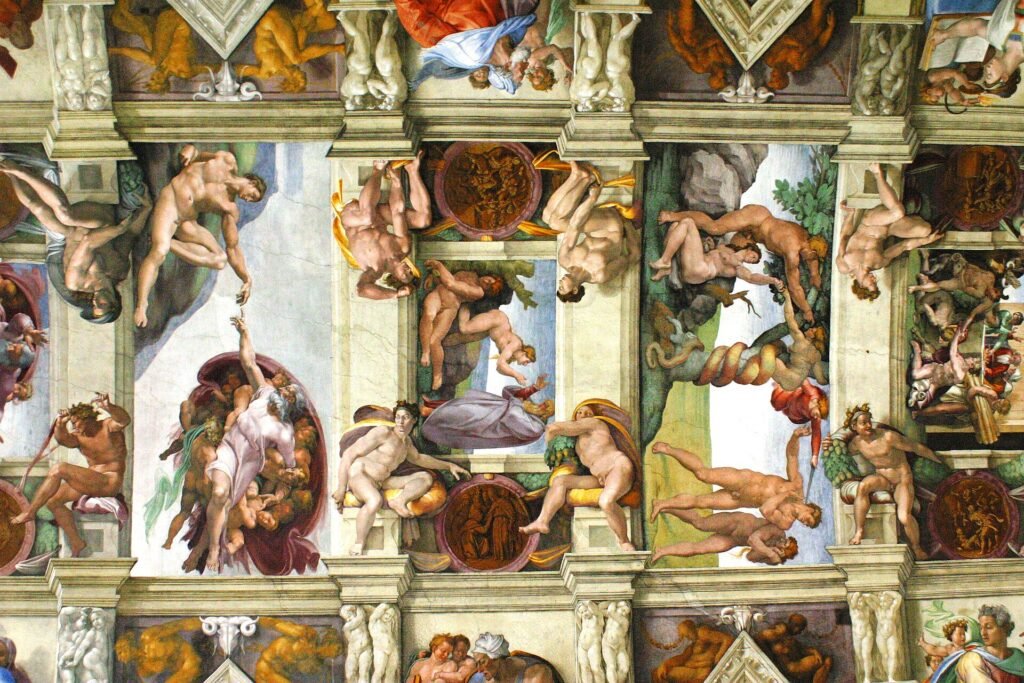
The Sistine Chapel ceiling is a cycle of frescoes painted by Michelangelo between 1508 and 1512 in the papal chapel at the Vatican in Rome. Commissioned by Pope Julius II, it presents nine scenes from the Book of Genesis, surrounded by prophets, sibyls and the ancestors of Christ. Its best-known panel is The Creation of Adam.
Background and creation of the Sistine Chapel ceiling
The chapel already had a painted decoration when Michelangelo began. The National Gallery in London records that the building was newly completed in 1481, when painters from Florence, among them Sandro Botticelli, were called to Rome to cover its walls with scenes from the lives of Moses and Christ. The ceiling was a separate project that came decades later.
The Vatican Museums explain that Julius II decided to renovate the ceiling because of structural problems that probably began early in his pontificate. Building work nearby for the Borgia Tower and the new St. Peter’s may have caused them, and the excavations carried out north and south of the chapel are the probable cause. In May 1504 a long crack opened in the ceiling, and the architect Donato Bramante fixed tie rods in the area above the chapel. The old painting was damaged badly enough that the pope chose a new decoration, so the project began as a repair before it became one of the great commissions of the period.
According to the British Museum, Michelangelo had been summoned to Rome by Julius II in 1505. On 8 May 1508 he signed a contract for a scheme with twelve apostles in the pendentives and ornamental motifs elsewhere. He considered that plan a poor thing, so the pope gave him a new commission and left the full planning of the program to the artist. The Vatican Museums think it likely that he consulted theologians of the papal court.
Description of the Sistine Chapel ceiling
Michelangelo placed nine central stories from Genesis within a powerful painted architecture. At their sides sit nude figures, often called ignudi, who hold medallions with texts taken from the Book of Kings. At the base of the architectural structure, twelve prophets and sibyls sit on monumental thrones.
Lower down, in the spandrels and lunettes on the north, south and entrance walls, are the forefathers of Christ. In the four corner pendentives the artist illustrated episodes of the miraculous salvation of the people of Israel. The scheme therefore links the creation of the world, the history of Israel, the prophets and the ancestry of Christ in one program.
The architecture is painted rather than built. It creates the impression of structure and depth on the ceiling itself, which is the quality the Touring Club Italiano praises. The club, writing through Google Arts & Culture, adds that Michelangelo organized the work in 1508, when he was 33, and that his design was revolutionary. He dispensed with flat geometric decoration and introduced depth and drama to the chapel.
Painting the ceiling, 1508 to 1512
The work was done in two stages. Michelangelo finished the first half, from the entrance wall as far as the Creation of Eve, in August 1510. The second half followed, and the figure of Adam was painted in this later stage, around 1511, according to the British Museum.
Michelangelo made preparatory studies for many figures. The British Museum owns a red chalk drawing of 1511 for Adam in which the pose is almost unchanged from the painted version, and it says he would then have used a full-size cartoon to transfer the final design to the ceiling.
The Vatican Museums state that the work must have been completed by 31 October 1512, because the pope celebrated Mass in the chapel the next day, on 1 November. The painting had taken a little over four years from the signing of the contract. The whole commission fell within the pontificate of Julius II, which the museums date from 1503 to 1513.
Themes and interpretation of the Sistine Chapel ceiling
The Vatican Museums present the frescoes of the chapel as an introduction to the content of Revelation, with the truths of the Christian faith expressed through imagery. The wall frescoes of the lives of Moses and Christ were already in place, so the ceiling supplied the earlier part of the biblical story from Genesis. Its central panels begin with creation and move through the first human beings, and the surrounding figures look ahead to the coming of Christ.
The program was unusual because Michelangelo, not the papal court, decided it. Julius II left the planning to him, and the result was a layered scheme in which narrative scenes, prophets and ancestors all support one theological idea. The sources used here describe the structure but do not give a single official reading, so more detailed interpretations should be treated as scholarly proposals.
Reception and legacy of the Sistine Chapel ceiling
The Touring Club Italiano calls the ceiling the crowning glory of all decorated ceilings. It also records that the work was not free of controversy. Michelangelo was criticized for his depiction of nudity, and some popes even threatened to remove the frescoes. They survived.
The chapel is part of Vatican City, which UNESCO lists as a World Heritage property for its concentration of artistic and architectural masterpieces. The ceiling is a landmark of the High Renaissance and the main work associated with Michelangelo’s years in Rome.
The best-known single panel, The Creation of Adam, has its own entry. Many other figures from the ceiling, including the prophets and sibyls, have also been widely copied and studied. The Vatican Museums publish a scheme of the ceiling on their website that shows where each scene sits, which is a helpful guide to the program for readers who cannot visit.
More in Visual Arts
Key facts
- The Sistine Chapel ceiling was painted by Michelangelo for Pope Julius II; the contract was signed on 8 May 1508.1
- Michelangelo finished the first half, up to the Creation of Eve, in August 1510, and the whole ceiling was complete by 31 October 1512.1
- It has nine central stories from Genesis, ignudi holding medallions, twelve prophets and sibyls, and the ancestors of Christ.1
- A crack that opened in May 1504 was one reason Julius II renovated the ceiling.1
- The Touring Club Italiano notes that Michelangelo was criticized for nudity and some popes threatened to remove the frescoes.2
Related concepts
Quick checkWho decided what would be painted on the Sistine Chapel ceiling?Show answer
Michelangelo did. The first contract of 1508 called for twelve apostles, but he thought it a poor plan, and Julius II then left the full program to him, probably with advice from papal theologians.
Sources
- Vatican Museums, Sistine Chapel: Ceiling, https://www.museivaticani.va/content/museivaticani/en/collezioni/musei/cappella-sistina/volta.html
- Touring Club Italiano, The Sistine Chapel, Vatican City, in 8 Incredible Decorated Ceilings, Google Arts & Culture, https://artsandculture.google.com/story/8-incredible-decorated-ceilings/MAXhvWC8kLrZFA?hl=en
- British Museum, Study for Adam by Michelangelo Buonarroti (registration number 1926,1009.1), Google Arts & Culture, https://artsandculture.google.com/asset/study-for-adam-michelangelo-buonarroti/WAGMoyZVzEFtNg?hl=en
- National Gallery, London, Sandro Botticelli (about 1445 - 1510) artist biography, https://www.nationalgallery.org.uk/artists/sandro-botticelli
- UNESCO World Heritage Centre, Vatican City, https://whc.unesco.org/en/list/286
Editorially reviewed by Specialty Digest Editorial TeamLast reviewed November 5, 2026Researched and drafted with AI assistanceReport an issue