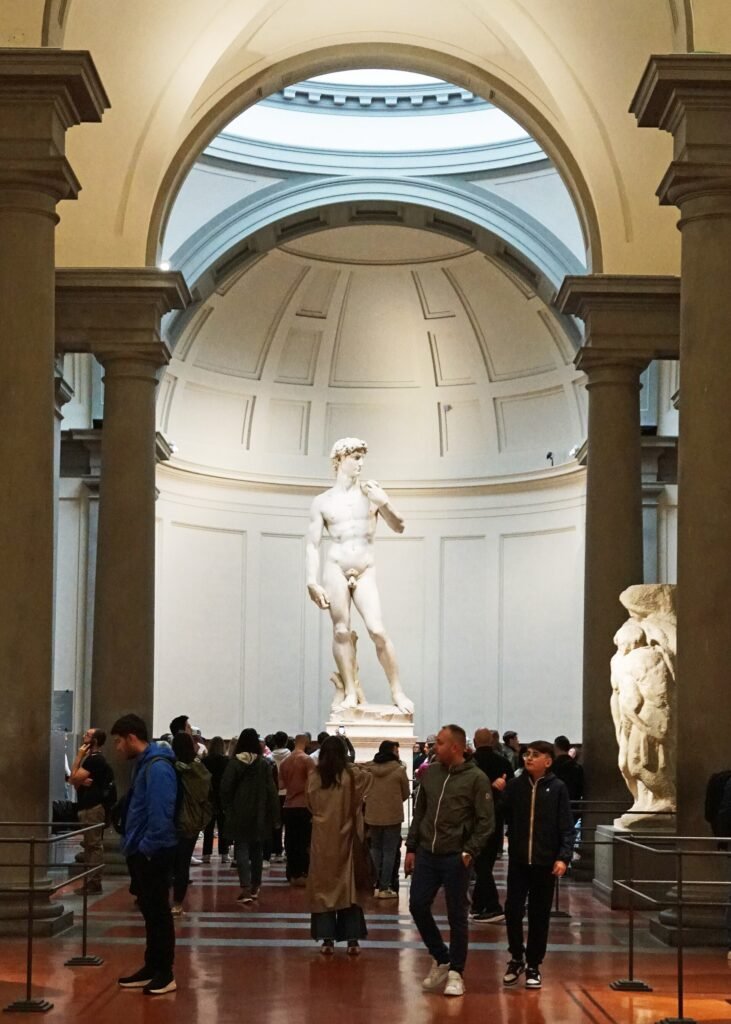
David is a marble statue of the biblical hero David, carved by Michelangelo in Florence between 1501 and 1504. It stands about 5.17 meters, or 17 feet, tall and is displayed in the Galleria dell’Accademia. The statue was commissioned for Florence Cathedral but was placed outside the city’s town hall, where it became a symbol of civic independence.
Background and creation of David
The Opera di Santa Maria del Fiore, the body that has looked after Florence Cathedral for centuries, says that Michelangelo was commissioned on 16 August 1501. He was one of several artists asked to make twelve statues of Old Testament figures for the buttresses of the cathedral. The original document is in the Opera’s archive. A Google Arts & Culture account adds that the wool guild was behind the commission.
Michelangelo did not start from a fresh block. The Opera explains that the sculptor Agostino di Duccio began working a large block of Carrara marble in 1464. He only roughly outlined a figure and damaged the stone, and he left the project in 1466. Antonio Rossellino made a second attempt that also went unfinished, and the block then sat unused for about 25 years.
In 1500 another attempt was made to finish the work, and several famous artists, including Leonardo da Vinci, were consulted. Michelangelo, who was 26, won the commission. He began work in August 1501, and the Opera records that the statue was almost finished by 25 January 1504. The Opera gives the height of the block as nine braccia, about 5.22 meters. Another account says that it took fifty years before the guild found an artist able to complete the statue.
Description of David
The statue shows a standing nude young man, carved from a single piece of white marble. He stands in contrapposto, with his weight on one leg and the other relaxed, a pose that Florentines knew from admired classical statues. The Google Arts & Culture account notes that the shining marble and the pose both refer to those ancient models.
Michelangelo chose a moment that earlier artists usually avoided. Most depictions show David standing victorious over the head of the defeated Goliath, or in the middle of the fight. Michelangelo instead shows David before the confrontation, in what the account calls the tense calm before the storm. His expression is anxious, and his furrowed brow suggests quiet determination.
It might look like a realistic depiction of the human body, but the same account points out that many of its features are wildly out of proportion. Michelangelo often used optical illusions in his work, so the unusual proportions do not make the figure look any less lifelike. Google Arts & Culture and the Scan the World project have also published a 3D model with a close look at the head.
Installation and later history of David
The cathedral plan did not survive the statue’s size and weight. The Opera says it convened a committee of prominent Florentines, including Leonardo da Vinci and Sandro Botticelli, to choose a site. The committee chose the entrance of the Palazzo dei Priori, which is today called the Palazzo Vecchio.
The statue was moved about 400 meters in a large wooden cage by roughly forty men and arrived at the Palazzo dei Priori on 18 May 1504. It then stood in the square outside the building for centuries. Some Medici supporters threw stones at it at night, and lightning struck it in 1512, but neither stopped it from becoming one of the most famous statues in the world.
In 1873 the original was moved indoors to its present home, the Galleria dell’Accademia. A copy now stands in front of the Palazzo Vecchio, so visitors who look at the statue in the square are seeing a replica.
Themes and interpretation of David
David soon came to represent the defense of civil liberties and the independence of Florence. Florence was a small city-state surrounded by more powerful neighbors, so the story of a small hero defeating a giant held a special place in its civic imagination.
The subject already carried political meaning. When the Medici family was exiled from Florence in 1494, their bronze David, made by Donatello around 1440, was taken from them and displayed in the courtyard of the Palazzo della Signoria. Florentines saw the figure as a symbol of their struggle with the Medici. The account adds that Michelangelo’s statue was oriented so that its gaze pointed straight toward Rome, the city that had become the home of the Medici.
Florence at the time was a rich and proud city, willing and able to pay for artists such as Leonardo da Vinci, Donatello and Raphael. The Google Arts & Culture account says that it took some years, and a good deal of politics and grudges, before the city decided where the statue should stand. Reading the statue as a political symbol does not rule out other readings, but the sources used here stress the civic meaning most.
Reception and legacy of David
The Google Arts & Culture account calls the statue an enduring symbol of strength, fortitude and beauty known all over the world. David has been copied many times. It appears on postcards and in advertisements, and replicas of it stand at sports stadiums, including the Pacaembu stadium in Sao Paulo, Brazil. That success, the account says, shows that the statue has come to stand for much more than Florentine pride.
David is also a standard example of sculpture in the Italian Renaissance. Its history also shows how a block of marble that two earlier sculptors had left unfinished could become a masterpiece in the hands of a young artist.
More in Visual Arts
Key facts
- Michelangelo was commissioned to carve David on 16 August 1501, and the statue was almost finished by 25 January 1504.12
- The marble block had been started by Agostino di Duccio in 1464 and later worked by Antonio Rossellino.1
- The statue stands about 5.17 meters (17 feet) tall.3
- It was moved to the Palazzo dei Priori on 18 May 1504 by about forty men with a large wooden cage.2
- The original was moved to the Galleria dell'Accademia in 1873, and a copy stands in front of the Palazzo Vecchio.34
Related concepts
In the news
Quick checkWhy does Michelangelo's David not show the fight with Goliath?Show answer
Michelangelo chose the tense moment before the confrontation. Earlier statues usually showed David already victorious over Goliath, so his choice emphasizes anxiety and determination.
Sources
- Opera di Santa Maria del Fiore, A giant on the move: Michelangelo's David, part 1, https://duomo.firenze.it/en/opera-magazine/post/4456/a-giant-on-the-move-michelangelo-s-david-part-1
- Opera di Santa Maria del Fiore, A giant on the move: Michelangelo's David, part 2, https://duomo.firenze.it/en/opera-magazine/post/4458/a-giant-on-the-move-michelangelo-s-david-part-2
- Google Arts & Culture with Scan the World, Michelangelo's David in 3D, https://artsandculture.google.com/story/michelangelo-39-s-david-in-3d/dAWBjX-EWTtdYA?hl=en
- Google Arts & Culture, Can You Find Michelangelo's David in Florence?, https://artsandculture.google.com/story/can-you-find-michelangelo-39-s-david-in-florence/0AVRN9EdsrlbIQ?hl=en
Editorially reviewed by Specialty Digest Editorial TeamLast reviewed November 5, 2026Researched and drafted with AI assistanceReport an issue