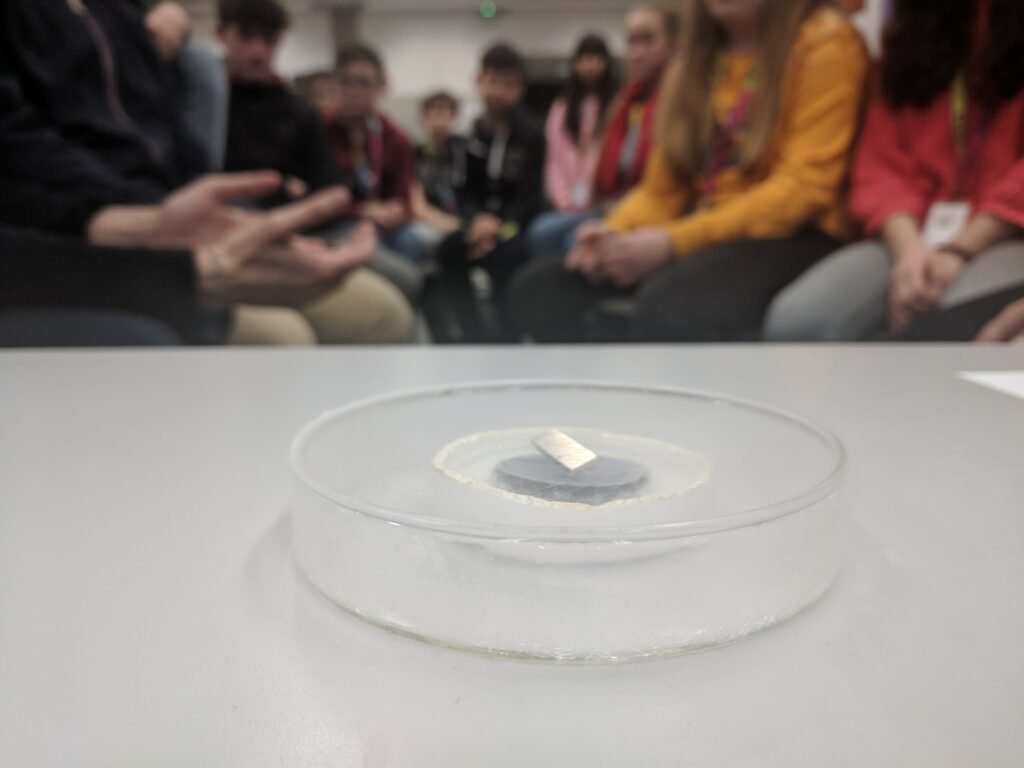
Superconductivity is a state of matter in which a material carries electric current with no electrical resistance and expels magnetic fields from its interior. It appears when certain materials are cooled below a critical temperature that differs from material to material. The effect has been known since 1911, and it now powers scientific instruments, medical scanners and experimental trains.
History of superconductivity
Superconductivity was discovered in 1911 in the laboratory of the Dutch physicist Heike Kamerlingh Onnes. He won the 1913 Nobel Prize in Physics for his investigations of the properties of matter at low temperatures, work that led, among other results, to the production of liquid helium. Helium was the practical coolant for decades, since it boils at about minus 269 degrees Celsius.
The Nobel committee noted that when a superconducting material is cooled below its critical temperature, a current can flow with no resistance whatsoever. At the same time the Meissner effect appears: a magnetic field cannot, or can only partly, enter the material.
A theory arrived in the 1950s. John Bardeen, Leon Cooper and Robert Schrieffer shared the 1972 Nobel Prize in Physics for their jointly developed theory of superconductivity, usually called BCS theory. In outline, electrons in a superconductor pair up and move together without scattering off the crystal lattice.
Progress in raising the critical temperature was slow until 1986. According to the Royal Swedish Academy of Sciences, nothing had changed since 1973, when an alloy was made that became superconducting at minus 250 degrees Celsius. Georg Bednorz and Alex Muller at the IBM Zurich Research Laboratory then reported superconductivity in an oxide containing copper and rare earth metals at a temperature 12 degrees higher. They received the 1987 Nobel Prize in Physics, and hundreds of laboratories began work on similar ceramics.
How superconductivity works
In an ordinary conductor such as copper, electrons collide with atoms and impurities, and these collisions turn electrical energy into heat. A superconductor avoids the losses. Below the critical temperature its electrons enter a collective state in which the current can circulate indefinitely without a power source.
The second defining feature is the Meissner effect. A superconductor pushes magnetic fields out, which is why a small magnet can float above a superconductor cooled with liquid nitrogen. This is different from perfect conduction alone, and it makes superconductivity a distinct phase of matter.
Superconductivity disappears if the material is warmed above its critical temperature, placed in too strong a magnetic field, or asked to carry too much current. These three limits shape every practical design.
Types of superconductors
Conventional, or low-temperature, superconductors are metals and alloys that work only near the temperature of liquid helium. Niobium-based alloys are common in magnets because they can be made into wire. Their behavior is well described by BCS theory.
High-temperature superconductors are ceramic oxides, first found in 1986. Many contain copper and oxygen layers, and some work above the boiling point of liquid nitrogen, which is far cheaper and easier to use than helium. Their ceramic nature makes them brittle and harder to form into wire, and scientists still debate exactly how they work.
The material called a superconductor is the physical substance. Superconductivity is the phenomenon and the technology built around it.
Applications of superconductivity
The best-known large-scale use is particle physics. CERN’s Large Hadron Collider is a 27-kilometer ring of superconducting magnets. Its magnets are cooled to minus 271.3 degrees Celsius, colder than outer space, by a distribution system of liquid helium. The collider includes 1,232 dipole magnets, each 15 meters long, which bend the particle beams, and 392 quadrupole magnets, which focus them. It first started up on September 10, 2008.
Superconducting magnets are also the basis of many magnetic resonance imaging scanners and of research magnets for physics and chemistry. Because a superconducting coil wastes no energy as heat, it can produce a very strong field with a modest power supply once it is cooled.
Magnetic levitation trains use the same idea. The U.S. Department of Energy explains that superconducting magnets, cooled to extreme temperatures, can generate fields up to ten times stronger than ordinary electromagnets, enough to suspend and propel a train car. Other developing uses include power cables, fault-current limiters for electric grids and sensitive magnetic detectors.
The idea of levitating trains with superconducting magnets traces to Brookhaven National Laboratory, where James Powell and Gordon Danby received the first patent for a magnetically levitated train design in the late 1960s, according to the Department of Energy. Researchers also build superconducting circuits for experimental quantum computers, because the absence of resistance helps fragile quantum states last long enough to be used.
Advantages and disadvantages of superconductivity
The advantages follow from zero resistance: no heat loss in the conductor, compact high-field magnets and the possibility of very efficient power equipment. The Meissner effect enables stable levitation and shielding.
The disadvantages are mostly about cooling and materials. Reaching the needed temperature requires cryogenic equipment, which adds cost, complexity and energy use. High-temperature ceramics are difficult to manufacture. The critical temperature, field and current limits also constrain what a given material can do.
A material that superconducts at room temperature and ordinary pressure would remove most of these obstacles, but it has not been established. Claims of such materials have repeatedly failed independent checks, so reports are weighed by whether other laboratories can reproduce them.
Superconductivity vs. ordinary conductivity
A good ordinary conductor, such as copper or silver, still has resistance, and a current in it dies away quickly once the source is removed. A superconductor’s resistance falls to zero below its critical temperature, so a current can persist. The information here is general scientific background.
More in Physics
Key facts
- Superconductivity has been known since 1911; below a critical temperature a current flows with no resistance and the Meissner effect keeps magnetic fields out.1
- Heike Kamerlingh Onnes won the 1913 Nobel Prize in Physics for low-temperature work that led to liquid helium.2
- Bardeen, Cooper and Schrieffer won the 1972 Nobel Prize in Physics for BCS theory.2
- Bednorz and Muller won the 1987 Nobel Prize in Physics for superconductivity in ceramic oxides.1
- The Large Hadron Collider uses 1,232 superconducting dipole magnets cooled to minus 271.3 degrees Celsius.3
Related concepts
Quick checkWhat is the Meissner effect?Show answer
It is the expulsion of magnetic fields from a superconductor, so a magnetic field cannot, or can only partly, penetrate the material. It is why a magnet can float above a cooled superconductor.
Sources
- 1. Royal Swedish Academy of Sciences, Press release: The 1987 Nobel Prize in Physics, https://www.nobelprize.org/prizes/physics/1987/press-release/
- 2. Nobel Prize Outreach, The Nobel Prize in Physics 1913 and The Nobel Prize in Physics 1972 (summaries), https://www.nobelprize.org/prizes/physics/1913/summary/ and https://www.nobelprize.org/prizes/physics/1972/summary/
- 3. CERN, The Large Hadron Collider, https://home.cern/science/accelerators/large-hadron-collider
- 4. U.S. Department of Energy, How Maglev Works, https://www.energy.gov/articles/how-maglev-works
Editorially reviewed by Specialty Digest Editorial TeamLast reviewed November 4, 2026Researched and drafted with AI assistanceReport an issue