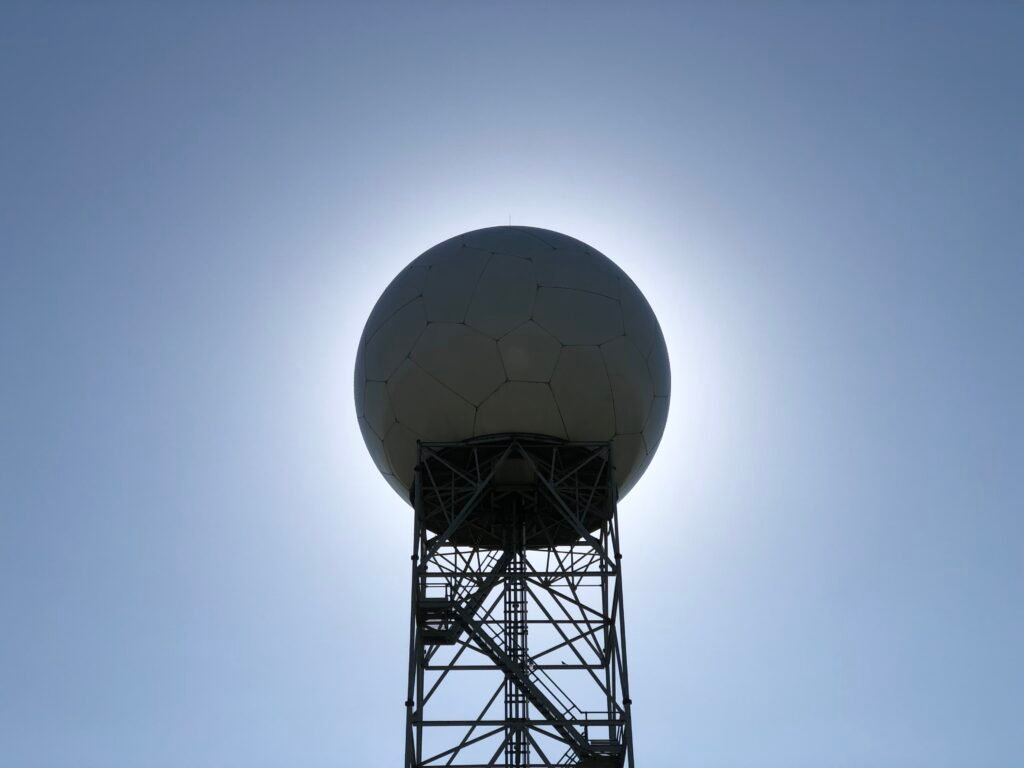
Radar is a technology that uses radio waves to detect objects and measure their distance, direction and, in many systems, speed. The word is an acronym for radio detection and ranging. A radar transmits radio energy, listens for the part that reflects off a target, and works out where the target is from the returning echo. It works day and night and through cloud and rain, which is why it underpins weather forecasting and air traffic control.
History of radar
The Engineering and Technology History Wiki dates a key moment in the field to February 12, 1935, when the Scottish engineer Robert Watson-Watt sent a memorandum titled “Detection of aircraft by radio methods.” The radio astronomer Robert Hanbury Brown called it the birth certificate of radar. Radar then moved quickly into military service. During the 1940 Battle of Britain, a radar system called Chain Home alerted the British to incoming German air raids.
After the war, radar became a civilian tool. In the United States, research at NOAA’s National Severe Storms Laboratory (NSSL), starting from the WSR-57 research project, led through Doppler radar to a national weather radar network. NSSL credits that work with moving severe-weather warnings from no lead time to about 15 minutes. The network is known as NEXRAD, and its radars are designated WSR-88D, short for Weather Surveillance Radar, 1988, Doppler. A later dual-polarization upgrade made their images more informative, and research on phased array radar continues.
How radar works
NOAA explains that a radar system usually has a transmitter that sends out radio signals and a receiver that catches reflected energy from targets. The transmitter does not send a continuous stream. It sends very brief pulses, and the system measures how long each pulse takes to leave, strike a target and return. That time gives the target’s range.
Radio waves travel at the speed of light, so the arithmetic is simple but the timing is demanding. An echo that returns one millisecond after the pulse left came from a target about 150 kilometers away. NOAA reports that the WSR-88D, in its usual short-pulse mode, sends pulses lasting 1.57 millionths of a second and repeats them about 1,300 times per second. The transmitter is on for a little more than 7 seconds in an hour, so the radar spends almost all of its time listening for returns.
Doppler radar adds speed. The radar keeps track of the phase and amplitude of each pulse, and when a pulse hits a moving target, the phase of the returning wave is shifted. The effect is like the change in pitch of a passing siren. The size of the shift shows how fast the target is moving toward or away from the radar, which lets forecasters see rotation inside a storm. NOAA notes that all modern weather radars are Doppler radars and that the sweeping line some television stations show is computer-generated for effect.
Geometry limits what a radar sees. The beam travels in a straight line while Earth’s surface curves away, so the beam climbs higher above the ground with distance. NOAA gives the example that at 100 miles from the radar, the lowest beam angle of 0.5 degrees is about 12,000 feet above the ground, so low-level features far from the radar can go unseen.
Types of radar
Radars are commonly grouped by purpose and by design. Weather radars measure precipitation and wind. Air surveillance radars track aircraft for air traffic control and defense, and NSSL counts more than 350 radars operated by the Federal Aviation Administration. Marine, automotive and speed-measurement radars apply the same principle on a smaller scale.
Design matters too. According to NOAA’s National Centers for Environmental Information, NEXRAD is a network of 160 high-resolution S-band Doppler weather radars operated jointly by the National Weather Service, the Federal Aviation Administration and other U.S. agencies. S-band is a range of radio frequencies whose wavelengths are several centimeters long.
Dual-polarization radar sends and receives pulses that oscillate both horizontally and vertically. NOAA says this gives forecasters a more informative picture and helps them tell rain, hail, snow, the rain-snow line and ice pellets apart. Phased array radar replaces the rotating dish with a flat panel of many small elements that steer the beam electronically. Phased array systems have been used by the military for years to track aircraft, and in 2018 NSSL installed an Advanced Technology Demonstrator, which it describes as the first full-scale S-band dual-polarization phased array radar built from the ground up for weather.
Applications of radar
Weather forecasting is the most visible use. Forecasters read radar images to locate rain, hail and snow, follow storms as they move, and spot the rotation that can precede a tornado. Because the pulses return even from precipitation too distant or too dark to see, warnings can reach communities before a storm arrives.
Aviation depends on radar to show controllers where aircraft are, and ships use it to see coastlines, buoys and other vessels in fog or darkness. On roads, radar sensors measure vehicle speed and feed driver-assistance systems that watch the distance to the car ahead. Scientists also fly radar on aircraft and spacecraft to map terrain and measure rainfall from above, and satellite links such as those described under satellite communication often carry the resulting data back to the ground.
Advantages and disadvantages of radar
Radio waves pass through darkness, cloud, fog and rain, so radar keeps working when cameras and eyes cannot. It measures range directly, and Doppler systems measure speed directly, over wide areas and in near real time.
The limits are mostly geometric and practical. The beam rises above the ground with distance, hills and buildings can block it, and echoes from birds, insects, buildings and wind turbines can clutter an image. Reading a radar picture takes training, because the same echo strength can come from different kinds of targets. Radars are also expensive to build and maintain, and NSSL has warned that large numbers of the nation’s weather and aviation radars were approaching the point where they would need to be replaced or have their service lives extended.
Radar vs. sonar
Radar and sonar share the same echo-timing principle but use different waves. Radar uses radio waves, which travel at the speed of light and fade quickly in seawater. Sonar uses sound pulses, which travel far under water at about 1,500 meters per second, so it is the standard tool for finding objects below the surface. Because sound is so much slower than radio, sonar echoes take far longer to return than radar echoes from targets at the same distance.
More in Electrical Engineering
Key facts
- Radar stands for radio detection and ranging.1
- Robert Watson-Watt sent his memorandum "Detection of aircraft by radio methods" on February 12, 1935.2
- The Chain Home radar system alerted Britain to German air raids during the 1940 Battle of Britain.2
- In short-pulse mode, the WSR-88D sends pulses lasting 1.57 millionths of a second, about 1,300 times per second.1
- At 100 miles from a radar, the lowest beam angle of 0.5 degrees is about 12,000 feet above the ground.1
- NEXRAD is a network of 160 high-resolution S-band Doppler weather radars.3
- NSSL research led to a warning lead time of about 15 minutes for threatening weather.4
Related concepts
In the news
Quick checkWhat does the word radar stand for?Show answer
It stands for radio detection and ranging.
Sources
- 1. NOAA JetStream, How Radar Works, https://www.noaa.gov/jetstream/doppler/how-radar-works
- 2. Engineering and Technology History Wiki, Radar, https://ethw.org/Radar
- 3. NOAA National Centers for Environmental Information, Next Generation Weather Radar (NEXRAD), https://www.ncei.noaa.gov/products/radar/next-generation-weather-radar
- 4. NOAA National Severe Storms Laboratory, Research Tools: Radar, https://www.nssl.noaa.gov/tools/radar/
Editorially reviewed by Specialty Digest Editorial TeamLast reviewed November 4, 2026Researched and drafted with AI assistanceReport an issue