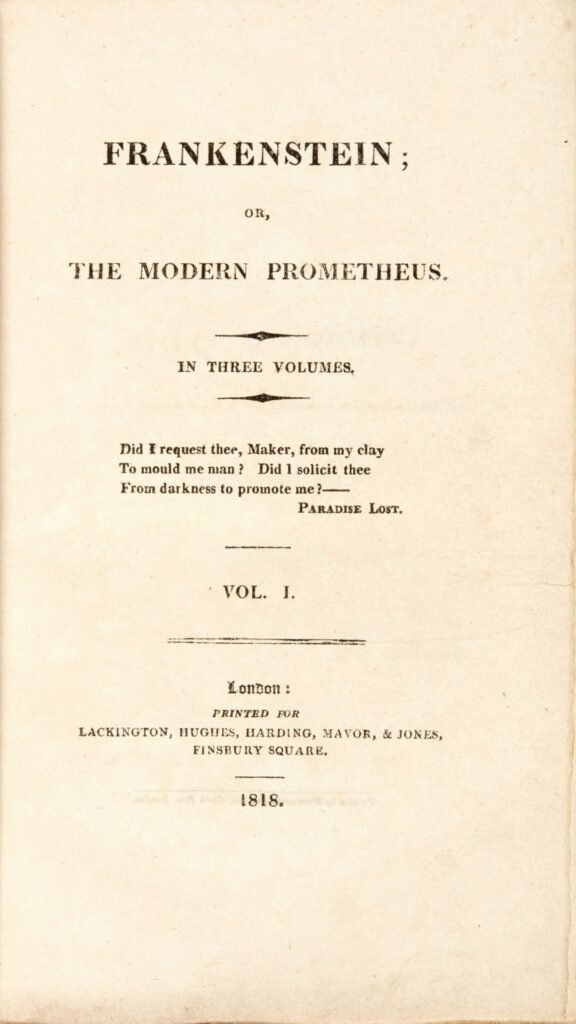
Frankenstein; or, The Modern Prometheus is a novel by the English writer Mary Shelley (1797 to 1851), first published anonymously in 1818. It tells of Victor Frankenstein, a young scientist who builds a living creature from parts of dead bodies and then abandons it, with tragic results for both of them. It is often described as an early work of science fiction and is also a landmark of Gothic literature.
Background and writing of Frankenstein
Mary Godwin was the daughter of two noted thinkers, the political philosopher William Godwin and the feminist writer Mary Wollstonecraft, who died ten days after giving birth to her. She grew up in a literary household and was well read in the scientific and intellectual ideas of her time.
In the summer of 1816 she and the poet Percy Bysshe Shelley, whom she married later that year, stayed near Lake Geneva in Switzerland. They visited Lord Byron, who was living at the Villa Diodati with his physician John William Polidori, and the group talked about literature, politics and science. The U.S. National Library of Medicine records that Byron suggested a contest to write a terrifying tale.
Mary was only eighteen when she began Frankenstein. She later described a waking dream in which she saw a pale student kneeling beside the thing he had put together, and she started the story from that image, opening with the words “It was on a dreary night of November.”
Publication and editions of Frankenstein
The first edition appeared in 1818 without the author’s name, and many readers assumed a man had written it. According to the Faculty of English at the University of Oxford, it sold about 500 copies.
Reviews were divided. The novelist Sir Walter Scott praised its vigor and originality, while other critics attacked what one called a tissue of horrible and disgusting absurdity and complained that it taught no useful moral lesson.
Stage versions in the 1820s brought wider fame. In 1831 Shelley published an expanded edition under her own name, with a new preface in which she described her “hideous progeny” with affection and set the book in the Gothic tradition. Scholars today read both the 1818 and 1831 texts, which differ in several ways.
Plot summary of Frankenstein
The novel is framed by letters from Robert Walton, an explorer sailing toward the Arctic, to his sister in England. Walton rescues an exhausted traveler, Victor Frankenstein, who tells him his story.
Victor grew up in Geneva and studied natural philosophy at the university at Ingolstadt. Obsessed with the secret of life, he assembles a creature from body parts and brings it to life on a dreary night in November. Horrified by what he sees, he flees and leaves the creature alone.
The creature wanders, learns language by secretly watching a family in a cottage, reads books including Paradise Lost, and tries to join human society, but people recoil from his appearance. He confronts Victor and asks him to make a female companion. Victor begins and then destroys the work, and the creature takes revenge by killing people close to Victor, including his friend Clerval and his wife Elizabeth.
Victor pursues the creature north across the ice, but dies of exhaustion after finishing his story to Walton. The creature appears at the end, says that he will end his own life, and disappears into the dark.
Characters in Frankenstein
Victor Frankenstein is intelligent and ambitious, but he avoids responsibility for his creation. The creature is articulate and sensitive, shaped by rejection into violence, and he is never given a name. Robert Walton mirrors Victor’s ambition and shows what he might choose differently.
Elizabeth, Henry Clerval and Victor’s father represent the warm domestic world that Victor neglects, while the executed servant Justine shows how fear and prejudice lead to injustice.
Themes in Frankenstein
The subtitle points to Prometheus, the figure from Greek myth who stole fire for humankind and was punished. The book asks what happens when a person reaches for forbidden knowledge without thinking of the consequences, a theme the University of Oxford describes as daring and reckless scientific overreaching.
Responsibility and abandonment are just as important. Victor creates a being and then refuses to care for it, and the novel invites readers to ask how much blame belongs to the creator and how much to the creation.
Isolation and the need for community run through the book. As the Oxford commentary notes, both Victor and the creature become outsiders, and both end up consumed by remorse. The creature blames his violence on being shut out of human company, and says that misery made him a fiend.
The novel also draws on contemporary science. The National Library of Medicine exhibition places it among the debates of its day about the boundaries of life, electricity and the human body, themes that connect the story with modern discussions of ethics in research.
Style and structure of Frankenstein
The book is built as a story within a story within a story. Walton’s letters frame Victor’s narrative, which in turn contains the creature’s own account, so readers hear competing versions of the same events.
Reception and legacy of Frankenstein
Mary Shelley became best known for this one story, though she also wrote five other novels, a novella, travel books, biographies, short stories, essays and poetry. Today the monster seen on stage and in film is often very different from the articulate creature of her book.
The novel has inspired countless adaptations, beginning with the stage versions of the 1820s and continuing through twentieth-century film, which the National Library of Medicine marks as another crossing of boundaries in 1931. The name Frankenstein is now used as shorthand in discussions of artificial intelligence, genetic research and other technologies, and the book remains a standard text in schools and universities.
Key facts
- Frankenstein; or, The Modern Prometheus was first published anonymously in 1818.12
- Mary Shelley (1797 to 1851) began it at age eighteen after a ghost-story contest suggested by Lord Byron in 1816 near Lake Geneva.12
- The first edition sold about 500 copies and was widely thought to be the work of a man.2
- Shelley published an expanded edition under her own name in 1831, with a new preface.12
- Sir Walter Scott praised its vigor and originality, while other early critics condemned it.1
Related concepts
Quick checkWho wrote Frankenstein, and when did it first appear?Show answer
Mary Shelley wrote it, and it first appeared anonymously in 1818. She published an expanded edition under her own name in 1831.
Sources
- U.S. National Library of Medicine, Frankenstein: Penetrating the Secrets of Nature (The Birth of Frankenstein), https://www.nlm.nih.gov/exhibition/frankenstein/exhibition1.html
- Faculty of English, University of Oxford, Frankenstein by Mary Shelley (Ten Minute Book Club), https://www.english.ox.ac.uk/ten-minute-book-club/shelley-frankenstein
- Poetry Foundation, Mary Wollstonecraft Shelley (biography), https://www.poetryfoundation.org/poets/mary-wollstonecraft-shelley
Editorially reviewed by Specialty Digest Editorial TeamLast reviewed November 5, 2026Researched and drafted with AI assistanceReport an issue