Triathlon is an endurance sport in which athletes swim, cycle and run in one continuous race. The Olympic distance is a 1.5-kilometer swim, a 40-kilometer bike ride and a 10-kilometer run. World Triathlon governs the sport, which made its Olympic debut at the Sydney Games in 2000.
History of triathlon
The first recorded triathlon was held in San Diego, California, on 24 September 1974, organized by the San Diego Track and Field Club, and 46 athletes finished it. The original race was made up of a 5.3-mile run, a 5-mile bike ride and a 600-yard swim.
The International Olympic Committee began discussing triathlon in 1988. The International Triathlon Union (ITU) was founded on 1 April 1989 at its first congress in Avignon, France, where 30 national federations attended and Les McDonald became the first president. The first world championships were held in Avignon in August 1989, with more than 800 athletes from 40 countries.
The IOC approved triathlon in 1994 on a provisional basis, to be reviewed after Sydney, and the popularity of the Sydney races secured its place. The ITU started a World Cup series in 1991, created a top-tier series with eight races in eight countries in 2009, and moved its headquarters from Vancouver to Lausanne on 1 January 2014. In October 2020 it officially adopted the name World Triathlon.
Rules and how triathlon is played
Competitors move through the three stages in sequence, swimming first, cycling second and running last, and the overall time includes the changeovers between stages, known as transitions. The fastest total time wins.
The Olympic distances were taken from events that were already on the Olympic program in each discipline. A mixed team relay was added for Tokyo 2020, and Paris 2024 hosted the second one. World Triathlon also oversees paratriathlon, which made its Paralympic debut at Rio 2016 with six medal events.
The sport rewards cardiorespiratory fitness, and athletes must manage the way effort in one stage affects the next, since the body is already tired when the run begins. Long races in heat also raise the issue of thermoregulation during exercise, which is the body’s control of its core temperature, and of fluid balance, or hydration.
Equipment and venues
Each stage needs its own equipment: swimwear or a wetsuit where the rules permit, a bicycle and helmet, and running shoes. Because the clock runs through the changeovers, athletes set out their gear in a transition area and practice moving between stages quickly.
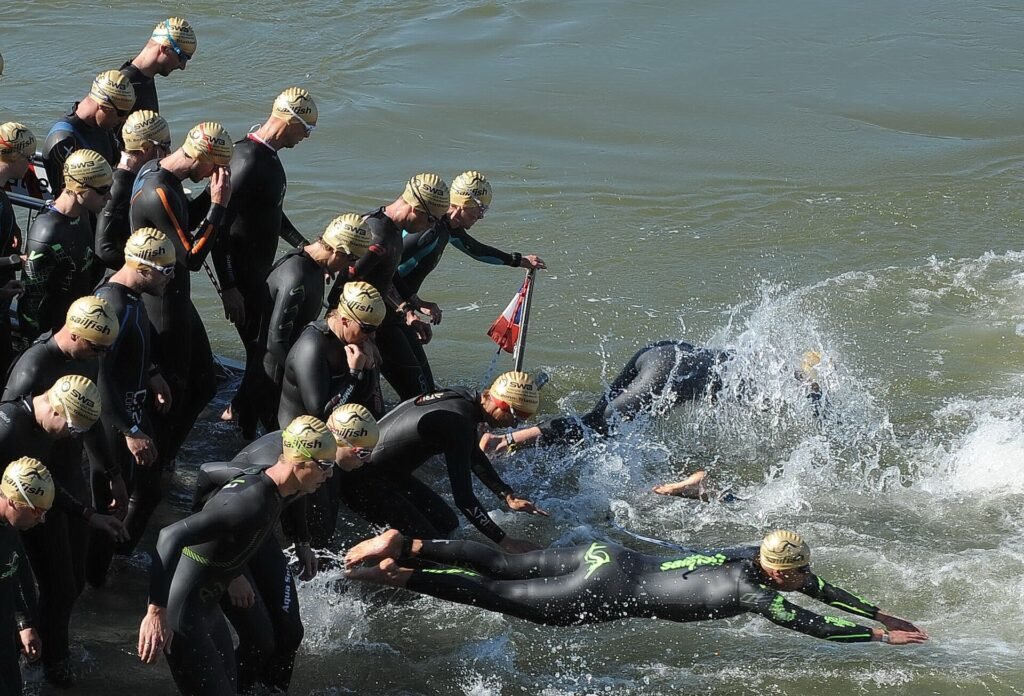
Venues vary. Swim legs are held in open water such as rivers, lakes and the sea, and the bike and run courses often use closed roads in city centers. The photograph above shows a swim start in Bonn, Germany, where triathletes entered the River Rhine from a ferry boat.
Governing bodies and major competitions
World Triathlon is the only body that can award World Triathlon Champion titles, and it reports more than 170 affiliated national federations. It is based in Lausanne, Switzerland.
The Olympic Games are the main stage. Every Games since 2000 has had a men’s and a women’s individual race, and the mixed team relay has been added at Tokyo 2020 and Paris 2024. The Sydney races on 16 and 17 September 2000 drew 100 athletes, 52 men and 48 women, from 34 national Olympic committees. They were the first of two medal events in the Olympic distance format.
Records and notable moments
The first Olympic champions were Simon Whitfield of Canada, in 1 hour 48 minutes 24 seconds, and Brigitte McMahon of Switzerland, in 2 hours 0 minutes 39 seconds. Great Britain’s Alistair Brownlee won the men’s race at London 2012 and again at Rio 2016, and his Rio time was 1 hour 45 minutes 1 second.
At Tokyo 2020 Kristian Blummenfelt of Norway won the men’s race in 1 hour 45 minutes 4 seconds, and Flora Duffy of Bermuda won the women’s race in 1 hour 55 minutes 36 seconds. At Paris 2024 Alex Yee of Great Britain won the men’s race in 1 hour 43 minutes 33 seconds, and Cassandre Beaugrand of France won the women’s race in 1 hour 54 minutes 55 seconds.
The men’s winning time fell from 1 hour 48 minutes 24 seconds in 2000 to 1 hour 43 minutes 33 seconds in 2024. The women’s winning time fell from 2 hours 0 minutes 39 seconds in 2000 to 1 hour 54 minutes 55 seconds in 2024. Courses and conditions differ between Games, so winning times are not strict records.
The mixed relay was won by Great Britain at Tokyo 2020, in 1 hour 23 minutes 41 seconds, and by Germany at Paris 2024, in 1 hour 25 minutes 39 seconds.
Olympic results by edition
The 2004 Athens races were won by Hamish Carter of New Zealand in 1 hour 51 minutes 6 seconds and by Kate Allen of Austria in 2 hours 4 minutes 43 seconds. At Beijing in 2008 Jan Frodeno of Germany won the men’s race, ahead of Simon Whitfield, and Emma Snowsill of Australia won the women’s race.
At London in 2012 the men’s podium was Alistair Brownlee, Javier Gomez Noya of Spain and Jonathan Brownlee, and Nicola Spirig of Switzerland won the women’s race in 1 hour 59 minutes 48 seconds. At Rio in 2016 Jonathan Brownlee took silver behind his brother and Henri Schoeman of South Africa took bronze, while Gwen Jorgensen of the United States won the women’s race in 1 hour 56 minutes 16 seconds.
Global reach of triathlon
The 1989 world championships already drew athletes from 40 countries, and triathlon today counts more than 170 national federations. Individual Olympic champions have come from 11 countries: Canada, New Zealand, Germany, Great Britain and Norway in the men’s race, and Switzerland, Austria, Australia, the United States, Bermuda and France in the women’s race.
Podium finishers have also come from Czechia, Spain, Sweden, Portugal and South Africa, among others, which shows how the three-stage format has attracted athletes from every continent with a tradition of endurance sport. Paratriathlon extends that reach, and its six medal events at Rio 2016 made triathlon part of the Paralympic program.
More in Sports Coaching and Performance
Key facts
- Array
Related concepts
Quick checkHow long is an Olympic triathlon?Show answer
The Olympic distance is a 1.5-kilometer swim, a 40-kilometer bike ride and a 10-kilometer run, raced in that order, and the fastest total time wins.
Sources
- Array
Editorially reviewed by Specialty Digest Editorial TeamLast reviewed November 4, 2026Researched and drafted with AI assistanceReport an issue