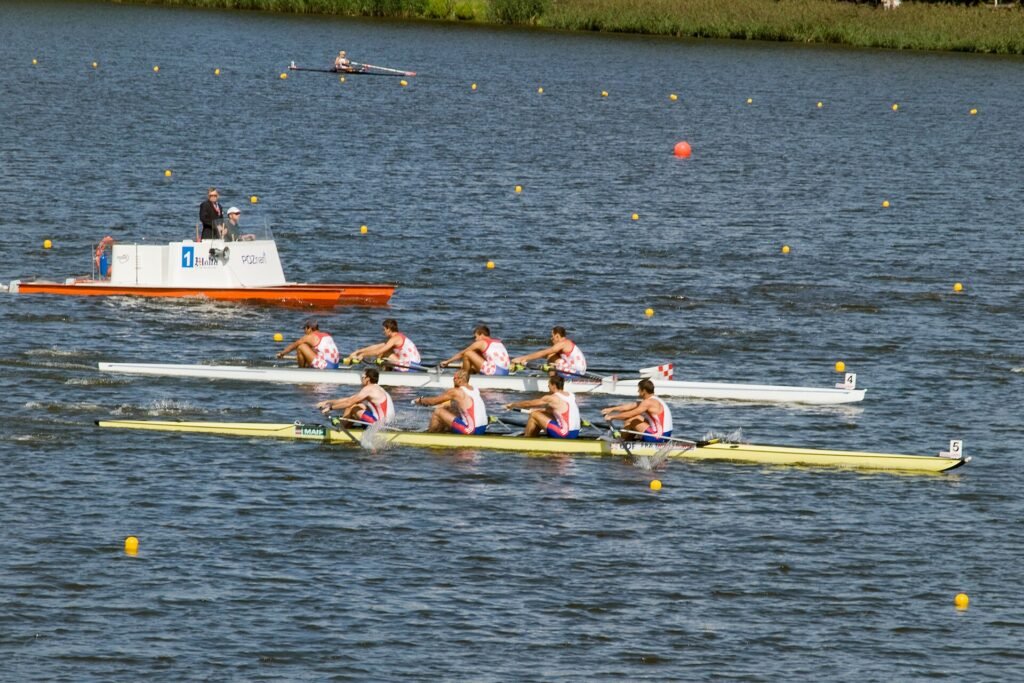
Rowing is a water sport in which crews race boats by pulling oars against the water, and the standard international racing distance is 2,000 meters. Boats range from a single scull for one rower to an eight with eight rowers, and the sport is governed worldwide by World Rowing. The federation was founded in 1892 as FISA, and rowing has been part of the Olympic Games since 1900.
History of rowing
Rowing has a long history. The first known representation of a rowing boat was found in Finland and dates to about 5800 BC, and the earliest recorded regatta took place in Venice in 1274. Modern competitive rowing developed in England, where the Oxford and Cambridge Boat Race began in 1829 on the Thames in the United Kingdom.
International organization came in the late nineteenth century. The first European Championship was held in 1890 and covered only one boat class, the sculling outrigger, over 2,840 meters, which is longer than today’s standard course. FISA was created in 1892 at a congress in Turin, Italy, and it was the first of the international sports federations. The body now known as World Rowing is the direct successor of that organization.
The first World Championships were held in Lucerne, Switzerland, in 1962. They were at first held every four years and later became annual. Women’s boat classes were added in 1974, lightweight events for both genders have run every year since 1985, and the program became gender-equal in 2018 with the same number of boat classes for men and women.
Rules and how rowing is played
Rowing is divided into two styles. In sweep rowing each rower handles one oar, and in sculling each rower handles two. Boats are described by the number of rowers they carry, from a single scull holding one rower to an eight holding eight, and the crew that crosses the finish line first wins a race.
National, collegiate, world and Olympic sprint races are 2,000 meters, or about 1.25 miles. Masters sprints are typically 1,000 meters, and scholastic or junior races are often 1,500 meters. The course is divided into six to eight lanes, with buoys marking each 500-meter section. Boats line up in their assigned lanes, and rowers hold each boat’s stern steady while an official, called the aligner, makes sure the boats are even and square to the course.
Each crew gets one false start, and a second means disqualification. If equipment breaks within the first 100 meters, the race is stopped and restarted. Stroke rates are highest at the start, typically 45 to 50 strokes per minute in an eight and 38 to 42 in a single scull. They then drop to a settled pace of about 38 to 40 in an eight and 32 to 36 in a single, and crews sprint when the coach and the race conditions call for it.
Rowers may leave their lanes without penalty if they do not interfere with another crew, and an official follows the crews. Head races are timed differently. The winner is the crew with the shortest elapsed time between the start and finish lines, plus any penalty time.
Equipment and venues
Boats were traditionally wooden. Top-level boats are now built from composite materials such as carbon fiber and Kevlar. Widths range from about 30 centimeters for a single scull to about 65 centimeters for an eight.
Racing boats have a fin for stability, a rudder in all but most sculling boats, a white ball at the bow used by judges to decide the start and the finish, and a splashboard. The seats roll on runners or tracks, which lets rowers use their legs in each stroke.
Oars are hollow and attached to the boat by adjustable outriggers. The average sweep oar is about 3.70 meters long, and the average scull is about 2.85 meters long. Sprint racing takes place on a straight buoyed course with six to eight lanes, and a typical regatta course therefore needs enough open water to fit every lane.
Governing bodies and major competitions
World Rowing is the international federation, and it organizes the World Rowing Championships, the main annual competition. The 2019 event in Linz-Ottensheim, Austria, drew 1,200 athletes from 80 nations. Para rowing joined the World Championships in 2002, with races originally of 1,000 meters that changed to 2,000 meters in 2017.
Rowing was on the program of the first modern Olympic Games in Athens in 1896, but rough seas forced the cancellation of that event. The first Olympic medals were awarded four years later in Paris. Women’s events were added to the Olympic program in 1976, and lightweight events were added in 1996. Para rowing first appeared at the Paralympic Games in 2008.
Records and notable moments
The sport’s history is marked by a series of firsts. The earliest recorded regatta in Venice in 1274 and the 1829 Boat Race in England bracket several centuries of organized racing on the water. The 1890 European Championship, the creation of FISA in 1892 and the first World Championships in 1962 mark its shift to a global competition.
The Olympic cancellation in 1896 is one of the sport’s best-known disruptions, because it meant that the first modern Games produced no rowing medals. Rowing’s first Olympic medals came in Paris in 1900, and the first Olympic events for women followed in 1976.
Global reach
World Rowing championships attract entries from many countries. The 2019 event alone brought together athletes from 80 nations, and the move to a gender-equal program in 2018 means that men and women now contest the same number of boat classes at the World Championships.
Para rowing and lightweight events add further categories to the program. The timeline, from a boat image in Finland to Olympic and Paralympic rowing, shows how an ancient form of transport became an international sport.
More in Sports Coaching and Performance
Key facts
- World Rowing was created as FISA in 1892 at a congress in Turin, Italy, and was the first international sports federation.1
- Sprint races at national, world and Olympic level are 2,000 meters, on a course of six to eight lanes.2
- Rowing first appeared at the 1896 Olympics but rough seas cancelled it; the first Olympic medals were awarded in Paris in 1900.1
- The first World Rowing Championships were held in Lucerne, Switzerland, in 1962, and the program became gender-equal in 2018.1
- Top-level boats are made of composites such as carbon fiber and Kevlar, and widths run from about 30 to 65 centimeters.1
Related concepts
Quick checkHow long is an Olympic rowing race?Show answer
Olympic and world sprint rowing races are 2,000 meters, or about 1.25 miles, on a course of six to eight lanes with buoys every 500 meters.
Sources
- World Rowing, History of rowing, https://worldrowing.com/about/history/
- US Rowing, The race, https://usrowing.org/learn-about-rowing/overview/the-race
Editorially reviewed by Specialty Digest Editorial TeamLast reviewed November 4, 2026Researched and drafted with AI assistanceReport an issue