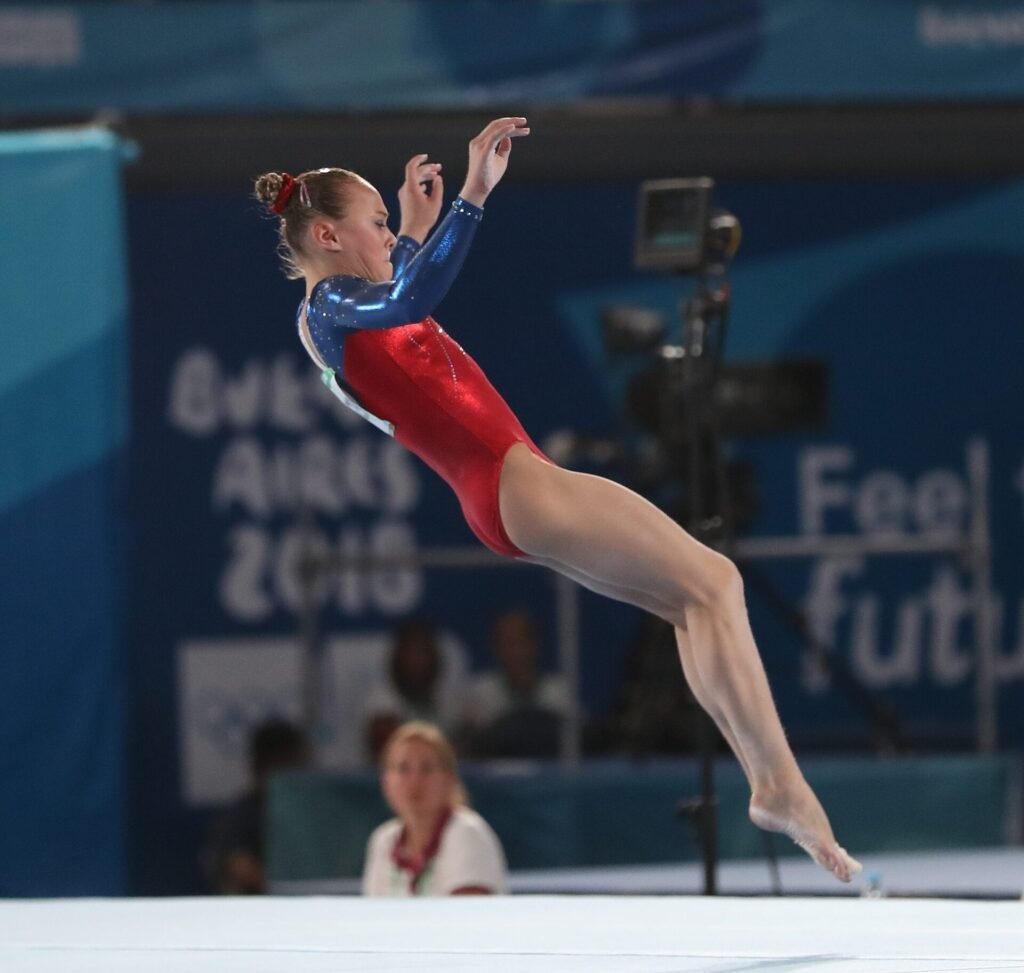
Gymnastics is a sport in which athletes perform routines of strength, balance and control on apparatus or on the floor, judged on difficulty and execution. It has been contested at every modern Olympic Games, and its world governing body, which was long called the International Gymnastics Federation, announced a rebrand as World Gymnastics in December 2025.
History of gymnastics
Gymnastics is an ancient activity, practiced in various forms in Ancient Greece and Rome. Gymnastics competitions, however, are relatively modern. Modern development began in the mid-19th century in Europe, when gymnastics societies formed in Germany, known as Turnvereine, and in Bohemia, where they were called Sokols. Similar societies appeared in France and Switzerland and then spread across Europe.
Competitive gymnastics grew from two systems. The German Turnverein system stressed formal apparatus work and muscular development, while the Swedish system of free exercises was concerned with developing rhythmic movement.
The sport’s governing body was founded on 23 July 1881 in Liège, Belgium, by three federations: Belgium, France and the Netherlands. It was called the Bureau des Fédérations Européennes de Gymnastique until 1921, then the Fédération Internationale de Gymnastique, or FIG, until 2025.
Rules and scoring in gymnastics
Olympic artistic gymnastics is scored by two panels of judges. The total score is the difficulty score, or D-score, plus the execution score, or E-score, minus any deductions.
The D-score has no set maximum and typically ranges from 5 to 7 at the Olympic level. Vault is the only apparatus with a fixed D-score. The E-score starts at 10 and falls with execution errors, and a fall costs a full point.
Competition follows a set sequence. Every gymnast takes part in qualification, after which the top eight teams reach the team final and the top eight gymnasts on each apparatus reach the apparatus finals. The all-around final adds up an individual’s scores across all apparatus, and the Olympics.com guide to Paris 2024 says no more than two gymnasts per country may enter any individual final.
Olympedia describes the same structure from the men’s side. Men first compete in a qualification on all six apparatus. The top competitors become eligible for the individual all-around, and the top teams advance to the team all-around. Women’s competition is similar, but on four apparatus. Olympedia gives a limit of three per nation in the all-around under the format it covers, so the quota has varied between Games.
Equipment and venues for gymnastics
Men compete on six apparatus: floor exercise, pommel horse, rings, vault, parallel bars and horizontal bar. Women compete on four: vault, uneven bars, balance beam and floor exercise.
At the Paris 2024 Olympics, artistic gymnastics ran for nine days at the Bercy Arena, from 27 July to 5 August, and produced 14 Olympic champions.
Gymnastics now covers more than the traditional Olympic events. The traditional form is called artistic gymnastics to separate it from the other disciplines. Rhythmic gymnastics for women joined the Olympic programme at Los Angeles in 1984, and trampoline for men and women was added at Sydney in 2000.
Governing bodies and major competitions
On 9 December 2025, the FIG announced its new identity as World Gymnastics in Lausanne, Switzerland. The release counted 165 member federations, and Olympedia reported 167 in January 2026.
The new brand presents eight disciplines: Gymnastics for All, Men’s Artistic, Women’s Artistic, Rhythmic, Trampoline and Tumbling, Acrobatics, Aerobics and Parkour.
Olympic gymnastics has been fairly constant in format since World War II. Los Angeles 2028 will bring the first change to the programme since Helsinki 1952, adding a mixed team competition alongside the men’s and women’s team all-around events. Artistic gymnastics, rhythmic gymnastics and trampoline have all been part of the Youth Summer Olympics since the first edition in Singapore in 2010.
Records and notable moments in gymnastics
The Soviet Union leads the all-time Olympic table with 182 medals and 72 golds as of 2024. The United States follows with 132 medals and 43 golds, and Japan with 107 medals and 36 golds.
On the men’s side, Sawao Kato of Japan has the most golds with eight, ahead of Nikolay Andrianov, Boris Shakhlin and Viktor Chukarin with seven each. Andrianov has the most medals with 15, followed by Shakhlin and Takashi Ono of Japan with 13 each.
Among women, Larisa Latynina leads with 18 medals and nine golds, representing the Soviet Union and Ukraine. Vera Caslavska of Czechoslovakia and Simone Biles of the United States each have 11 medals and seven golds. Mariya Gorokhovskaya won seven medals at Helsinki in 1952, a mark later equaled by swimmer Emma McKeon in 2020.
Olympedia singles out Romania for producing remarkable female gymnasts, notably Nadia Comaneci, while the Soviet Union and its successor republics have dominated the women’s events.
Because gymnasts may compete in so many events at one Games, many athletes have won multiple Olympic medals. Among the individual leaders are Andrianov with 15 medals and Latynina with 18.
Global participation in gymnastics
Gymnastics began in a few European nations, with three founding federations in 1881, and now has 165 to 167 member federations. Men’s competition since World War II has been divided almost evenly between Japan and the Soviet Union, and the sport has been contested at every Olympic Games, though the programme has varied widely over time.
The new World Gymnastics brand names eight disciplines, from artistic gymnastics to parkour. That is a wider field than the three disciplines of artistic gymnastics, rhythmic gymnastics and trampoline that appear at the Olympics.
Medals have also gone to China with 78, Romania with 72, Switzerland with 47, Germany with 43, Hungary with 40 and Italy with 32, which shows how widely the sport has spread beyond its founding countries.
More in Sports Coaching and Performance
Key facts
- The international gymnastics federation was founded on 23 July 1881 in Liège by Belgium, France and the Netherlands.1
- Men compete on six apparatus at the Olympics and women on four.21
- An Olympic artistic gymnastics score is the D-score plus the E-score, with the E-score starting at 10.2
- Rhythmic gymnastics joined the Olympics in 1984 and trampoline in 2000.1
- The FIG announced its rebrand as World Gymnastics on 9 December 2025.3
Related concepts
Quick checkHow is Olympic artistic gymnastics scored?Show answer
A routine score is the difficulty score plus the execution score, minus deductions. The execution score starts at 10 and falls with errors, and a fall costs a full point.
Sources
- Olympedia, Artistic Gymnastics (discipline overview, with federation history and Olympic medal data), olympedia.org, https://www.olympedia.org/sports/GAR
- International Olympic Committee, Olympic Artistic Gymnastics 101: Key terms, definitions and rules, olympics.com, https://olympics.com/en/news/olympic-artistic-gymnastics-101-terms-definitions-rules
- Inside Gymnastics, International Gymnastics Federation (FIG) unveils new global identity: World Gymnastics, insidegymnastics.com, https://www.insidegymnastics.com/news-features/international-gymnastics-federation-fig-unveils-new-global-identity-world-gymnastics/
Editorially reviewed by Specialty Digest Editorial TeamLast reviewed November 4, 2026Researched and drafted with AI assistanceReport an issue