Every year on February 12, the world pauses to talk about a harm that is easy to name and hard to end: the recruitment and use of children by armed forces and armed groups. The day is known as Red Hand Day, and in United Nations calendars as the International Day against the Use of Child Soldiers. A child, in international law, is anyone under 18. Boys and girls are drawn into conflict as fighters, but also as porters, cooks, messengers and lookouts, and many suffer other abuse along the way. This article explains what the day marks, what the law asks of governments and armed groups, and what the latest United Nations figures show. It treats a painful subject plainly and without graphic detail.
A date tied to a treaty
The date was not chosen at random. The Optional Protocol to the Convention on the Rights of the Child on the involvement of children in armed conflict was adopted by the General Assembly on May 25, 2000 (resolution 54/263) and entered into force on February 12, 2002. The United Nations children and armed conflict office lists that date as the International Day against the Use of Child Soldiers. The UN’s 2026 calendar of events carries the day under two names, one of them the International Day to Prevent the Recruitment and Use of Children by Armed Forces and Armed Groups, with the Special Representative’s office and UNICEF as the lead contacts.
The treaty is one step in a longer story. The General Assembly created the mandate of a Special Representative on children and armed conflict in December 1996, after a landmark study by Graça Machel. The Security Council then took up the subject in a series of resolutions, and in 2005 it adopted resolution 1612, which established a system to monitor and report grave violations against children.
What “recruitment and use” means
The phrase covers more than carrying a weapon. A child can be conscripted by force, pressed into service through threats or hardship, or join an armed group because it appears to offer food, protection or belonging. Once inside, children may be used in many roles, and the UN stresses that the child is a victim of the recruitment, whatever role the child is made to play. That principle is why the UN speaks of children “associated with” armed forces and groups rather than simply “child soldiers.”
The Optional Protocol sets clear rules. States must take all feasible measures to ensure that members of their armed forces under 18 do not take a direct part in hostilities, and they may not compulsorily recruit anyone under 18. States that accept volunteers must raise the minimum age above the one in the Convention on the Rights of the Child, declare that age when they join the treaty, and keep minimum safeguards. Armed groups that are separate from the state “should not, under any circumstances, recruit or use in hostilities” anyone under 18.
Example 1: the difference between volunteer and recruit. Imagine a country that sets its volunteer age at 17 and requires a parent’s consent, proof of age and full information about duties. Under the Protocol that can be lawful, but the same 17-year-old may not be sent to take a direct part in hostilities, and no one may be forced to enlist. The numbers are made up to show the rule.
The numbers behind the day
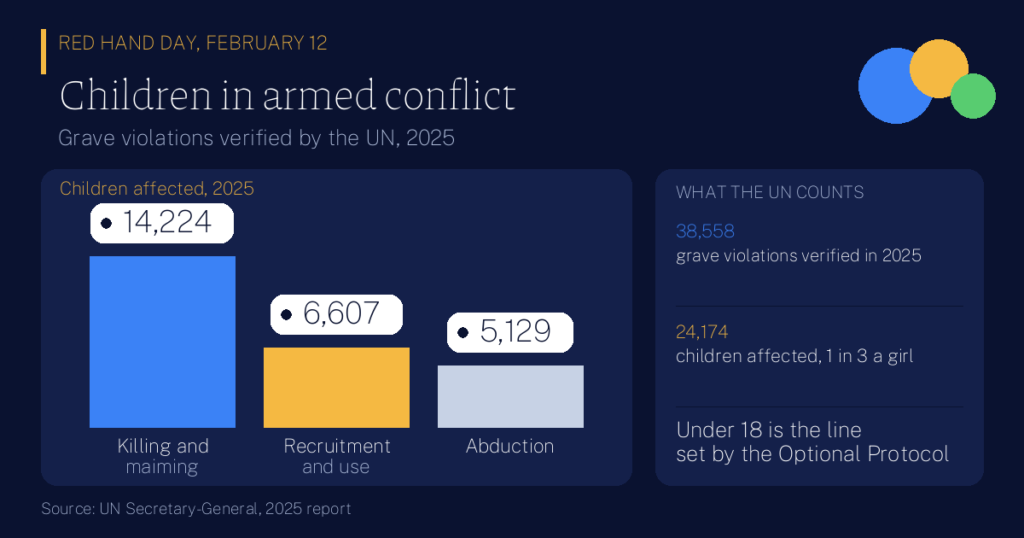
Each year the Secretary-General reports on children in armed conflict. The report for 2025, covering 23 situations (22 countries plus the Lake Chad basin), verified 38,558 grave violations against children. Incidents that happened earlier but were verified in 2025 are counted. The UN says 24,174 children were affected, and that the total number of children affected rose by 7.5 percent. Some children suffered more than one violation, and 3,176 were victims of several.
- 38,558grave violations verified by the UN in 2025
- 24,174children affected by the six grave violations, 2025
- 6,607children recruited and used, 2025
- 1 in 3child victims in 2025 was a girl
Recruitment and use is only one of six grave violations the UN tracks, alongside killing and maiming, sexual violence, abduction, attacks on schools and hospitals, and denial of humanitarian access. They are linked. A school that is attacked or closed leaves children with fewer safe places to be, and a family without food or safety is more exposed to pressure from armed groups.
Who is affected, and where
Of the 24,174 children affected in 2025, 15,493 were boys, 7,990 were girls and 691 were of unknown sex. Girls were therefore about one in three of the child victims. The UN notes that numbers for some violations are almost certainly undercounted, because families fear reprisals and access to many areas is limited.
In 2025 the countries with the most children recruited and used, in the report’s ranking, were the Democratic Republic of the Congo, Nigeria, Haiti, Somalia and Colombia. Reporting also noted that, for the first time in 30 years of UN monitoring, government forces were responsible for more grave violations than non-State armed groups. The UN attributes these findings to its monitoring and reporting system, and it works with parties to conflict on action plans. The report records 21 plans under implementation and 3 under negotiation. A UN peacekeeping article from 2024 cited an estimate of 250,000 children still associated with armed forces and groups worldwide.
Example 2: reading a report. Suppose a district reports 400 verified recruitments in a year, but local workers believe families in remote villages did not report another 200. The verified figure is a floor, not a ceiling. The numbers are round and illustrative, but this is why the UN calls its totals the number it could verify.
Coming home
Release is only the first step. Children leaving armed groups need safe shelter, health care, a return to school or training, and help rejoining families and communities that may fear or reject them. The UN reports that in 2024, 16,482 children formerly associated with armed forces or groups received protection or reintegration support. Peacekeeping missions say they have helped secure the release of over 100,000 children since the first Child Protection Adviser was deployed to Sierra Leone in 2001.
Reintegration works best when it is local and long. Programs that support the whole family, that avoid labeling children, and that include girls, who are often overlooked in release programs, give children a better chance to rebuild their lives.
Example 3: why a year of support matters. Imagine a 15-year-old who returns home after two years away. Counseling, catch-up classes and a small apprenticeship over twelve months can mean the difference between rejoining a group and finishing school. The case is made up, but it follows the pattern of support the UN and its partners describe. Children who have faced harm, or adults who know of a child at risk, can contact local child protection services or a trusted humanitarian organization such as UNICEF.
How the day is marked
The red hand is the day’s symbol: people press a red handprint onto paper as a silent “stop” and send it to leaders. Schools, community groups and UN offices take part, and handprints have been delivered to UN officials. The aim is to keep the issue visible, push governments to ratify and follow the Optional Protocol, and support programs that help children return to school and family life. For related work on child rights, see World Children’s Day.
Key Takeaways
- The date comes from a treaty. February 12 marks the 2002 entry into force of the Optional Protocol.
- Eighteen is the line. The Protocol bars compulsory recruitment of anyone under 18 and tells armed groups never to recruit or use them.
- The scale is large. The UN verified 38,558 grave violations against children in 2025.
- Recruitment is one harm among six. In 2025, 6,607 children were recruited and used, and many suffered more than one violation.
- Girls are not absent. About one in three child victims in 2025 was a girl.
- Coming home needs support. Care, schooling and family help decide whether release lasts.
- Counts are floors. Verified figures understate what children endure.
How solid is this? Figures are verified counts from the UN monitoring system for 2025 and likely understate the true scale. The 2024 reintegration figure and the 250,000 estimate come from UN sources for earlier years and are not directly comparable. Sexual violence totals appear slightly differently across parts of the source report, so the chart shows a rounded floor. The three worked examples use round, made-up numbers. See also the International Days hub and the International Days Calendar.
More in Society
- United Nations, 2026 Calendar of Selected United Nations Events
- UN Office of the Special Representative for Children and Armed Conflict, Timeline
- UN Office of the Special Representative for Children and Armed Conflict, Optional Protocol on the involvement of children in armed conflict
- UN Secretary-General, Children and Armed Conflict annual report, Supplementary Analysis 2025
- UN News, Security Council open debate on children and armed conflict, June 24, 2026
- UN Peacekeeping, From fear to freedom, February 2024