Every day, somewhere, a small group of people with no government badge and no company payroll decides that a problem is theirs to solve. They run a clinic, a food bank, a legal aid desk or a river cleanup. We call such groups non-governmental organizations, or NGOs. World NGO Day, observed every year on February 27, says thank you to them and asks a harder question: what do they need in order to keep working? Unlike many days in this series, it did not begin with a United Nations resolution. It grew from a civil society idea and has since won support from governments and institutions. That makes it a useful lens on the sector itself: how large it is, how it is paid for, how it connects to the UN, and why its freedom to operate cannot be taken for granted. It also sits close to International Volunteer Day, since volunteers power so many NGOs.
From a student idea to a global day
According to published accounts, the idea is credited to Mārcis Skadmanis, a Latvian-British lawyer and philanthropist, who developed it in 2009 while studying in Riga. In 2010, with the support of Civic Alliance Latvia, it was recognized by 12 Baltic Sea Region countries at the X Baltic Sea NGO Forum. The day was first officially marked on February 27, 2014, in Helsinki, Finland, with representatives of the UN, UNESCO and the European Union attending.
Recognition has grown since. The European Union is reported to have added the day to its list of recognized international days in 2024, and on February 26, 2025, Latvia’s parliament, the Saeima, amended its law on holidays, remembrance and observance days to include it. It is reported to be marked in more than 145 countries.
Precision about status matters. The UN General Assembly has not designated February 27 by resolution, so the day has no resolution symbol and no UN-wide theme. It is a civil society observance. Its stated aims are to honor NGO contributions in areas such as health, education, human rights and environmental protection, to remember NGO workers who have lost their lives or suffered while doing their duty, and to strengthen cooperation between NGOs and public and private partners.
What counts as an NGO
There is no single legal definition, but the core idea is simple: an organization that is independent of government, does not exist to distribute profit to owners, and works toward a public purpose. The range is wide, from village associations and community clinics to professional bodies, foundations and large international relief agencies.
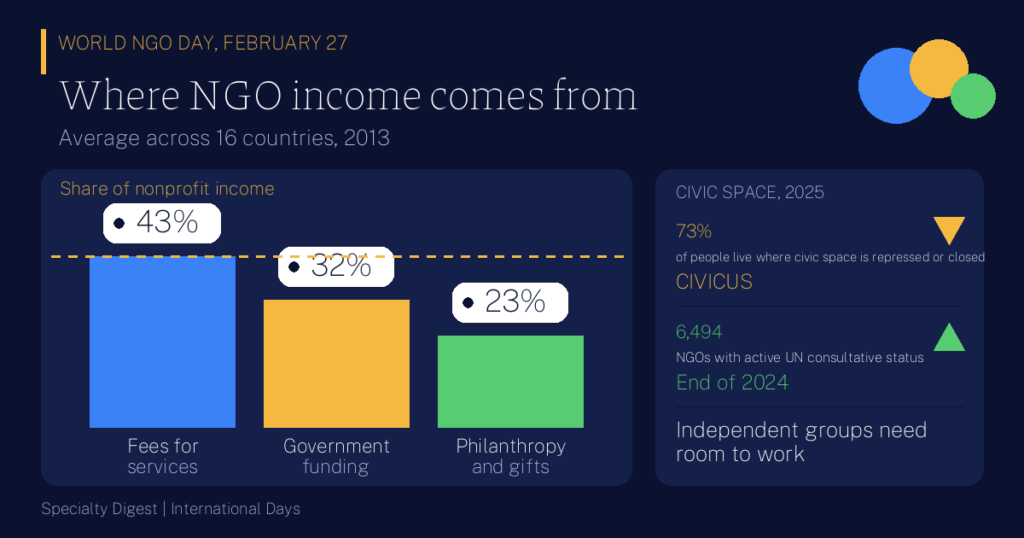
The United Nations wrote NGOs into its founding framework. Article 71 of the UN Charter provides for suitable arrangements for consultation with them, and the Economic and Social Council (ECOSOC) built a formal system on it, now governed by ECOSOC resolution 1996/31. In 1945, 41 NGOs were granted consultative status. By 1992 more than 700 had it, and as of December 31, 2024, 6,494 held active status.
There are three categories. General status suits large international groups whose work spans most of ECOSOC’s agenda, special status suits those with competence in a few fields, and roster status covers the rest. The path is demanding: a Committee on NGOs of 19 Member States reviews applications and recommends, but does not decide. Its 2025 regular session was expected to consider 258 new applications and 356 deferred from earlier sessions.
Example 1: from local to global. A neighborhood group of 30 volunteers organizes a monthly river cleanup. It has no UN status and needs none, yet it is an NGO in the everyday sense: independent, owned by no one and aimed at a public good. If it joined 5 other groups to form a regional coalition, that coalition might one day apply for consultative status. The numbers are round and illustrative, but the path from local to global is real.
The numbers behind the sector
Counting NGOs is hard, because countries define and register them differently. The best data come from a few careful studies. A Johns Hopkins study reported in 2003, covering 35 countries, found nonprofit groups employing the equivalent of about 40 million full-time workers, including some 22 million paid workers, plus more than 190 million volunteers. They generated about 5 percent of those countries’ gross domestic product. A 2013 Johns Hopkins report, covering 16 countries that used the UN Handbook on Nonprofit Institutions, found an average of 4.5 percent of GDP, about the same as construction. In 6 of the 16 countries, nonprofits employed 10 percent or more of the workforce. These studies are older and cover limited countries, so read them as a sense of scale, not a current global total.
- 6,494NGOs with active ECOSOC status, end of 2024
- 4.5%average nonprofit share of GDP, 16 countries, 2013
- 190 millionvolunteers counted in 35 countries, 2003
- 145+countries reported to mark the day
Money matters as much as headcount. In those 16 countries, nonprofit income came 43 percent from fees, 32 percent from government and 23 percent from philanthropy, and the report noted that the philanthropy share is probably overstated. Many people picture NGOs as donation-funded. The data suggest fees and public money often matter more.
Example 2: one budget. Suppose a community health NGO has a $100,000 budget and matches that average mix. About $43,000 comes from fees, $32,000 from government contracts and $23,000 from donations, with rounding leaving about $2,000. Losing the government contract would cut nearly a third of its income. The figures are illustrative, not data about any real group.
Why independence needs room to breathe
An NGO can work only where people are free to form groups, speak, assemble and receive funding. The CIVICUS Monitor, run by the civil society alliance CIVICUS, rates 198 countries and territories as open, narrowed, obstructed, repressed or closed. Its December 2025 report found only 39 rated open, and 83 rated repressed or closed. It reported that 73 percent of the world’s people live under restricted conditions, almost 31 percent in countries rated closed, and just 7.2 percent where civic space is open or narrowed. The Monitor says that share was nearly 13 percent in 2020, and that 15 countries were downgraded in 2025.
These are CIVICUS’s own assessments, not UN findings, and methods can be debated. They still show why the day pairs remembrance of NGO workers with a call for cooperation.
Example 3: hours that vanish. Imagine 10 volunteers who each give 5 hours a week to a literacy NGO. That is 50 hours, more than a 40-hour full-time job, though nobody is paid. If the group were forced to close, the community would lose more than one full-time worker’s effort, plus years of trust. The numbers are round and illustrative.
How to mark the day and judge a group
Because the day has no UN secretariat, I could not confirm one official annual theme, so observances vary: forums, open-door days, statements by officials and social media posts. A good way to take part is to look closely at a group near you. Ask who funds it, who governs it, what it publishes about spending and results, and who it answers to. Strong NGOs welcome those questions, and the sector has its own critics who raise transparency, donor influence and uneven accountability. Honest scrutiny strengthens it. Then give time, skills or money to a group whose work you can see.
Key Takeaways
- NGOs are independent public-purpose groups. They range from village associations to global relief agencies.
- The day is a civil society initiative. It was recognized in 2010, launched in 2014 and is not a UN-designated day.
- The UN has a formal door for NGOs. 6,494 held active ECOSOC consultative status at the end of 2024.
- The sector is an economic force. Studies found about 4.5 to 5 percent of GDP in the countries covered.
- Funding is mixed. Fees and government income outweighed philanthropy in 16 countries.
- Freedom to organize is shrinking. CIVICUS reports 73 percent of people live in repressed or closed settings.
- Ask good questions. Who funds, governs and audits a group is the best test of trust.
How solid is this? UN figures come from ECOSOC and UN press releases. The sector studies are from 2003 and 2013 and cover 35 and 16 countries. The civic space ratings are CIVICUS assessments. Origin details come from published accounts and the Saeima. The three worked examples use round, made-up numbers. See also the International Days hub and the International Days Calendar.
More in Society
- UN ECOSOC NGO Branch, Introduction to ECOSOC Consultative Status
- UN Meetings Coverage, Committee on Non-Governmental Organizations, 2025 resumed session
- CIVICUS Monitor, Global Findings 2025: In Numbers
- CIVICUS Monitor, People Power Under Attack 2025 (press release, December 9, 2025)
- Johns Hopkins Bloomberg School of Public Health, nonprofit sector findings (2013)
- The Chronicle of Philanthropy, Nonprofit Employment Is on the Rise Around the Globe (2003)
- Saeima of Latvia, World NGO Day added to official days (2025)