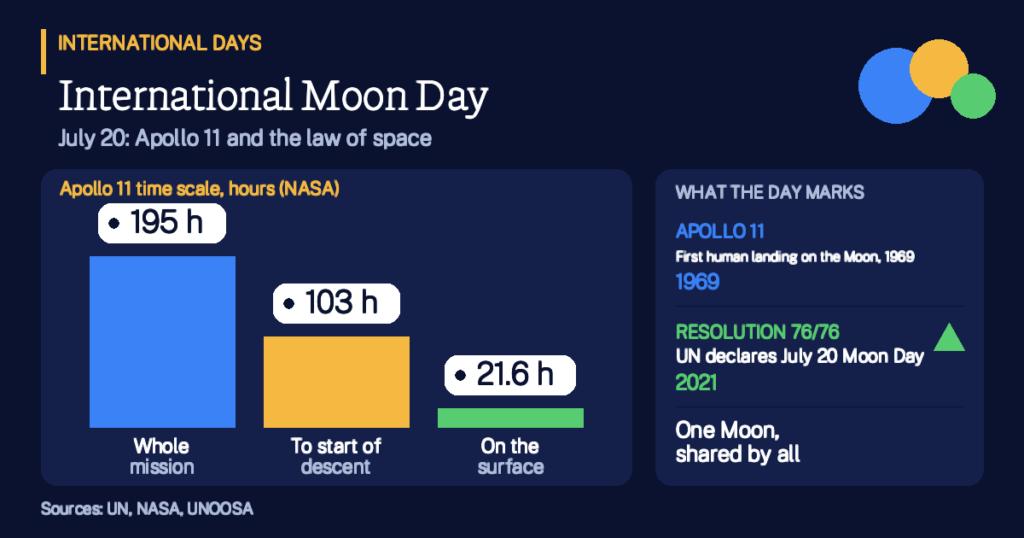
Almost everyone has looked up at the Moon, yet few of us stop to ask who it belongs to, what we have taken from it, or what we plan to do there next. International Moon Day, observed every year on July 20, is the United Nations’ invitation to ask. It marks the anniversary of the first landing by humans on the Moon, part of the Apollo 11 mission of 1969, and it looks forward as much as back. Its purpose is to celebrate what states have achieved in exploring the Moon and to raise public awareness of sustainable exploration and use. The day falls on the same date as World Chess Day, a reminder that humanity has many reasons to pause on July 20.
A day built on a landing and a treaty
The General Assembly declared International Moon Day in 2021, in its resolution 76/76 on international cooperation in the peaceful uses of outer space. The date honors a single afternoon. Apollo 11 launched on July 16, 1969, and on July 20 Neil Armstrong became the first human to set foot on the Moon, with Edwin “Buzz” Aldrin following as the second. Michael Collins stayed in orbit in the command module. The crew splashed down in the Pacific Ocean on July 24.
But the day is just as much about rules as about rockets. The United Nations pairs the anniversary with the legal framework that governs space, beginning with the Outer Space Treaty, which was opened for signature in January 1967 and entered into force in October of that year. The UN’s own history of space cooperation, from that treaty to the present, is the backdrop to the day.
What the treaty says, in plain words
The Outer Space Treaty is sometimes called the Magna Carta of space. Four of its ideas explain most of what the Moon Day message is about. First, outer space is free for exploration and use by all states. Second, it is not subject to national appropriation by claim of sovereignty, so no country can declare the Moon its territory. Third, states shall not place nuclear weapons or other weapons of mass destruction in orbit. Fourth, the Moon and other celestial bodies are to be used exclusively for peaceful purposes. The treaty adds that states are liable for damage caused by their space objects.
A later agreement went further. The Moon Agreement, adopted by the General Assembly in 1979 and in force since July 11, 1984, says the Moon and its natural resources belong to all humanity. It remains far less widely accepted than the 1967 treaty, so who may use lunar resources, and how, is a live debate rather than a settled question. That is why “sustainable” appears in the day’s mission.
Example 1: the flag and the claim. Imagine a country plants its flag near a lunar crater and announces the area is now its land. Under the treaty’s principle of no national appropriation by claim of sovereignty, the flag is a symbol of presence, not a title deed. The scenario is illustrative, but it shows why the rule exists.
The Moon in numbers
The Moon is an average of 384,400 kilometers (238,855 miles) from Earth. Its equatorial radius is about 1,737.5 kilometers, and NASA describes it as less than a third of the width of Earth. Gravity at the surface is one-sixth of Earth’s. It circles our planet in about 27 days and spins at the same rate, so we always see the same face, while the cycle of phases we watch takes about 29 days. It is the only celestial body beyond Earth visited by humans so far, and more than 105 robotic spacecraft have been launched to explore it.
- 384,400 kmaverage distance from Earth (NASA)
- 1/6of Earth’s gravity at the surface
- 382 kgof lunar rock and soil Apollo astronauts brought back (842 pounds)
- 105+robotic spacecraft launched toward the Moon
Example 2: the lighter jump. Suppose a hiker who can lift a 12 kilogram pack on Earth stands on the Moon, where gravity is one-sixth as strong. Her pack would press down like a 2 kilogram load. The numbers are round and illustrative, but they explain the bounding gait seen in Apollo footage.
Eight days, 21 hours on the surface
Apollo 11 launched at 9:32 a.m. Eastern time on July 16, 1969, and splashed down at 12:50 p.m. on July 24. According to NASA, about 102 hours and 45 minutes into the mission the lunar module began its descent, and Armstrong and Aldrin spent 21 hours and 36 minutes on the surface. Measured from launch to splashdown, the whole trip lasted a little over 195 hours. Most of the journey was spent getting there and back; the time on the Moon was brief.
The astronauts returned with a lasting scientific gift. Apollo crews brought back 382 kilograms of lunar rocks and soil in all, and researchers have been studying such samples for decades.
Why the Moon matters now
The Moon is no longer a one-nation story. The UN says the day will help consider the achievements of all states in lunar exploration, and that it serves as a reminder of past success and as an annual testimony to future endeavors. Agencies and companies now plan missions, bases and resource studies, and each raises questions the 1967 treaty answers only in broad terms: who coordinates traffic, who protects scientific sites, and what “peaceful” means in practice. For recent science from a new generation of missions, see our report on the Artemis II lunar science data release.
Example 3: a shared landing zone. Picture three agencies who each want to study the same ten-kilometer region because it holds scarce ice. If each acts alone, their equipment might interfere. If they publish plans and share results, all three finish sooner. The place and numbers are invented, but this is the kind of cooperation the day encourages.
How the day is marked
International Moon Day is celebrated by schools, observatories, museums and space agencies, and the UN reported that its 2023 observance was the second annual one. No single theme governs every year, so the day works best as an open invitation: look at the Moon, learn how we reached it, and ask how it should be shared. Good starting points are a local observatory night, a classroom lesson on the phases, or a reading of the treaty itself.
Key Takeaways
- The day marks a landing. July 20 is the anniversary of the first human landing on the Moon, during Apollo 11 in 1969.
- It is a young observance. The General Assembly declared it in 2021 through resolution 76/76.
- Law matters as much as rockets. The 1967 Outer Space Treaty bars national claims and weapons of mass destruction in orbit.
- The Moon is close but not simple. It is 384,400 kilometers away, with one-sixth of Earth’s gravity.
- The landing was brief. Armstrong and Aldrin spent 21 hours and 36 minutes on the surface of a mission lasting over 195 hours.
- Sustainability is the new theme. The UN wants awareness of sustainable exploration and use.
- Anyone can take part. Look up, learn, and ask how a shared Moon should be managed.
How solid is this? Dates, the resolution number, the treaty principles and the Apollo times come from UN and NASA pages. The whole-mission total of about 195 hours is our own arithmetic from NASA’s launch and splashdown times. We did not find current counts of treaty parties, so none are given. The three worked examples use round, made-up numbers. See also the International Days hub and the International Days Calendar.
More in Science
- United Nations, International Moon Day
- UN News, International Moon Day gives boost to peaceful cooperation in space (2023)
- United Nations, Outer Space (Global Issues)
- UN Office for Outer Space Affairs, The Outer Space Treaty
- NASA Science, Moon Facts
- NASA Science, Compare Earth and the Moon
- NASA, Apollo 11 Mission Overview