Most days on the United Nations calendar ask the world to fight a problem. This one asks the world to look at a method. Neutrality, a state’s decision not to take sides in other countries’ wars, is old, widely misunderstood and quietly useful. Observed every year on December 12, the International Day of Neutrality invites people to ask what it means to stand apart, why some nations build their foreign policy on it, and how a country that refuses to pick a side can still help others end a fight. It is a natural companion to Human Rights Day, which the world marks two days earlier.
From the laws of war to a UN day
Neutrality is older than the United Nations. In 1907, states meeting at The Hague adopted Convention V on the rights and duties of neutral powers and persons in a war on land. Its logic is simple. A neutral country’s territory cannot be violated, and in return the country stays out of the fighting and treats the warring sides impartially.
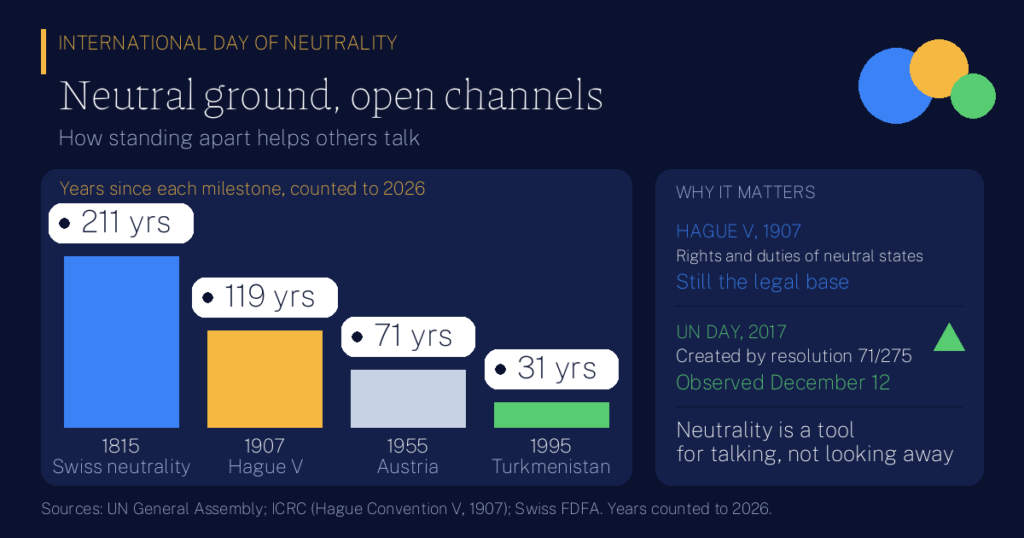
Some countries turned that wartime status into a permanent national identity. The European powers recognized Switzerland’s neutrality in 1815, and Switzerland still treats it as a pillar of its foreign policy. Austria adopted neutrality in 1955. In 1995 the General Assembly adopted a resolution on the permanent neutrality of Turkmenistan, which had become independent four years earlier. In 2017, in resolution 71/275, the Assembly declared December 12 the International Day of Neutrality, the anniversary of that 1995 vote.
What neutrality means, and what it does not
In law, neutrality is a status. A neutral state does not join either side in an armed conflict between other states, does not let its territory be used for the fight, and deals with the warring sides evenhandedly. Permanent neutrality extends that stance into peacetime: the country commits in advance to stay out of future wars and out of alliances that would pull it in.
Neutral is not the same as weak, isolated or indifferent. Switzerland, for one, keeps an army to defend its neutral territory. Neutrality also does not release a country from the United Nations Charter, under which members agree to accept and carry out decisions of the Security Council. And it concerns armed conflict between states, not values. Neutral countries still take positions on human rights, development and international law.
Example 1: the borrowed table. Imagine two countries of about 10 million people each, at odds over a border river. Both want to talk, but neither will send its delegation to the other’s capital. A neutral country with no stake in the dispute offers a conference room. The numbers are round and illustrative, but the point is real: a shared table is easier to accept when its owner has nothing to gain.
Neutral does not mean silent
Staying out of a war is different from staying out of the world. Austria has been a United Nations member since the year it adopted neutrality, and Switzerland, long neutral, joined the Organization in 2002. Their membership shows that neutrality and collective action can coexist. The UN Charter asks all members to settle disputes by peaceful means, and neutral states can be especially credible when they say so.
The 2017 resolution takes that view. In summary, it recognizes that neutrality can help strengthen peace, security and stability, and it encourages the use of neutrality in efforts such as preventive diplomacy and mediation. The text is short and worth reading in full on the UN website.
Three ways a neutral state helps
Neutrality earns its keep through trust. Switzerland describes its own contribution as good offices, a term for services that help states in conflict talk to one another. In practice the neutral state can play three roles, and the same country may play more than one at a time.
Example 2: the messenger. Suppose two sides cannot speak directly but both want 200 captured people home. A neutral government passes a list from one side to the other and back, five times over two weeks, until the lists match. The figures are made up for illustration. Real exchanges are slower and harder, yet the pattern, a trusted go-between making small steps possible, is the heart of good offices.
The price and the limits
Neutrality is not free. A country that wants to be trusted by every side must resist favoring any of them, in what it says, sells and allows on its soil. Armed neutrality adds a cost of its own, because the country must be able to defend its borders without allies.
Example 3: the cost of standing apart. Picture a neutral country of 5 million people that spends 1 percent of its national income on defense. Because it has no allies, it must make any crossing of its territory costly on its own. The percentage is illustrative and not any real country’s budget, but it shows why neutrality asks for discipline, not only goodwill.
Neutrality is also debated. Supporters say it keeps channels open when others cannot. Critics ask whether staying out can, in some conflicts, favor the stronger side. The UN resolution does not settle that argument. It recognizes neutrality as one useful tool among many, and each nation decides for itself, within the Charter, whether and how to use it.
How the day is marked
The day is an invitation to reflect rather than a campaign with a slogan. The UN and its country offices hold events and statements, and schools and universities can use it to study how neutral states have helped end conflicts. A simple way to take part is to read your own country’s position. Is it neutral, allied or something between? What does that choice allow it to do for peace?
Key Takeaways
- Neutrality is a legal status and a policy. It means not joining either side in other states’ wars and treating them evenhandedly.
- It has a long legal history. The 1907 Hague Convention V spelled out the rights and duties of neutral powers.
- The day is recent. Resolution 71/275 created it in 2017, on the anniversary of the 1995 resolution on Turkmenistan’s neutrality.
- Neutral does not mean silent. Neutral states belong to the United Nations and remain bound by its Charter.
- Trust is the asset. A neutral state can host talks, pass messages and mediate because no side sees it as an opponent.
- It carries costs and debate. Impartiality takes discipline, and people disagree about when staying out helps peace.
How solid is this? Dates and resolution details come from United Nations records, the ICRC treaty database and Swiss government sources listed below. The description of resolution 71/275 is a summary, so read the full text for its exact wording. The article uses no statistics, and the three worked examples use round, made-up numbers to show an idea. See also Human Rights Day, the International Days hub and the International Days Calendar.
More in Society
- United Nations, International Day of Neutrality
- UN in Turkmenistan, Declaration of the International Day of Neutrality
- UN Secretary-General, message marking 25 years since the resolution on Turkmenistan’s permanent neutrality (2020)
- UN Secretary-General, message on fifteen years of Turkmenistan’s permanent neutrality (2010)
- ICRC, Hague Convention (V) respecting the Rights and Duties of Neutral Powers, 1907
- Swiss Federal Department of Foreign Affairs, Neutrality
- Swiss Federal Department of Foreign Affairs, Switzerland’s good offices