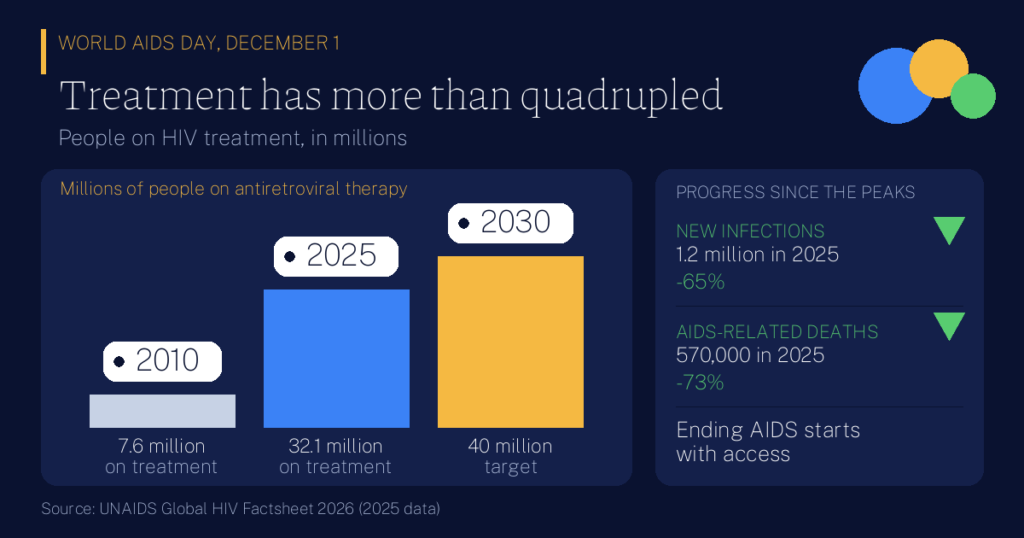
For a disease that once seemed unstoppable, HIV now has a clear shape. It can be tested for, treated and, with the right tools, prevented. Yet in 2025 an estimated 1.2 million people still acquired HIV and 570,000 died of AIDS-related causes. World AIDS Day, held every December 1, exists to hold both truths at once: the gains are real, and they are fragile. It is a day to remember the people lost, to support those living with HIV, and to ask who still cannot get the services that work.
A day older than most health campaigns
World AIDS Day was founded in 1988, and UNAIDS describes it as the first international day for global health. Its first theme was “A world united against AIDS.” Since then United Nations agencies, governments and civil society groups have joined each year around a shared message, and the red ribbon has become its symbol. The day now sits beside a larger effort: the global goal of ending AIDS as a public health threat by 2030, part of Sustainable Development Goal target 3.3.
The 2026 theme, “Ending AIDS starts with access,” points to services, rights, resources and political leadership. It also arrives as UNAIDS marks 30 years of work and after a June 2026 United Nations Political Declaration on HIV and AIDS set new targets for 2030.
What HIV and AIDS actually are
HIV is a virus that attacks the immune system. Left untreated, it can lead to AIDS, the advanced stage in which the body can no longer fight off many infections. There is still no cure, but WHO describes HIV as a manageable chronic health condition when a person takes antiretroviral therapy, often called ART. Treatment does two things. It keeps the person healthy, and it lowers the amount of virus in the blood, called the viral load. When the virus is suppressed, a person stays well and the risk of passing HIV on falls sharply.
That is why the world tracks three steps, known as 95-95-95. The aim is that 95 percent of people with HIV know their status, 95 percent of those are on treatment, and 95 percent of those on treatment are virally suppressed.
The numbers behind the day
At the end of 2025, UNAIDS estimates that 41.0 million people were living with HIV, including 1.3 million children under 15. Women and girls were 53 percent of the total. WHO notes that 64 percent of all people with HIV live in its African Region. Since the epidemic began, 92.0 million people have acquired HIV and 44.2 million have died of AIDS-related illnesses. Every figure here is an estimate with a range, and the ranges are wide, for example 35.3 to 47.5 million for people living with HIV.
Example 1: what a quadrupling means. Imagine a country with 100 people on treatment in 2010. If it followed the global pattern, it would have about 420 by 2025. The numbers are round and illustrative, but they show how a steady expansion of clinics, tests and medicines changes a whole population’s odds.
The treatment ladder: where people drop off
The 2025 data show how close the world is to its testing and treatment goals, and where the gaps remain. Among all people living with HIV, 88 percent knew their status, 78 percent were accessing treatment and 74 percent were virally suppressed. Among those who knew their status, 89 percent were on treatment, and among those on treatment, 95 percent were suppressed. Put plainly, once people reach treatment, it works. The weak points are testing and getting people connected to care.
Example 2: following 100 people. Take 100 people living with HIV. At the 2025 global rates, about 88 know they have it, about 78 are on treatment, and about 74 have the virus under control. Twenty-six are not yet protected by treatment. The figures are rounded and illustrative, but they show where outreach has to focus.
Why the burden is not shared equally
HIV does not fall evenly. UNAIDS reports that, compared with all adults, the risk of acquiring HIV in 2025 was 18 times higher for gay men and other men who have sex with men, 17 times higher for sex workers and for transgender women, and 34 times higher for people who inject drugs. Stigma, discrimination and laws that criminalize these groups keep people away from testing and care. Children are also behind: only 55 percent of children with HIV were on treatment in 2025, and new child infections, at 93,000, have been stalled in recent years even though they are down 69 percent from 300,000 in 2010.
- 41.0 millionpeople living with HIV, end of 2025
- 1.2 millionpeople newly infected in 2025
- 570,000AIDS-related deaths in 2025
- 87%of pregnant women with HIV had access to antiretrovirals in 2025
Real progress, and why it can slip
The long view is encouraging. New infections peaked at 3.5 million in 1994 and are now down 65 percent from that peak. AIDS-related deaths peaked at 2.1 million in 2004 and are down 73 percent. These gains came from treatment, testing, prevention and the work of communities.
The danger is that progress depends on money and access. UNAIDS says external HIV financing fell 18 percent in 2025, the largest drop in almost two decades. In low- and middle-income countries, US$ 17.6 billion was available at the end of 2025, about 20 percent below the US$ 21.9 billion a year that the 2030 plan requires. About 60 percent of that money was domestic. UNAIDS warns that funding cuts raise the risk of the epidemic coming back.
Example 3: the funding gap. Suppose a household needs $219 a month to cover its bills but earns only $176. It can cut back for a while, but eventually something essential goes unpaid. The figures are scaled from the global totals and are illustrative, but they show why a shortfall of about one fifth matters for clinics, tests and community workers.
New tools, and what it takes to reach people
Prevention has improved. WHO now recommends four forms of pre-exposure prophylaxis, or PrEP: oral tablets, a vaginal ring, long-acting injectable cabotegravir and long-acting injectable lenacapavir. According to UNAIDS, more than 50,000 people in nine sub-Saharan African countries had received lenacapavir by the end of June 2026, and its price for lower-income countries is due to fall to US$ 40 per person per year from 2027. The 2030 targets in the Political Declaration call for 40 million people on treatment and 20 million using antiretroviral-based prevention.
UNAIDS also asks governments to make prevention, testing and treatment available where people live at no or low cost, to remove legal and policy barriers and end stigma in health care, to fund community-led services, and to ensure new technologies are affordable for everyone. Linked health gaps, such as cervical cancer in women living with HIV, are covered in World Cervical Cancer Elimination Day.
How people mark the day
Many people wear the red ribbon, share the hashtag #WorldAIDSDay, attend vigils, or support local organizations. The most useful step may be personal: if you have never tested, ask a local clinic or health service about confidential testing. Anyone worried about exposure can ask a health worker about PrEP or post-exposure treatment. Language also matters. Speaking about people living with HIV with respect, and without blame, makes it easier for others to seek care.
Key Takeaways
- The day is old, and still needed. Founded in 1988, it was the first international day for global health.
- Treatment works. Of people on treatment in 2025, 95 percent had suppressed virus, and 32.1 million were on treatment.
- The gaps are in testing and linkage. About 88 percent knew their status, and 78 percent were accessing treatment.
- Progress is large. New infections are down 65 percent from the 1994 peak, and deaths are down 73 percent from 2004.
- Not everyone benefits equally. Risk is far higher for key populations, and only 55 percent of children with HIV were on treatment.
- Money is the weak link. International funding fell 18 percent in 2025, and the 2030 plan needs US$ 21.9 billion a year.
- Access is the 2026 message. Tests, treatment, prevention and respect must reach people where they live.
How solid is this? All figures are UNAIDS and WHO modeled estimates for 2025, each with a wide uncertainty range, and they are revised with each annual update. The 2030 targets and projections come from the 2026 Political Declaration as reported by UNAIDS. The three worked examples use round, made-up numbers to show an idea. This article is general information, not medical advice. See also the International Days hub and the International Days Calendar.
More in Health
- UNAIDS. World AIDS Day 2026: Ending AIDS starts with access.
- UNAIDS. Global HIV Factsheet 2026 (2025 data).
- World Health Organization. HIV and AIDS fact sheet (July 2026).
- UNAIDS. World AIDS Day history and themes.
- UNAIDS. Global HIV response falters as reemergence looms (July 2026).
- World Health Organization. HIV data and statistics.