Pregnancy is meant to last about nine months. For roughly one baby in ten around the world, it ends sooner. World Prematurity Day, observed by the World Health Organization on November 15, turns attention to those babies, to the parents who keep watch beside incubators, and to a stubborn fact: where a baby happens to be born still helps decide whether that baby lives. A baby born at the same point in pregnancy can go home healthy in one country and die within days in another, often for lack of simple care. This day exists to close that gap.
A short history and a new date
According to WHO, World Prematurity Day was first initiated in 2008 and first celebrated in 2009. For years it was marked on November 17 by health workers, families and advocacy groups. In May 2025, Member States endorsed it as an official WHO global health campaign at the 78th World Health Assembly, and the first official observance followed in November 2025 under the theme “A strong start for a hopeful future.”
From 2026 the date changes. WHO says the day will be observed on November 15, because November 17 is already World Cervical Cancer Elimination Day and both topics deserve their own moment. Older WHO publications still refer to November 17, so check the year of any material you read.
What “born too soon” means
A baby is preterm when born alive before 37 completed weeks of pregnancy. WHO sorts these births into three groups: extremely preterm (under 28 weeks), very preterm (28 to under 32 weeks) and moderate to late preterm (32 to under 37 weeks). The earlier the birth, the less ready the lungs, brain, gut and skin are, and the more help a baby needs to breathe, stay warm, feed and fight infection.
Example 1: two babies. Baby A is born at 30 weeks and Baby B at 35 weeks. Both are preterm, but Baby A is very preterm and will usually need breathing support and weeks of specialized care. Baby B is moderate to late preterm and often needs less, though still close monitoring, warmth and help with feeding. The week counts are illustrative; the categories are WHO’s.
The numbers behind the day
WHO estimates that 13.4 million babies were born preterm in 2020, more than 1 in 10 births. Rates vary widely, from about 4 percent to 16 percent of births across countries. Over the decade from 2010 to 2020, an estimated 152 million babies were born too soon, and the 2023 Born Too Soon report found that preterm birth rates had not changed in any region of the world in that period. Some WHO pages round the yearly figure to 15 million, so you may see both numbers. This article uses the year-specific estimate.
- 13.4 millionbabies born preterm in 2020, more than 1 in 10
- 152 millionborn preterm from 2010 to 2020
- 900,000under-5 deaths from preterm complications in 2019 (approximate)
- 65%+of preterm births are in Southern Asia and sub-Saharan Africa
Preterm birth is the leading cause of death in children under 5. The 2023 report put it at more than 1 in 5 of all such deaths, and about three quarters of them could be prevented with current, cost-effective care.
Where the gap is widest
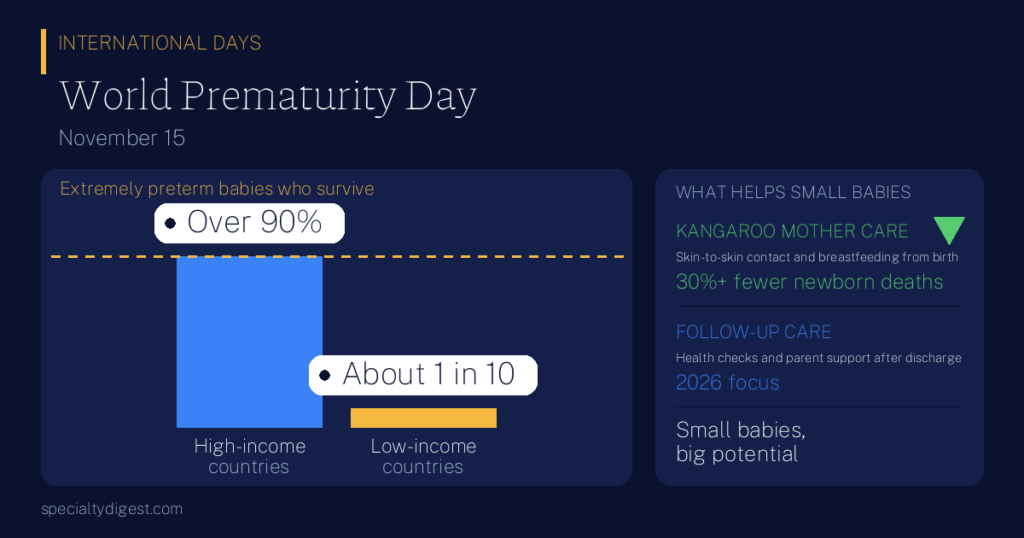
The burden is not evenly shared. Southern Asia and sub-Saharan Africa carry the highest rates and the highest risk of death, and WHO says at least 80 percent of preterm deaths occur in low and middle income countries. Survival tells the sharpest story. Only 1 in 10 extremely preterm babies survive in low-income countries, compared with more than 9 in 10 in high-income countries.
Example 2: a thousand babies. Imagine 1,000 extremely preterm babies born in a low-income setting and another 1,000 in a high-income one. At the survival levels above, about 100 would live in the first setting and more than 900 in the second. The numbers are round and illustrative, but a gap of roughly 800 lives per thousand is largely a difference in care.
More than survival
Surviving is the first goal, not the last. WHO notes that preterm survivors face an increased likelihood of disability and developmental delays, which is why the 2026 campaign looks beyond the hospital. Follow-up care means regular health and developmental checks after a baby leaves the newborn unit, support for parents and access to specialist services when a child needs them.
Causes matter too. Air pollution is estimated to contribute to 6 million preterm births each year, and nearly 1 in 10 preterm babies are born in the 10 most fragile countries affected by humanitarian crises. Health in pregnancy counts: diabetes, high blood pressure and infections raise the risk, and early, regular prenatal care helps find them.
What works
Much of what saves preterm babies is low-tech. WHO recommends kangaroo mother care, which combines skin-to-skin contact with exclusive breastfeeding, started immediately after birth and without an initial period in an incubator. WHO’s 2025 clinical practice guide applies this to preterm or low birth weight babies, except those who cannot breathe on their own or whose circulation is dangerously low. Other measures include breathing support with CPAP, caffeine for breathing problems, early breastfeeding and infection prevention. Before birth, WHO points to at least eight contacts with health professionals during pregnancy starting before 12 weeks, early ultrasound, and antenatal steroids when preterm birth is expected.
Example 3: a hospital’s year. Suppose a hospital network records 1,000 newborn deaths in a year. If kangaroo mother care were linked to a 30 percent reduction, as WHO describes, about 300 fewer babies would die. The numbers are round and illustrative, and real results depend on who receives the care and how well it is delivered.
How the day is marked
WHO’s campaign invites governments, hospitals, parents and communities to raise awareness and press for investment in newborn care. The 2026 slogan, “Small babies, big potential. Invest in follow-up care to protect their future!”, focuses on care in special newborn care units and after discharge. Families of preterm babies can ask their pediatrician or neonatal team about local support groups and follow-up services. For the wider picture of child wellbeing, see World Children’s Day.
- 2025A strong start for a hopeful future
- 2026Small babies, big potential: invest in follow-up care to protect their future
Key Takeaways
- The date is now November 15. WHO moved it from November 17 beginning in 2026 so cervical cancer elimination has its own day.
- Preterm means before 37 weeks. The earlier the birth, the more help a baby needs.
- The scale is large. An estimated 13.4 million babies were born preterm in 2020, more than 1 in 10.
- It is a leading killer of young children. Preterm complications caused about 900,000 under-5 deaths in 2019.
- Place decides survival. About 1 in 10 extremely preterm babies live in low-income countries, against over 9 in 10 in high-income ones.
- Simple care works. Skin-to-skin contact, breastfeeding and breathing support save lives, and about three quarters of these deaths are preventable.
- Care continues after discharge. Follow-up checks and parent support help survivors thrive, which is the 2026 focus.
How solid is this? Counts of preterm births and deaths are modeled estimates from WHO, UNICEF and partners for 2019 and 2020, and they are revised over time. WHO pages also cite a rounded 15 million births per year without naming a year. The kangaroo mother care percentages are WHO-reported associations, not guarantees. The three worked examples use round, made-up numbers to show an idea. See also the International Days hub and the International Days Calendar.
More in Health
- World Health Organization. World Prematurity Day 2026.
- World Health Organization. Member States endorse World Prematurity Day as official global health campaign (28 May 2025).
- World Health Organization. Preterm birth fact sheet.
- WHO, UNICEF and PMNCH. 152 million babies born preterm in the last decade (9 May 2023).
- World Health Organization. WHO promotes lifesaving intervention for small and preterm babies on first official World Prematurity Day (14 November 2025).
- World Health Organization. World Prematurity Day 2025: key messages.
- World Health Organization. WHO advises immediate skin-to-skin care for survival of small and preterm babies (15 November 2022).